
A Railcard isn’t automatically a business expense. For touring expenses tax deductions for musicians in the UK, the key test is whether the cost is incurred wholly and exclusively for the music trade. Business train travel may qualify, but personal use can affect the claim.
Keeping track of fares, mileage and receipts between rehearsals and performances can feel like another admin task, especially when a tour crosses cities or borders. The rules offer a practical way to separate business travel from personal costs.
Here, you’ll learn which touring costs may be claimed, how the flat mileage rate compares with actual car running costs, and what records support your expenses. We’ll also cover accommodation and meals, so you can keep your accounts in step with your work.
Key Takeaways
- Business travel may qualify when it’s wholly and exclusively for your music trade; the purpose of a journey matters more than the fact that it’s part of a tour.
- Compare the flat mileage rate with the business-use share of your actual car costs to understand which method fits your touring pattern.
- Tour accommodation and meals are treated differently, so learn which costs may be allowable and where personal spending can take a different tune.
- Keep records that connect each expense to your work, such as receipts and evidence of the journey’s business purpose.
- HM Revenue & Customs says the Making Tax Digital gross-income threshold in the UK drops to £20,000 from April 2028.
Do musicians pay tax differently to other self-employed?
Musicians generally follow the same self-employed expense principles as other sole traders. The deciding factor is whether a cost has a clear connection to earning income from the music trade.
Business travel to music engagements
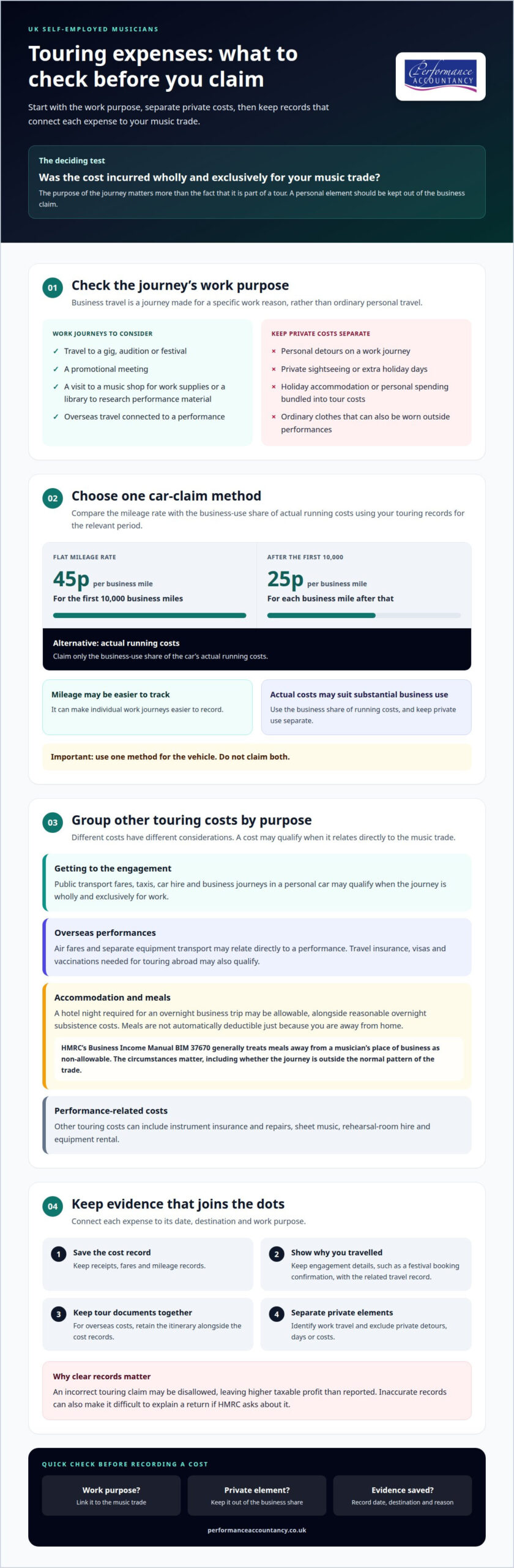
Business travel is a journey made for a specific work purpose, rather than ordinary personal travel. A gig, audition or festival can all involve a business journey. So can visiting a music shop to source work supplies or a library to research material for a performance. The reason for the trip matters: touring expenses tax deductions for musicians in the UK depend on the connection between the travel and the trade.
Keep engagement details with the related fare or travel record. A festival booking confirmation, for example, can help explain why you travelled. If you add a personal visit to the same trip, keep that separate from the work journey.
Travel methods and touring expenses
Costs for performing or promoting music may include public transport fares, taxis, car hire and business journeys in a personal car. Train travel to a paid performance or a rental car needed to reach a venue may qualify when the journey is wholly and exclusively for the trade. The same principle applies to travel for a promotional meeting. These touring expenses tax deductions for musicians in the UK depend on purpose, not simply destination.
Self-employed musicians can use the flat mileage rate for business journeys in a personal car, or claim the business-use share of actual running costs. Keep personal detours separate. Don’t automatically treat a cost serving both private and business purposes as wholly business-related.
Overseas touring costs
Overseas gig expenses are assessed using the same business-purpose principle. Air fares and separate equipment transport may relate directly to a performance. Travel insurance, visas and vaccinations needed for touring abroad may also qualify as business expenses. Yes, musicians can claim qualifying costs for overseas gigs, provided they relate to the music trade. Keep the tour itinerary and cost records together to show that connection.
An employed musician has a different tax position from a self-employed artist. A musician might receive an orchestra salary through PAYE and also earn freelance income from sessions or teaching. Record income and related costs under the correct work arrangement. For example, don’t automatically treat travel for a separately contracted teaching engagement as an employee expense.
For self-employed artists, allowable costs reduce trading profit used to calculate tax. Private sightseeing or extra holiday days should not be bundled into tour costs. HM Revenue & Customs says the Making Tax Digital gross-income threshold in the UK drops to £20,000 from April 2028. Keeping income and expense records organised can help musicians prepare for reporting requirements as their work evolves.
An incorrect touring claim may be disallowed, leaving higher taxable profit than reported. Inaccurate records can also make it difficult to explain a return if HMRC asks about it. Link each expense to its date, destination and work purpose, and correct any entry that includes a private cost. This helps avoid unsupported claims in your accounts.
Actual car running costs versus the flat mileage rate
Touring costs can include more than driving: overnight accommodation, meals and performance essentials may also affect your accounts. The right treatment depends on the expense and its business purpose.
Car costs and mileage claims
The flat mileage rate gives you a set deduction for each business mile, while the actual-cost method uses the business share of your car’s running costs. For a self-employed musician, the mileage rate is 45 pence per business mile for the first 10,000 business miles, then 25 pence per mile. Alternatively, you can claim the business-use share of actual running costs. Keep to one method for the vehicle rather than claiming both.
Actual costs may suit a touring pattern with substantial business use, while mileage can make individual work journeys easier to record. Compare the methods using your touring records for the relevant period. Include only business journeys, such as driving to a paid performance, and keep personal use separate. The method affects the expenses recorded against trading income when calculating income tax.
Separating business and personal use
Business use is the proportion of a cost connected with work rather than private activity. For a mixed-purpose journey, identify the business travel and exclude personal detours or private days. A hotel night required for a performance has a different purpose from an extra night spent on a personal visit. A private element cannot be treated as a music-business expense.
Costs with a private purpose aren’t deductible as touring expenses. Examples include holiday accommodation, personal sightseeing and ordinary clothes that can also be worn outside performances. Record the work purpose and any private element clearly, rather than assigning the entire bill to the tour.
Accommodation and meals need separate consideration. Hotel costs for an overnight business trip may be allowable, alongside reasonable overnight subsistence costs. However, meals are not automatically deductible simply because you’re away from home. HMRC’s Business Income Manual BIM 37670 generally treats meals away from a musician’s place of business as non-allowable. The circumstances of the journey matter, including whether it falls outside the normal pattern of the trade.
Other touring costs for musicians can include instrument insurance and repairs, sheet music, rehearsal-room hire and equipment rental. Performance-specific concert wear may qualify, including dry cleaning and laundry, while everyday clothes generally have a private use. A rehearsal-room booking for an upcoming engagement has a clearer work connection than an item bought for general personal use.
A self-employed musician earning over £1k from self-employment must register as a sole trader. Whether you drive, take a train or book a hotel, keep the journey and expense linked to the performance or rehearsal. If the distinction between business and private use complicates your accounts, specialist musician tax return support can help bring the figures into order.
Accommodation and meals while away on tour
A hotel night required for a performance has a different business purpose from a holiday stay. Meals need separate consideration, even when your tour keeps you away from home.
Overnight accommodation on tour
Overnight accommodation is a place to stay when work requires you to be away from home. Its connection to a performance matters when recording the cost on your tax return. For example, a hotel near a festival may relate to the engagement if the schedule makes an overnight stay necessary. Separate any extra nights booked for a private visit.
Keep the hotel invoice with the tour dates and performance details. This makes it easier to show why the stay was needed to earn income, rather than simply convenient. If a booking covers work and personal time, distinguish the work-related nights from the private stay.
Meals while away on tour
Meal costs are not automatically allowable because a musician is travelling or staying overnight. HMRC’s Business Income Manual BIM 37660 says subsistence costs are not allowable because eating is a personal necessity. BIM 37670 generally treats meals away from a musician’s place of business as non-allowable. The distinction matters: a tour itinerary alone does not make every meal a business expense.
For an overnight business trip, reasonable overnight subsistence costs may be deductible under HMRC guidance. Keep meal receipts with the itinerary, and separate ordinary meals from clearly personal spending. Newspapers and bar bills aren’t part of allowable hotel and meal costs.
Rules for touring stays and meals
HMRC’s rules consider why you travelled, whether work required an overnight stay, and whether the cost relates to that business journey. Hotel accommodation and reasonable overnight subsistence may be deductible when the trip requires you to stay away. Claim the business-related stay and qualifying costs, not holiday accommodation or routine personal spending.
A hotel in another city for a late performance is different from extending the booking for sightseeing. Likewise, meals bought during an ordinary day away from your usual work base don’t become allowable just because you’re on tour. HMRC’s BIM 37670 provides guidance on meals away from a place of business, while BIM 37660 addresses subsistence.
Record the dates, venue, reason for staying and amount paid for each booking. A tour schedule, performance agreement and itemised hotel bill can connect the accommodation to your work. If one invoice includes a room, breakfast and extras, keep the breakdown so each item can be assessed separately.
The same distinction applies to a stay near a rehearsal or festival: your work schedule should explain why an overnight stay was needed. Don’t include a private trip added to the tour as a business cost. Keep the two purposes distinct in your accounts and record only costs related to the work period.
Business-purpose evidence and expense records
Records connect each touring expense to the work that generated it. Keep a clear trail from each payment to the engagement, rehearsal or promotional activity.
Evidence of business purpose
Evidence of business purpose shows why a cost belongs to your music trade, which matters when deciding whether it is allowable. A performance contract, festival schedule or rehearsal confirmation can explain the reason for a journey. For a studio session, keep the booking details with related travel or equipment costs.
Touring-related expenses can extend beyond transport. Venue hire, performance licences, show make-up and hairstyling may relate to a specific production, while haircuts have a personal element. Fees for a choreographer, session musician or back-up dancer should connect to the performance. Live-streaming set-up costs also need a clear link to your music work.
Records of touring expenses
Record the date, amount, supplier and work purpose for each purchase. Keep receipts for train fares, accommodation, instrument repairs and rehearsal-room hire with the relevant tour or session details. A short note such as “rail fare to festival performance” is more useful than a bank entry alone when preparing your annual tax return or explaining an assessment.
Can a musician claim a Railcard as a business expense? Not automatically: its business purpose and any personal use matter. Keep the purchase receipt and travel records, then distinguish business journeys from personal trips. If you use a Railcard for both, consider the private benefit rather than treating it as wholly business.
Organise digital receipts by tour, engagement or accounting period, and keep the original invoice where available. Match card statements to receipts instead of relying on the statement alone. For shared costs, note how the amount relates to the business activity and separate any private element.
Expense treatment by work status
Tour costs can be deductible for self-employed musicians and may be recorded as business costs by a limited company when they relate to its trade. Employees face a narrower test. Under section 336(1) ITEPA, an employee may deduct an expense from earnings only if incurred and paid as an employee, and incurred wholly, exclusively and necessarily in performing employment duties.
This distinction matters for a musician combining an orchestra job with freelance work. Record a ticket for a freelance session against that trade, not automatically against employment income. For company-paid travel, keep the invoice and engagement details in the company’s records. For self-employed work, connect the expense to the relevant performance or promotion.
Good records make expenses easier to explain across different work arrangements. Keep the evidence with the relevant income and expense entries, so a festival journey, company booking or employee claim isn’t confused with another role.
Occasional journeys outside the normal work pattern
A musician’s usual travel pattern helps distinguish routine trips from occasional business journeys. That distinction can affect whether subsistence costs connected with travel are allowable.
HMRC guidance in BIM 37670 allows deductions for subsistence where a trade is itinerant or occasional business journeys fall outside the normal pattern. An itinerant musician may travel between changing venues as part of the trade, rather than work repeatedly from one base. The nature of the work and its travel pattern both matter.
Consider a performer who usually rehearses locally but travels to a one-off festival elsewhere. The festival journey differs from a regular trip to the same rehearsal room. HMRC considers whether you visit the destination only occasionally and whether the journey forms part of your normal work pattern.
A musician with no settled travel pattern is in a different position from someone who regularly visits the same venue. For example, a freelance artist moving between changing performance locations may have no usual route. HMRC considers the lack of a normal travel pattern when assessing whether food and drink costs fall outside the normal course of the trade.
That doesn’t make every meal on an unusual journey an allowable expense. The business reason for travelling, the frequency of similar trips and your working pattern all inform the treatment. A one-off trip to teach at a school may differ from weekly teaching at the same location. The cost must still relate to the trade.
For a touring musician, compare each journey with your established work pattern. A regular commute to a rehearsal base doesn’t become occasional simply because you add a concert elsewhere. By contrast, a short-notice performance in a new town may be outside your usual route. Keep the engagement details with the travel record to make the reason for the trip clear.
There is no single journey threshold that replaces this assessment. Consider how the trip fits your trade: whether your work involves travel between locations, whether you visit the destination occasionally, and whether the route is part of your normal work. An itinerary, booking confirmation or teaching schedule can help show those details.
For a musician working through a limited company, clear records also help separate company activity from private travel. Get support with company accounts to keep business costs organised alongside the company’s other records.
Performance Accountancy: Tax returns for Musicians, Opera Singers, actors, ballet dancers and Conductors
Performance Accountancy helps performing artists bring touring income and business expenses into clear tax records. Its tax return service for musicians and other performers is relevant when freelance work, performance fees and travel costs need to be reported together.
For self-employed musicians, Self-Assessment Tax Returns bring income and allowable expenses into one return. If you work through a limited company, Limited Company Accounts address the company’s reporting. Performance Accountancy also provides MTD IT support for musicians whose tax records fall within Making Tax Digital requirements.
When you’re organising tour dates, receipts and different types of work, specialist accountancy support can help keep the paperwork in step with your performance schedule. Contact Performance Accountancy to discuss your tax return or accounts.
Make your next tour’s paperwork part of the plan
Build a short accounts review into your tour wrap-up, while engagement details and payment records are still easy to find. Bring each performance’s income and related paperwork together before the next run of dates begins. This makes tax admin a regular part of your working rhythm, rather than a scramble at filing time.
A clear approach to touring expenses tax deductions for musicians in the UK starts with decisions made throughout the year, not just at tax-return time. A consistent process helps you see how freelance work, performances and touring activity fit together, giving your accounts a stronger foundation for the next stage of your career.
For support with the accounting work behind your performances, contact Performance Accountancy. Take the next step with confidence and keep your focus on the music.
Frequently Asked Questions
Can musicians claim Railcards as expenses?
A Railcard may qualify to the extent that it serves business travel, but personal use matters. For example, if you use it for paid performances and private trips, distinguish the business journeys rather than automatically treating the full purchase as a work cost. Keep the purchase evidence with records of relevant trips. The key is the Railcard’s connection to the music trade and excluding private benefit from the claim.
What are subsistence expenses?
Subsistence means costs such as meals and accommodation connected with business travel. It doesn’t make every meal on a tour deductible: HMRC’s BIM 37660 says eating is a personal necessity, while BIM 37670 generally treats meals away from a musician’s place of business as non-allowable. For an overnight business trip, reasonable overnight subsistence may be deductible. A bar bill or newspaper is different from a work-related overnight cost.
What counts as a “reasonable” expense?
Reasonableness depends on whether a cost is appropriate to the business journey and its circumstances. A hotel needed near a late performance, for example, has a clearer work connection than an upgraded stay chosen for personal comfort. HMRC guidance allows hotel accommodation and reasonable overnight subsistence when a business trip requires an overnight stay. The expense still needs a business purpose: calling a personal extra “reasonable” doesn’t make it allowable.
What touring expenses can UK musicians claim as tax deductions?
Self-employed musicians may claim costs connected with earning income from their trade, including qualifying travel and separate equipment transport. Other examples include instrument insurance and repairs, sheet music, rehearsal-room hire, equipment rental, agent commissions and professional subscriptions. Each cost needs a business connection, so exclude personal purchases and private elements of mixed expenses. Keep engagement or work details with the expense record to show its purpose.
Can musicians claim mileage, fuel, train fares, flights and taxis for touring?
Yes, business travel by personal car, train, plane or taxi may qualify when the journey relates to the music trade. For a personal car, self-employed musicians can use 45 pence per business mile for the first 10,000 business miles, then 25 pence per mile, or claim the business-use share of actual running costs instead. Don’t claim both methods for the same vehicle. Record journeys and separate private travel.
Can musicians deduct hotels, meals and subsistence while touring in the UK?
Hotel accommodation may be deductible when a business trip makes an overnight stay necessary. Meals aren’t automatically allowable just because you’re away touring: HMRC generally treats meals away from a place of business as non-allowable, while reasonable overnight subsistence may qualify for a trip requiring an overnight stay. Keep a private extension to a booking, bar bill or newspaper out of the business claim.
Can musicians claim equipment hire, repairs, insurance and instrument transport costs?
Equipment rental, instrument repairs and instrument insurance may be allowable when they relate to the music trade. Separately transporting an instrument or other equipment to a performance may also count as a business expense. Keep the hire invoice with the rehearsal or performance details, for example, and link a repair receipt to the instrument used professionally. Exclude any personal element in a mixed-use cost from business spending.
What records and receipts must musicians keep to claim touring expenses to HMRC?
Keep receipts or invoices with records of the date, amount, journey and work purpose. A tour itinerary, performance booking, rehearsal schedule or session confirmation can help explain why you incurred a cost. Match each document to the relevant transaction, and note any private element in a mixed-purpose expense. HMRC can request records up to six years back, so keep them organised and accessible instead of relying on memory.