A performance costume may be tax-deductible; everyday clothes generally aren’t. This freelance performer tax guide for the UK explains the key rule: a business expense must be incurred wholly for the purposes of your acting trade. Clear records help support your claims if HMRC asks for evidence.
When work involves auditions, rehearsals, travel and performances, it can be hard to tell which costs qualify. The answer depends on the purpose of the expense, not simply whether you incurred it on a working day.
This guide explains which acting expenses may qualify, how to work out freelance profits and losses, and when you may need to register with HMRC or complete Self Assessment. It also covers the records to keep and how Making Tax Digital for Income Tax may affect performers, helping you apply the rules rather than rely on guesswork.
Key Takeaways
- Costumes used for performances may qualify as expenses, while everyday clothing generally doesn’t. The purpose of the cost matters.
- Work out freelance profit by deducting allowable business expenses from income, and keep clear records to support your figures.
- From April 2026, sole traders and landlords with turnover of £50,000 or more must submit quarterly digital updates under Making Tax Digital for Income Tax, according to HM Revenue & Customs.
- According to HM Revenue & Customs, musicians must register for VAT when gross UK turnover reaches £90,000 in any rolling 12-month period.
- Understand how freelance earnings sit alongside PAYE work, and when Self Assessment or specialist support may help keep your tax admin in step.
Claiming Expenses: What is Tax-Deductible as an Actor?
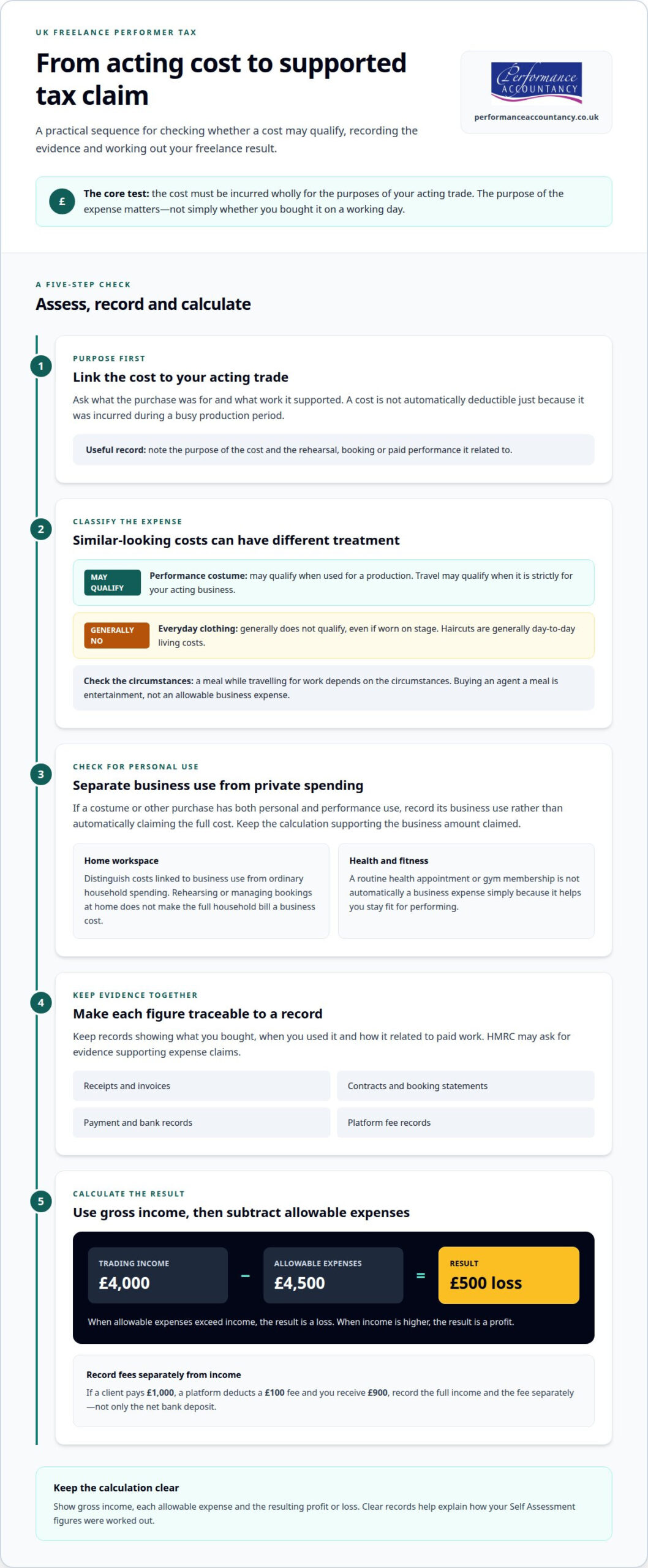
An acting expense may be deductible when it is incurred wholly for your trade. The purpose matters: a costume worn for a production is different from everyday clothing, even if both appear on stage. Keep receipts and records showing what you bought, when you used it and how it related to paid work. This guide to tax for freelance performers in the UK starts with that distinction.
For freelance work, you’ll usually operate as a sole trader and report your income through Self Assessment. The £1,000 Trading Allowance can cover up to £1,000 of gross trading income in a tax year, before expenses, according to HM Revenue & Customs. If your gross trading income exceeds £1,000, tell HMRC and register for Self Assessment. Registration is normally due by 5 October following the end of the tax year in which the freelance income began.
A Self Assessment registration gives you a 10-digit Unique Taxpayer Reference (UTR). The UTR arrives by post 10 days after registration. If freelance income began in the tax year ending 5 April 2026, the usual registration deadline is 5 October 2026. Keep a separate bank account for work if it helps distinguish performance payments and costs from personal spending.
Claim costs only when they relate to your acting trade. Performance costumes may qualify, but everyday clothes generally don’t. Travel may qualify when it is strictly for your acting business. Whether a meal while travelling for work is a personal or business expense depends on the circumstances. Haircuts are generally treated as day-to-day living costs, while buying an agent a meal is entertainment, not an allowable business expense.
Keep invoices, receipts, contracts and payment records together. If you use a costume for both personal and performance purposes, record its business use rather than automatically claiming the full purchase as a work cost. Clear evidence makes it easier to explain your claim if HMRC asks for supporting records.
Actors can receive PAYE wages and freelance income in the same tax year. A payslip shows tax deducted from employed work, but it doesn’t automatically account for separate freelance earnings. Each member of a partnership must submit an annual Self Assessment return, and the nominated partner registers the partnership with HMRC.
A sole trader reports business income through Self Assessment; a limited company has separate accounts and filing obligations. The right structure depends on how you work and manage your business administration. This guide to tax for freelance performers in the UK explains the difference between these routes.
For overseas performances, keep contracts, payment statements and touring-cost records with your UK income records. The treatment can vary with the country and engagement, so cross-border performance income is a sensible topic for specialist tax advice. For support with registration and returns, an accountant familiar with performers’ irregular income can help; HMRC handles its registration and submission processes.
Freelance profit, allowable expenses and losses
Freelance profit is your trading income less allowable business expenses; a loss occurs when expenses exceed income. This distinction matters because Self Assessment uses your figures to establish taxable profit, while accurate records help explain the calculation.
Calculating Freelance Profit and Losses
Start with income before expenses, then subtract costs incurred wholly for your acting trade. The result is profit if income is higher, or a loss if allowable expenses are higher. For example, a freelancer earning £4,000 and spending £4,500 has made a loss of £500.
Turnover means your gross business income, not the amount left after costs. Keep gross receipts visible in your records, even when an agent or platform deducts a fee before paying you. For instance, if a client pays £1,000, a platform deducts £100 and you receive £900, record the full income and the fee separately.
A loss can affect the figures reported in your tax assessment, so don’t report only your net bank deposits. Keep a clear calculation showing your income, each allowable expense and the resulting profit or loss. Profit also informs your wider Income Tax and National Insurance position, so precise figures matter beyond one line of Self Assessment.
Tax-Deductible Performer Expenses
Allowable performer expenses are costs incurred wholly for the purposes of your trade. This test helps separate business spending from personal costs, even when both support your ability to work. A purchase isn’t automatically deductible simply because you made it during a busy production period.
Health and home-office costs need particular care. A routine health appointment or gym membership isn’t automatically a business expense just because it helps you stay fit for performing. For a home workspace, distinguish costs linked to business use from ordinary household spending; don’t claim the full household bill simply because you rehearse or manage bookings at home.
For each cost, note its purpose, the work it supported and any personal use. A receipt for equipment, paired with a note linking it to rehearsals or paid performances, is clearer evidence than a bank transaction alone. If a cost has mixed purposes, keep the calculation supporting the business amount claimed.
Keeping Expense Records and Receipts
Record-keeping means retaining evidence of income and expenses so your Self Assessment figures can be traced to transactions. Keep invoices, receipts, contracts, booking statements, platform fee records and bank statements together. These show who paid you, what work the payment covered and how each cost relates to your acting trade.
HMRC can ask for evidence supporting expense claims, so note the date, amount, supplier and business purpose for each item. Keep records of sales, income and business expenses even if an accountant or tax agent helps prepare your return. Freelancers must retain financial records for at least five years after the 31 January submission deadline.
A simple monthly routine can keep the paperwork in step with your performance calendar: match invoices to payments, record cash or bank income, then file receipts against the related work. If you need help preparing the return from those records, Self-Assessment Tax Returns can support performers with the filing.
Making Tax Digital for Income Tax
Making Tax Digital for Income Tax changes how some sole traders keep records and report income to HMRC. The rules use turnover thresholds, so a performer’s reporting requirements depend on their qualifying income and tax year.
Who needs to use Making Tax Digital?
From April 2026, UK sole traders and landlords with turnover of £50,000 or more must submit quarterly digital updates under Making Tax Digital for Income Tax, according to HM Revenue & Customs. Turnover means income before expenses, not the profit left after deducting costs.
The threshold is due to fall to £30,000 the following year, then to £20,000 after that. A performer with freelance work alongside other qualifying income needs to consider the relevant turnover together. For example, acting fees and income from another sole-trader activity can both affect whether the threshold applies.
Digital updates are not the same as an annual tax return. They involve reporting business income and expenses during the tax year, while Self Assessment brings your tax position together. Keep your bookkeeping up to date between performances instead of relying on a last-minute reconstruction at year-end.
Digital records, apps and platform income
Digital bookkeeping can bring invoices, bank transactions and expense records into one organised system. Use a process that lets you identify each performance payment, its source and any related costs. A spreadsheet or app can help organise information, but your records must still reflect actual transactions accurately.
Digital platforms connecting performers with agents and productions were required to report performers’ income to HMRC starting January 1, 2024. That reporting doesn’t replace your own record-keeping or tax obligations. Compare platform statements with invoices and bank receipts, and record fees separately from gross income.
Keep a clear trail for irregular payments, such as a deposit followed by a final fee. Record when each amount arrived, which production or engagement it relates to, and any deductions shown by the platform. This makes it easier to reconcile digital updates with your annual figures.
How VAT fits alongside Income Tax reporting
Making Tax Digital for Income Tax and VAT are separate reporting obligations. VAT-registered businesses submit VAT returns quarterly, while Income Tax reporting concerns a sole trader’s trading income and expenses. Depending on your VAT status and Income Tax obligations, you may need to manage both.
Use bookkeeping categories that distinguish VAT records from Income Tax figures. Keep sales invoices, purchase receipts and VAT information together, while also tracking the business income and allowable costs needed for Income Tax. Clear records reduce the risk of mixing turnover, expenses and tax calculations across separate filings.
Government plans include an online tool, expected by 2029, for reporting some side-hustle income to HMRC. It doesn’t replace the current requirements described above. For performers, the practical next step is to keep digital records current and understand which reporting rules apply to each income stream.
Do I need to register with HMRC?
Freelance performance income can bring registration duties alongside your Income Tax return. The steps that apply depend on your trading income, business structure and VAT turnover.
HMRC Registration and UTRs
Registering for Self Assessment tells HMRC that you need to report taxable income outside PAYE. Freelancers normally register by 5 October following the end of the tax year in which freelance income started. For income beginning in the tax year ending 5 April 2026, the usual deadline is 5 October 2026.
After registration, HMRC issues a Unique Taxpayer Reference, or UTR, which contains 10 digits. It arrives by post 10 days after registering for Self Assessment. Keep the UTR with your tax records because you’ll need it to identify your return and communicate with HMRC.
The £1,000 Trading Allowance applies to gross trading income across all side activities, not separately to each one. For example, £800 from content creation and £500 from selling crafts totals £1,300. If your combined trading income exceeds £1,000, tell HMRC about the additional income and establish whether Self Assessment registration is needed.
Partnerships have a separate registration step: the nominated partner registers the partnership with HMRC, and each partner submits an annual Self Assessment return. If you also receive PAYE wages, keep those income records distinct from freelance earnings when reporting both in the same tax year.
VAT Registration and Returns
VAT registration is separate from Self Assessment registration and Income Tax. In the UK, a musician must register for VAT when gross UK turnover reaches £90,000 in any rolling 12-month period, according to HM Revenue & Customs. The test uses turnover, not profit after expenses.
Once turnover exceeds the applicable threshold, a business must charge VAT and pay it to HMRC. VAT-registered businesses file VAT returns quarterly. Track gross UK turnover across each rolling 12-month period, rather than relying only on the tax year, so rising performance fees don’t obscure when the threshold is reached.
Voluntary VAT registration is possible below the compulsory threshold. It can affect how you charge VAT and account for business purchases, so consider the impact on your production clients and bookkeeping before registering. Keep sales invoices and purchase records organised to support each return.
VAT registration doesn’t replace Income Tax reporting. A VAT return reports VAT transactions, while Self Assessment reports taxable income and other relevant details. Treat them as separate filings, even when the same performance income appears in both sets of records.
Do freelancers need to register for Self Assessment?
PAYE work and freelance bookings can sit side by side in the same UK tax year. How each payment is made, and your employment status, affect how you report the income.
Freelance Work Alongside PAYE Employment
Freelance work alongside PAYE employment means receiving wages through payroll and separate trading income. PAYE deductions cover the wages on your payslip, but your employer doesn’t automatically account for separate freelance earnings.
If a production pays you through payroll, tax should already be deducted from that work. You generally don’t need to report that income through Self Assessment unless you already complete a tax return. Freelance fees paid outside PAYE may need to be reported to HMRC, depending on your income and circumstances.
Keep payslips, freelance invoices and payment statements separate in your accounting records. For example, a performer with a regular theatre salary and independent voiceover bookings should be able to identify each payment route. This helps distinguish tax already deducted from income that may need to be assessed separately.
Agencies and Employment Status
An agency may arrange a booking, but the payment method and working arrangement help establish whether the engagement is employed or self-employed. A supporting artist’s employment status can depend on the circumstances of the engagement. Other performers may have both employed and freelance engagements in one tax year.
A casting or employment agency might process a production fee through payroll, with tax shown on a payslip. A separately invoiced acting fee is different: when required, the performer is responsible for reporting that trading income to HMRC. An agency’s involvement alone doesn’t mean every booking has the same tax treatment.
Employment status also affects expenses. HMRC tends to prefer classifying workers as employed rather than self-employed, which narrows the scope for claiming expenses. Don’t assume a cost connected with an employed production can be claimed against freelance profits. Keep the contract, booking details and payment record together for each engagement.
The £1,000 Trading Allowance applies across side activities in a tax year, rather than separately to each one. If combined gross trading income exceeds £1,000, tell HMRC about the additional income. A performer with freelance income alongside PAYE work should consider the total from all trading activities, not only one agency’s payments.
For an online Self Assessment return, the submission deadline is 31 January after the tax year ends. The return brings together relevant income, including PAYE details and reportable freelance earnings. Keep the figures consistent with payslips, invoices and agency statements; digital copies can make the annual accounting easier to follow.
If agency bookings and PAYE income make your return difficult to untangle, get support with performer Self Assessment.
Performance Accountancy
Performance Accountancy helps performing arts professionals manage tax returns and the accounting demands of freelance work. If your income combines PAYE engagements with self-employed bookings, specialist support can help bring your records and reporting duties into one clear picture.
Services include Self-Assessment Tax Returns and tax returns for musicians, opera singers, actors, ballet dancers and conductors. Performers working through a limited company can also use Limited Company Accounts, while MTD IT support helps with digital Income Tax reporting when the rules apply.
Consider getting help when a return includes several income streams, allowable expenses or changing reporting requirements. Clear records still matter, but you don’t have to make the tax paperwork your main performance. Contact Performance Accountancy to discuss support with your performer tax matters.
Make your next tax decision with confidence
Your next step is to build a routine around the rhythm of your working life. A freelance performer tax guide for the UK can clarify the framework, but applying it to changing contracts, income streams and business structures requires careful attention to your records.
Performance Accountancy offers Self-Assessment Tax Returns, Limited Company Accounts and MTD IT for performing arts professionals. This support can help organise tax filing and digital reporting, leaving you better placed to focus on auditions, rehearsals and performances.
You don’t need to wait until paperwork has become a final-act scramble. If you’d like support with the tax and accounting side of freelance performance work, contact Performance Accountancy for tax support. A clear plan can make the administrative side feel more in step with your creative career.
Frequently Asked Questions
How much tax do I have to pay?
There isn’t one fixed tax bill for every performer; it depends on your taxable income, allowable expenses and other earnings. For planning, the research facts indicate that an actor’s income tax set-aside may range from 20% to 50%, depending on income levels. Treat that as a budgeting guide, not a personalised calculation. Include PAYE wages and freelance profits when working out your overall position.
How much tax do freelancers pay in the UK?
Freelancers pay tax according to their individual taxable income and circumstances, rather than a special flat rate for freelance work. A performer’s final bill can reflect both freelance profit and income already taxed through PAYE. For example, a voiceover artist with a salaried role may need to consider both income streams. Keep payment records for the tax year together to see how they affect your overall assessment.
Is an Actor a Sole Trader?
An actor is a sole trader when they carry on freelance acting work on their own account, rather than through a limited company. An actor employed for a production is not automatically self-employed for that engagement. Some performers have both types of work, so a payslip for one role doesn’t determine the status of a separately invoiced booking. The contract and payment arrangement help distinguish each engagement.
Is there VAT to pay?
VAT may apply once a performer’s business reaches the relevant registration threshold. According to HM Revenue & Customs, a musician must register for VAT when gross UK turnover reaches £90,000 in any rolling 12-month period. That threshold concerns turnover, not profit. VAT registration is separate from Income Tax, so a performer should track business turnover and keep VAT transactions distinct from personal tax calculations.
How are freelance performers taxed in the UK?
Freelance performers generally report trading profit through Self Assessment, while employed pay is usually taxed through PAYE. Profit is calculated by deducting allowable business costs from trading income. For instance, a performer paid partly through payroll and partly against invoices has two payment streams to account for. Their tax return brings relevant income together, and the tax due depends on their overall taxable position.
Do freelance performers need to register as self-employed with HMRC?
Freelancers whose gross trading income exceeds the £1,000 Trading Allowance need to tell HMRC about the additional income and may need to register for Self Assessment. The allowance applies across trading activities, not separately to every side job. For example, acting fees and income from selling crafts are combined when checking the threshold. Keep track of all trading receipts, even if each activity seems small on its own.
What is the Self Assessment registration deadline for freelancers?
Freelancers normally need to register by 5 October following the end of the tax year in which their freelance income started. For example, if freelance income began in the tax year ending 5 April 2026, the usual registration deadline is 5 October 2026. Registration and return filing have different deadlines: an online tax return is due by 31 January after the tax year ends.
What are the UK income tax and National Insurance rates for self-employed performers?
There isn’t one combined rate for Income Tax and National Insurance: the amounts depend on taxable income, trading profit and the applicable tax year. Income Tax is calculated on your overall taxable income, while National Insurance for self-employed work is assessed separately. PAYE deductions from an employed role also affect the overall calculation. Use your return and payment records to establish the amounts relevant to your circumstances.