
A high-street accountant might understand the tax code, but they rarely understand the difference between a call time and a curtain call. If you’ve spent your Sunday evening staring at a pile of receipts whilst worrying about how to declare a mix of PAYE theatre contracts and self-employed teaching work, you’ve likely felt the weight of financial stage fright. This confusion is exactly why you need a specialist accountant for the arts. You deserve a professional partner who doesn’t just see numbers; they recognise the specific costs of keeping your creative career in the spotlight.
We know that your income doesn’t arrive in a neat monthly package, and your office might be a rehearsal room or a touring van. In this guide, we’ll show you how a specialist protects your career from HMRC enquiries and ensures you maximise every allowable expense, from headshots to travel mileage. By the end, you’ll see how turning your accounts over to an expert who speaks your language can transform your financial admin from a chaotic rehearsal into a managed, stress-free performance.
Key Takeaways
- Learn how to balance the complex rhythm of multiple income streams, from touring royalties to PAYE contracts, whilst maintaining total tax compliance.
- Navigate the upcoming Making Tax Digital (MTD) changes for 2026 with confidence, ensuring your digital records are ready for HMRC.
- Discover why you need a specialist accountant for the arts to uncover industry-specific allowable expenses that high-street firms frequently miss.
- Evaluate whether a sole trader or limited company structure offers the most tax-efficient path for your evolving creative career.
- Gain professional peace of mind by partnering with a Chartered Accountant who understands the stage as well as the spreadsheets.
Beyond the Balance Sheet: The Unique Financial Rhythm of the Arts
Specialist arts accounting is a hybrid discipline. It blends rigid HMRC compliance with a deep, lived empathy for the creative process. For most performers, finances aren’t a linear progression of monthly pay slips. Instead, they’re a syncopated rhythm of touring stipends, teaching fees, and unpredictable royalties that can arrive months apart. This irregularity creates a significant administrative headache that often clashes with the focus needed for a creative career. It’s difficult to stay in character when you’re worried about VAT thresholds or missing receipts. This is fundamentally why you need a specialist accountant for the arts; you need someone to apply “financial stagecraft” to your books, turning a chaotic pile of invoices into a managed, professional performance.
The Problem with the “High Street” Approach
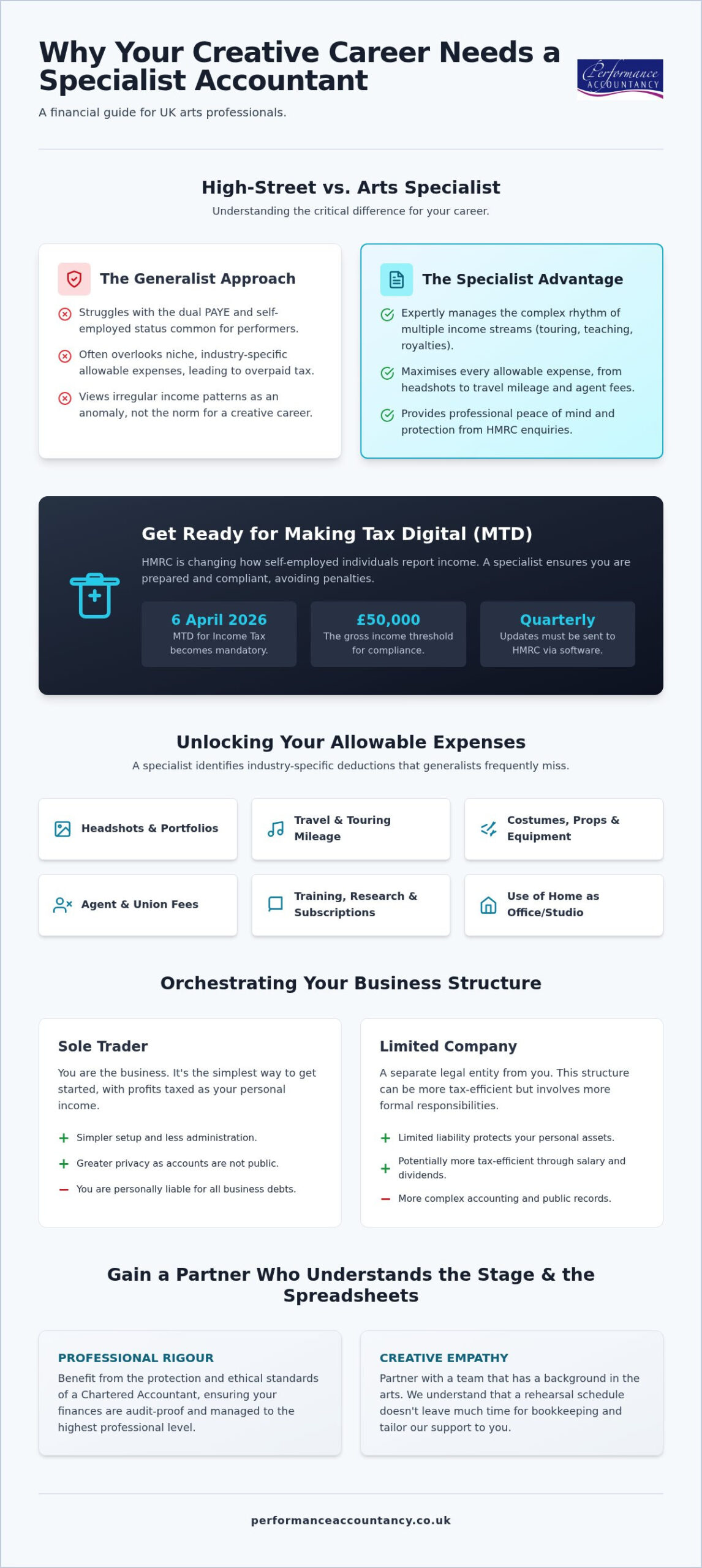
High-street accountants are accustomed to the “nine-to-five” client. They understand shopkeepers and tradespeople, but they often struggle with the “dual-status” reality of a performer who is simultaneously an employee (PAYE) for a West End show and self-employed for their private coaching business. Generalists might miss the nuances of industry-specific deductions or fail to account for the complex nature of Hollywood accounting practices when dealing with international royalties or performance rights. Without niche knowledge, you risk overpaying tax or, worse, failing to meet specific HMRC reporting requirements for those with non-standard working patterns. A generalist sees a missing receipt as a minor error, but in the arts, that receipt could be the key to claiming essential travel or costume expenses that keep your business viable.
Empathy Meets Professional Rigour
It matters whether your accountant knows the difference between an aria and an audition. At Performance Accountancy, our founder’s professional operatic background means we don’t just see you as a “client file”. We’re a peer who understands that a rehearsal schedule doesn’t leave much room for bookkeeping. By acting as a friendly guide rather than a distant corporate consultant, we strip away the anxiety that usually builds as the January tax deadline approaches. This partnership is precisely why you need a specialist accountant for the arts; it ensures your tax returns are accurate, your deductions are maximised, and your creative energy remains exactly where it belongs. We take the “black box” of tax and turn it into a clear, structured path forward, allowing you to focus on the next performance rather than the next HMRC letter.
Avoiding “Stage Fright”: Navigating HMRC Compliance and MTD
The days of the “January rush” are numbered. HMRC is fundamentally changing how performers report their income, moving away from a single annual event toward a continuous digital dialogue. This shift can feel like a daunting new script to learn, especially when your focus should be on your next role. This transition from yearly to quarterly reporting is a primary reason why you need a specialist accountant for the arts. You need a partner who can maintain your financial tempo year-round, ensuring that compliance never becomes a distraction from your creative output.
Making Tax Digital for Income Tax (MTD IT)
From 6 April 2026, Making Tax Digital for Income Tax (MTD IT) becomes mandatory for self-employed individuals with a gross income over £50,000. This isn’t just about using software; it requires you to keep digital records and send quarterly updates to HMRC. The first of these updates for the 2026/2027 tax year will be due by 7 August 2026. For a performer with erratic touring schedules and varied income streams, this is a significant administrative hurdle. Specialist software can help track everything from performance fees to touring stipends, but it requires careful setup to avoid common pitfalls like miscategorised expenses or missed deadlines. We help you organise these digital requirements into a seamless routine, providing bespoke MTD IT support that fits around your rehearsals and show times.
The Value of Chartered Expertise
In an increasingly digital environment, “DIY” accounting carries higher risks. HMRC’s automated systems are designed to flag inconsistencies, and non-standard working patterns often trigger enquiries. Having a Chartered Accountant by your side provides a protective shield. The “Chartered” designation signifies a level of rigour and ethical standing that standard tax preparers simply don’t match. We don’t just file your returns; we build an audit-proof financial history for your business. This involves:
- Handling complex VAT returns for those reaching the £90,000 rolling turnover threshold.
- Managing the nuances of dual-status income to ensure your PAYE and self-employed earnings are balanced correctly.
- Providing professional representation if HMRC ever raises a query regarding your “wholly and exclusively” business expenses.
Ultimately, why you need a specialist accountant for the arts comes down to security. We act as your rigorous guardian, turning the complexity of HMRC compliance into a managed, background performance that gives you total peace of mind.
Allowable Expenses: Finding the Harmony in Deductions
HMRC’s “wholly and exclusively” rule sounds simple. It states that an expense is only deductible if it’s used solely for your business. For a shopkeeper, this is clear. For a performer, the lines blur. Is that gym membership a personal luxury or a business necessity for a dancer maintaining their physical “tool”? Is a leather jacket a costume or everyday wear? This ambiguity is precisely why you need a specialist accountant for the arts. A generalist will often take the “safe” route, advising you to omit anything that looks slightly non-standard. A specialist takes a thorough approach, defending valid industry expenses that a high-street firm would simply overlook.
The Specialist Difference: A Comparison
Whilst a generalist accountant focuses on stationery and laptops, we look at the tools that actually power your creative career. A specialist understands that your business requires a unique set of investments. These often include:
- Instruments, sheet music, and specialist instrument insurance.
- Rehearsal space hire, studio fees, and audition room bookings.
- Professional subscriptions such as ISM, Equity, and Spotlight.
- Coaching, vocal lessons, and gym memberships specifically required for dancers to maintain professional standards.
The “Performer’s Wardrobe” is a classic example of this specialist difference. You can’t usually claim for “work clothes” if they could be worn on the street. However, stage costumes, specialist dance footwear, or a tuxedo used exclusively for concert performances are legitimate deductions. We help you draw these lines clearly, ensuring you don’t miss out on tax-saving opportunities whilst remaining firmly within HMRC’s guidelines.
Travel and Subsistence on Tour
Navigating the complexities of “temporary workplaces” is another area where niche knowledge pays for itself. If you’re an actor on a six-month tour or a musician with a residency, your travel and subsistence rules change. We help you calculate accurate home office deductions for the time you spend rehearsing or managing your admin from home. Proper record-keeping is the only way to maximise these reliefs.
Whether you’re on a tour bus or between contracts, tracking every mile and meal is essential. With the AMAP rate for cars and vans at 55p per mile for the first 10,000 miles in the 2026/2027 tax year, even small trips to rehearsals add up significantly. This level of detail is why you need a specialist accountant for the arts; we provide the framework to ensure your financial records are as rehearsed and professional as your stage performance.
Orchestrating Your Business: Sole Trader vs. Limited Company
Deciding between staying as a sole trader or incorporating as a limited company is a pivotal movement in any creative career. It’s the difference between a solo recital and managing an entire ensemble. Most high-street firms will point to a specific profit threshold, often around £50,000, as the signal to incorporate. However, the performing arts don’t follow such a linear path. A musician might have a bumper year with a global tour followed by a quieter period of composition. This volatility is exactly why you need a specialist accountant for the arts. We don’t just look at this year’s spreadsheet; we look at your career trajectory to ensure you don’t incorporate too early and end up trapped in a web of unnecessary administrative costs.
When to Make the Move
Incorporation offers a protective layer, legally separating your personal assets from your business liabilities. This is particularly valuable if you’re hiring venues, employing staff, or managing large-scale productions where the financial stakes are higher. From a tax perspective, the 2026/2027 rules require careful navigation. With the dividend allowance now at just £500 and the basic rate dividend tax at 10.75%, the traditional strategy of low salary and high dividends requires much more nuance. A specialist helps you strike the right balance between a tax-efficient salary and dividend payments, protecting your £12,570 personal allowance whilst managing the company’s Corporation Tax obligations. We ensure the transition happens at the optimum moment for your specific career rhythm.
Limited Company Compliance
Operating as a director brings statutory duties that can feel like a full-time role in themselves. You’re responsible for Companies House filings, confirmation statements, and Corporation Tax returns, which are currently set at 19% for profits up to £50,000. For a busy performer, these rigid deadlines can easily clash with a demanding production schedule or a tour. We take over the heavy lifting of your Limited Company Accounts, ensuring you stay compliant without sacrificing your creative focus. We turn the potentially chaotic statutory obligations into something organised and manageable. This professional partnership is why you need a specialist accountant for the arts; we act as your rigorous guardian in the background, allowing you to stay centre stage without the headache of Companies House letters landing on your doormat.
Performance Accountancy: Where Professional Rigour Meets Creative Empathy
Choosing an accountant shouldn’t feel like a high-stakes audition where you’re forced to explain your lifestyle to a sceptical stranger. Most accounting firms operate within the rigid confines of standard business models, but the arts require a different kind of score. Performance Accountancy was built on a unique “Specialist Insider” perspective. Our founder’s background in professional opera means we don’t just understand your tax returns; we understand your world. This lived experience is exactly why you need a specialist accountant for the arts. You aren’t just hiring a Chartered Accountant; you’re partnering with a peer who knows that a conductor’s expenses look nothing like a plumber’s receipts.
A Peer Who Speaks Your Language
We bridge the gap between financial stagecraft and your artistic career by providing a bespoke service for musicians, singers, actors, and dancers. We know that your “office” changes weekly and your income streams have a syncopated rhythm that generalists find difficult to track. Whether you’re navigating the complexities of Self-Assessment Tax Returns or managing Limited Company Accounts, we apply professional rigour to every detail. Our goal is to take the administrative headache out of your life, replacing it with the clarity you need to stay creative. We’ve spent years refining this process, ensuring that every allowable deduction is captured whilst maintaining the highest standards of HMRC compliance.
Next Steps: From Confusion to Organised Calm
Moving from financial chaos to organised calm starts with a specialist review. If you’re an ISM member, our dedicated ISM Member Accounting Services provide a tailored path to getting your books in order. We also specialise in MTD IT (Making Tax Digital for Income Tax), helping you transition to the 2026 digital requirements without the stress of doing it alone. We handle the VAT Returns and statutory filings so you can focus on your next role, rehearsal, or recording session.
Understanding the nuances of your industry is fundamentally why you need a specialist accountant for the arts to ensure your compliance is handled with the same precision as a choreographed routine. Don’t let tax anxiety dampen your creative energy. You can Enquire about our specialist services today to see how we can turn your financial admin into a managed, background performance that gives you total peace of mind. Let’s work together to make your creative business as robust and professional as your stage presence.
Taking the Spotlight with Financial Confidence
Your creative career shouldn’t be overshadowed by the anxiety of HMRC deadlines or the confusion of Making Tax Digital. We’ve explored how a specialist approach ensures your industry-specific expenses are fully maximised and your business structure is perfectly tuned to your professional rhythm. Whether you’re navigating complex VAT for international tours or transitioning to quarterly reporting, having a peer who understands the stage is exactly why you need a specialist accountant for the arts. We bring the rigour of Chartered status to your books whilst speaking your language.
Performance Accountancy was founded by a Chartered Accountant with a professional operatic background, specifically to support musicians, actors, and dancers. We provide dedicated ISM member accounting services and expert guidance on MTD for Income Tax, ensuring your financial admin remains a managed, background performance. Don’t let spreadsheets distract you from your craft. You can book a consultation with a specialist arts accountant today to secure your financial future. It’s time to trade the administrative headache for organised calm and focus on what you do best: performing.
Frequently Asked Questions
Do I really need a specialist accountant if I only have one or two roles a year?
Yes, because even a single performance contract involves complex “dual-status” tax issues and specific allowable expenses. A specialist ensures you don’t overpay tax on your PAYE earnings whilst missing out on self-employed deductions. This precision is why you need a specialist accountant for the arts, as we help you establish a clean financial record from the start of your career, regardless of your current volume of work.
What are the most common tax mistakes performing artists make?
The most frequent errors include failing to separate personal and business spending and missing industry-specific deductions like coaching or Spotlight fees. Many performers also struggle with the balance between PAYE theatre work and self-employed teaching. These mistakes often lead to HMRC enquiries or unnecessary tax bills. Working with a peer who understands your schedule helps you avoid these pitfalls and ensures your returns are both compliant and tax-efficient.
Can I claim for my gym membership or stage makeup as a performer?
You can claim for these if they are “wholly and exclusively” for your business, but the rules are strict. Stage makeup used specifically for performances is deductible, whilst everyday cosmetics are not. Similarly, a gym membership is often allowable for dancers who must maintain a professional level of physical fitness, but less so for actors unless a specific role requires it. We help you navigate these grey areas with professional rigour.
How does Making Tax Digital (MTD) affect musicians and actors in 2026?
From 6 April 2026, self-employed performers with a total gross income over £50,000 must use MTD-compatible software for their records. This requires sending quarterly updates to HMRC instead of just one annual return. The first update for the 2026/27 tax year is due by 7 August 2026. This shift makes it essential to maintain a steady financial tempo, as DIY spreadsheets will no longer meet the new digital reporting standards.
Is it more expensive to hire a specialist arts accountant than a local firm?
While fees vary, a specialist often provides better value by uncovering deductions that a high-street firm would overlook. A local accountant might be cheaper initially, but they may lack the niche knowledge required to maximise your tax efficiency or handle complex touring subsistence. This expertise is why you need a specialist accountant for the arts; the tax savings and peace of mind usually far outweigh any difference in professional fees.
What is the difference between a Chartered Accountant and a standard tax preparer?
A Chartered Accountant has completed years of advanced training and is held to a strict code of ethics. This qualification provides a higher level of security if HMRC ever queries your accounts compared to an unqualified preparer. At Performance Accountancy, our Chartered status is backed by a professional operatic background. This ensures your financial admin is handled with total rigour by someone who truly understands the specific pressures and schedules of the creative sector.
How do I handle tax if I am both PAYE and self-employed in the same year?
You must declare both income streams on your Self-Assessment tax return to ensure your total tax liability is calculated correctly. Your PAYE tax is usually deducted at source, but your self-employed profits might push you into a higher tax bracket. We specialise in balancing these “dual-status” roles, ensuring you don’t overpay National Insurance or miss out on specific reliefs available to performers who work across multiple contracts.
Can a specialist accountant help me with ISM member accounting services?
Yes, we offer dedicated ISM member accounting services designed to support musicians and performers within the society. We understand the specific insurance and professional requirements associated with ISM membership. Our bespoke support helps you manage your tax returns and MTD compliance whilst ensuring you take full advantage of the professional subscriptions and costs relevant to your membership. It’s a partnership built on shared industry values and niche expertise.