
Could a journey to one rehearsal be allowable while a similar trip is not? For conductors, conductor tax deductible expenses depend on the purpose of each cost, the work arrangement and the evidence behind the claim. A fare, score or concert outfit may look like an obvious work expense, but the details matter.
Moving between rehearsals, venues and engagements can make it difficult to separate work travel from ordinary commuting. It can also be hard to distinguish costs connected with self-employed work from those linked to employment or a limited company. Buying something specifically for a performance does not automatically make it deductible. A few practical checks can help you organise the details before filing.
This checklist covers expenses to review against your circumstances, how HMRC’s “wholly and exclusively” rule may apply, and what records to keep. It looks at travel, clothing, equipment and mixed-purpose costs, including receipts and mileage records. You’ll also find guidance on when specialist tax support may help you review an uncertain claim before filing.
Key Takeaways
- Check your employment or self-employment arrangements first, as they can affect how a work cost is assessed.
- Use the checklist to identify travel, scores, equipment and professional costs to review against your circumstances.
- Professional use alone does not make clothing or other purchases deductible. Check the rules and keep evidence to support your claim.
- For conductor tax deductible expenses, record each cost’s purpose and any relevant business-use share, especially where it has mixed uses.
- Multiple engagements, different work arrangements or unusual costs may be worth reviewing with a specialist before filing.
Conductor tax deductible expenses: start with your work arrangement
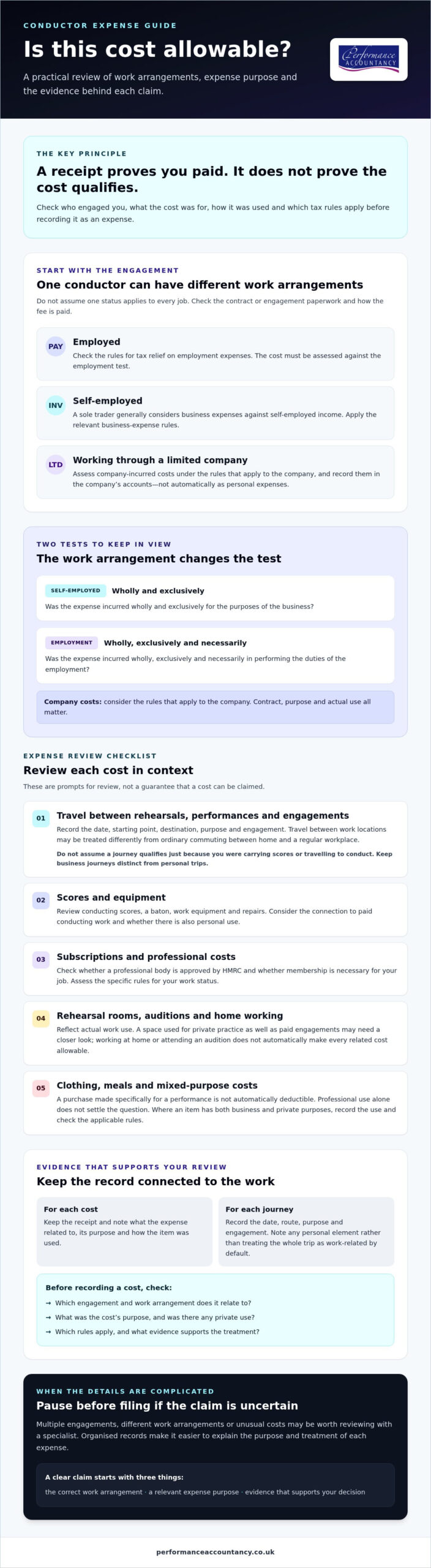
The same receipt can have different tax treatment depending on who engaged you and how you work. A train ticket to a rehearsal, for example, might relate to a self-employed engagement, an employed role or work carried out through your limited company. The receipt records the purchase, but it does not determine whether the cost is allowable.
An allowable expense is a cost assessed under the tax rules that apply to your circumstances. For conductors, that means checking the arrangement for each engagement before deciding where, or whether, to record a cost. Freelance, employed and limited-company work are not interchangeable, even when the work itself looks similar.
Are you employed, self-employed or working through a company?
Start by checking who engaged you and how the fee is paid. Look at your contract or engagement paperwork, then note whether you are paid through payroll, invoice the engager as a sole trader, or have your company contract for the work. A conductor can have different arrangements across separate engagements, so do not assume one status applies to every job.
A personal Self Assessment return and a company’s accounts are also different places to record costs. A sole trader generally considers business expenses against self-employed income. An employee may need to check the rules for tax relief on employment expenses. If your limited company incurs a cost, assess and record it in the company’s accounts rather than automatically treating it as your personal expense.
The tax test is about the work, not just the receipt
For self-employed costs, HMRC’s general test is whether an expense was incurred wholly and exclusively for the purposes of the business. Employment expense rules use a different test: the cost must be incurred wholly, exclusively and necessarily in performing the duties of the employment. Company expenses must also be considered under the rules that apply to the company. The contract, purpose and actual use of an item all matter.
If a cost has a private element, do not assume the whole amount qualifies. A purchase with mixed purposes may need particular care. Under the relevant rules, some costs may not be claimable if business and personal purposes cannot be separated. Keep a note of what the expense related to and how the item was used.
A receipt proves that you paid; it does not prove that the cost qualifies for tax relief. Before including an item among your conductor tax deductible expenses, identify the relevant work arrangement, connect the cost to that work and check the applicable HMRC rules. This first review helps organise your records before you assess each expense category.
Conductor expense checklist: travel, scores, equipment and professional costs
Use these categories as prompts for review, not as a guarantee that a cost can be claimed. The rules depend on your work arrangement and the details of the expense. For self-employed work, GOV.UK explains the rules for allowable expenses. Employment and company costs need to be considered under the rules that apply to them.
Travel between rehearsals, performances and engagements
For each journey, record the date, starting point, destination, purpose and engagement. Travel between work locations may be treated differently from ordinary commuting between home and a regular workplace. Do not assume a trip qualifies simply because you were carrying scores or travelling to conduct. Check the engagement details and the travel rules that apply to your work arrangement.
Keep business journeys distinct from personal trips. If a journey combines both, note the circumstances rather than treating the whole cost as work-related by default. Clear notes make it easier to explain why you travelled and which engagement the journey supported.
Scores, equipment, subscriptions and workspaces
Review costs such as conducting scores, a baton, work equipment, repairs and professional subscriptions. For each one, consider whether it was required for, or sufficiently connected with, your paid conducting work, and whether it also has a personal use. Membership fees may qualify for tax relief where the professional body is approved by HMRC and membership is necessary for your job. Check the specific rules for your status.
Rehearsal-room hire, audition costs and home-working expenses also need to reflect your actual work. A space used for private practice as well as paid engagements, for example, may need a closer look. Do not assume that working at home or attending an audition automatically makes every related cost deductible.
- Travel: Record journey details and the engagement purpose.
- Scores and equipment: Keep purchase or repair evidence, and note work and private use.
- Subscriptions: Keep proof of payment and note the membership’s professional relevance.
- Workspaces and auditions: Record what the cost was for and how it relates to paid work.
For broader record-organising guidance, see this musician tax return checklist. If you are unsure how a cost fits your work arrangements, a specialist review of tax returns for conductors may help you assess it against the relevant rules. The aim is to support a claim with its purpose and evidence, not simply a collection of receipts.
Can conductors claim clothing, meals and mixed-purpose expenses?
Buying something for professional use does not automatically make it deductible. A formal outfit worn for concerts may still be ordinary clothing, while a meal eaten during a work trip needs to be considered in context. The rules depend on your work arrangement and the purpose of each cost. If you are self-employed, check HMRC guidance on allowable expenses, and verify the rules that apply separately to employed or company work.
Stage clothes, formalwear and everyday clothing
Consider whether an item is part of an everyday wardrobe or has a specific work-only function. A suit bought for conducting engagements may still be wearable as ordinary clothing, even if you would not have bought it otherwise. Protective clothing, branded uniforms and performers’ costumes may be treated differently, but do not assume formalwear or a stage outfit qualifies. Check current HMRC guidance and your circumstances.
Meals, accommodation, phone and other mixed-use costs
Separate costs arising from eligible business travel from routine personal spending. For a self-employed person, meal costs may be considered when travelling outside the normal work routine, such as for an overnight trip or a journey to a temporary workplace. Claims should reflect actual, reasonable costs rather than a fixed daily allowance. Accommodation also needs to relate to the work trip, not a personal extension or unrelated stay.
For a phone or another item used for both work and personal purposes, consider whether you can identify and support a business-use share. Do not choose a percentage simply because it feels fair. Base any apportionment on a reasonable record of actual use and check the applicable rules.
| Expense | Work context | Issue to check | Evidence to retain |
|---|---|---|---|
| Formalwear or stage clothing | Worn for rehearsals or performances | Is it ordinary clothing, protective wear, a uniform or a costume? | Receipt and note of the item’s function and use |
| Meals and accommodation | Overnight trip or travel to a temporary workplace | Was the cost caused by qualifying work travel, and is it reasonable? | Receipts, trip details and engagement information |
| Phone or other mixed-use item | Used for both conducting work and personal purposes | Can the work-related share be evidenced? | Itemised bills or a usage record, where available |
Borderline expenses need evidence of purpose and treatment under the rules that apply to your work. Keep your reasoning alongside the receipt, then review uncertain items before filing. If you would like help assessing conductor tax deductible expenses against your work arrangements, explore tax returns for conductors.
How to check and document conductor expenses before filing
A consistent record-keeping routine makes it easier to review conductor tax deductible expenses before filing, rather than reconstructing a season of rehearsals and engagements from bank statements. Use the same sequence for each cost: identify whether it relates to employed, self-employed or company work; connect it to the work; check the relevant rules; then keep evidence to support your decision.
A practical evidence checklist for each expense
Give every cost a clear entry in your records. Include the expense category, date, amount, supplier, work purpose and engagement. If an item had both business and personal use, note how you worked out the business-use share and keep evidence for that calculation.
- Travel: Record the journey’s origin, destination, date and work purpose. Link it to the engagement, and retain relevant tickets, booking confirmations or mileage records.
- Purchases and services: Keep receipts or invoices, with a short note explaining the connection to your conducting work.
- Unusual or mixed-purpose costs: Save a brief explanation of the circumstances alongside the supporting documents.
Contracts, itineraries and engagement correspondence can help show why a cost arose and which work it relates to. Keep company records separate from personal Self Assessment records. Do not record a company expense as though you paid it personally, or the other way round.
Review claims before submitting a tax return
Before filing, compare your expense list with bank or card statements, invoices and engagement paperwork. Check that the amounts match, each item is recorded in the right place and you have not included the same cost twice. If an entry is unclear, pause and confirm its treatment rather than guessing or claiming the full amount.
HMRC requires Self Assessment records to be kept for at least five years after the relevant submission deadline. Check the current requirements for your circumstances, particularly if you work through a company as well as personally. A consistent filing system, whether digital or paper-based, can help keep receipts and explanations easy to find.
If several engagements or work arrangements make a cost difficult to assess, specialist accountancy support for performing arts professionals may help you review your circumstances. For help with a conductor’s Self Assessment tax return, explore Self Assessment tax returns for conductors. A specialist review can help you organise the details, while the applicable HMRC rules remain the basis for each claim.
When specialist tax support can help a conductor make a confident claim
A careful expense review follows four steps: identify your work status, connect each cost to the work, check the relevant rules and keep supporting records. If your engagements span employed and self-employed work, or include a limited company, sorting costs into the right place can take more than a quick look at a receipt.
Specialist tax support may help you review how your contracts, payments and expense evidence fit together. It cannot guarantee that a particular item will qualify. HMRC’s rules remain the test, so the aim is to understand how they apply to your circumstances before you file.
Signs an expense needs a closer look
Pause before claiming if a contract does not clearly explain the engagement, a purchase has substantial personal use, or an engager has reimbursed some or all of a cost. These details can affect how an expense should be treated and where it belongs. Do not rely on assumptions or include the full amount simply because you have a receipt. Resolve uncertainties before filing, using the engagement facts and the relevant tax rules.
A review may be especially helpful if the same type of cost arises across engagements with different payment arrangements. An expense connected to a self-employed booking may need different handling from a cost linked to employment or incurred by your company. A clear record of the purpose, contract and payment trail gives you a stronger basis for deciding what to do next.
A clear next step for conductors
Before seeking help, prepare a short expense summary. List each cost, the engagement it relates to, how you were paid for that work, any reimbursement and the evidence you have. Include contracts, invoices, receipts, travel records and notes about personal use. This makes the points needing attention easier to identify.
Performance Accountancy provides specialist accountancy and tax compliance services for performing arts professionals, including conductors. Depending on your circumstances, support may include a Self Assessment tax return or limited-company accounts. The practice is led by a Chartered Accountant with professional operatic experience, bringing an understanding of the varied engagements that can shape a conductor’s working life.
If you are still unsure about conductor tax deductible expenses after organising your records, consider having your position reviewed before filing. Explore specialist accountancy support for performers and discuss which accounting support fits your needs.
Make your next tax return easier to conduct
A confident expense review starts with the right work arrangement. Check the purpose of each cost against the rules that apply, then keep clear records linking it to an engagement. For conductor tax deductible expenses, a receipt is useful evidence, but it does not decide eligibility by itself.
Travel, scores, equipment, clothing and mixed-use costs can all need a closer look. If you have different types of engagement, unclear contracts or expenses shared between work and personal use, organise the details and resolve questions before filing rather than relying on assumptions.
Performance Accountancy provides specialist accountancy services for conductors and other performing arts professionals. The practice is led by a Chartered Accountant with professional operatic experience and supports performers with tax and accounting requirements. Explore specialist accountancy support for performers to discuss your tax return or accounting needs. Clear records can help put the admin in order and leave you ready for your next engagement.
Frequently Asked Questions
What expenses can a conductor claim against tax?
Conductor tax deductible expenses must be assessed against your work status, the purpose of each cost and the HMRC rules that apply. Travel to engagements, conducting scores, equipment and professional subscriptions may be worth reviewing, but none is automatically claimable. Employed, self-employed and limited-company arrangements have different rules and reporting routes. Keep receipts and notes linking costs to work, and check uncertain items before including them on a return.
Can a self-employed conductor claim travel to rehearsals and concerts?
Possibly, but the journey’s purpose and circumstances matter. Do not treat ordinary commuting as business travel without checking. A trip between work locations may need different consideration from travel between home and a regular workplace. Record the date, origin, destination and engagement for each journey, then check your contract and the applicable rules. If your travel pattern is regular or unusual, confirm its treatment before making a claim.
Can a conductor claim for formal or stage clothing?
Wearing clothing for work does not automatically make its cost deductible. Ordinary garments may remain everyday clothing even if you bought them for performances, while some items may have a specific professional function. Do not assume a particular suit, uniform or stage garment qualifies without checking the facts and current HMRC guidance. Keep the receipt and a note of how the item was used, and seek advice if you are unsure before claiming.
Can conductors claim for scores, batons and instrument or equipment repairs?
Scores, batons and equipment purchases or repairs are sensible costs to review if they relate to conducting work, but they are not automatically allowable. Consider why the item was bought, who owns it, whether it has private use and which work arrangement the cost relates to. Keep invoices and note the engagement or professional use. If an item serves both work and personal purposes, check how it should be treated before claiming any amount.
What records should a conductor keep for tax-deductible expenses?
Keep receipts or invoices and record each expense’s date, amount, supplier, work purpose and relevant engagement. For travel, add journey details and supporting tickets, bookings or mileage records. If a cost has mixed use, document how you assessed the business share and retain evidence for that calculation. Record-keeping requirements depend on your circumstances and the current rules, so check HMRC guidance on what to keep and for how long.
Are tax-deductible expenses different for employed and freelance conductors?
Yes. Employment, self-employment and working through a limited company involve different expense rules and reporting arrangements. A conductor may have more than one status across engagements, so identify who pays each fee and who incurred each cost. Keep personal and company records separate, and do not assume a cost treated one way for freelance work can be handled identically for employment or company work. Check the correct treatment before making a claim.