
What if the biggest cost of doing your own taxes isn’t the bill, but the attention they take from your music? If you’ve searched for “accountant for musicians uk”, you may already be weighing up whether tax admin is taking more time and headspace than it should.
Keeping on top of your finances is part of working independently, but musicians rarely have a neat, predictable schedule. Fees can arrive at different times, and income may come from performing, teaching and other work. Paperwork can easily compete with rehearsals, practice and the next performance. If records slip or filing starts to feel like a worry waiting in the wings, it helps to identify which part of the process is causing the pressure.
This article will help you distinguish manageable admin from persistent tax-related stress, with practical ways to keep records organised. It also explains when an accountant for musicians in the UK may be worth considering, particularly if specialist support could help you manage Self Assessment around the realities of a performing career. Not every musician needs an accountant. The aim is to help you decide what would make your working life more manageable.
Key Takeaways
- Notice when tax admin is disrupting your creative focus or rest, rather than remaining routine paperwork.
- Break record-keeping into practical steps: gather income records, organise them and note questions for your return.
- Compare DIY tax with an accountant for musicians uk by considering the time involved, your confidence and how well organised your records are.
- A regular admin slot and one consistent place to store paperwork make it easier to pick up where you left off.
- Consider how support with Self Assessment, bookkeeping, VAT returns or limited company accounts could fit your working arrangements.
Why doing your own taxes can feel like a second job for UK musicians
A tax task rarely arrives in a quiet week. It might mean sorting invoices after a run of performances, finding teaching records between rehearsals or trying to focus on a return when you’d planned to rest. Each item can seem small on its own. Together, they take time and attention you may want to give to music.
Tax-related admin burden is the time, attention and worry spent keeping track of tax obligations and working out what needs doing next. Feeling overwhelmed by that burden doesn’t automatically mean you’ve made a tax mistake. It may mean your system for collecting and organising information isn’t working well with your schedule.
Why musicians’ working patterns can make tax admin feel relentless
A musician’s paperwork can come from several places: performance fees, teaching, freelance projects or other work. One engagement might generate an invoice, another a fee statement, and a teaching arrangement its own records. The mix differs from one musician to another, but information arriving in different forms can make it harder to see the full picture.
Record-keeping also has to compete with changing schedules. After a late performance or a run of rehearsals, updating records can slide down the list. A quiet moment then becomes a catch-up session, and it may be difficult to remember which documents are missing or what still needs attention. The phrase “accountant for musicians uk” may enter the search bar when that cycle feels unsustainable. Start by identifying what is creating the pressure: finding documents, recording income, understanding tax questions or completing the return.
The difference between a busy tax period and ongoing stress
A concentrated burst of admin before filing can be frustrating without dominating the rest of the year. Ongoing stress is different: tax tasks keep resurfacing, questions remain unanswered, or you repeatedly put off a task because you’re unsure where to begin.
Notice what the workload is displacing. Is it cutting into practice, interrupting time off or making it harder to concentrate on an upcoming performance? Are you carrying the task into evenings when you meant to switch off? These are useful signs to take seriously, not proof that anything is wrong with you or your records.
A short annual rush may be manageable with a better routine. If the worry returns throughout the working year, your current approach may need adjusting. You could set aside a regular time for records or consider whether specialist accounting support would help organise responsibilities around your particular mix of music work.
What makes self-managed tax harder when music work is unpredictable?
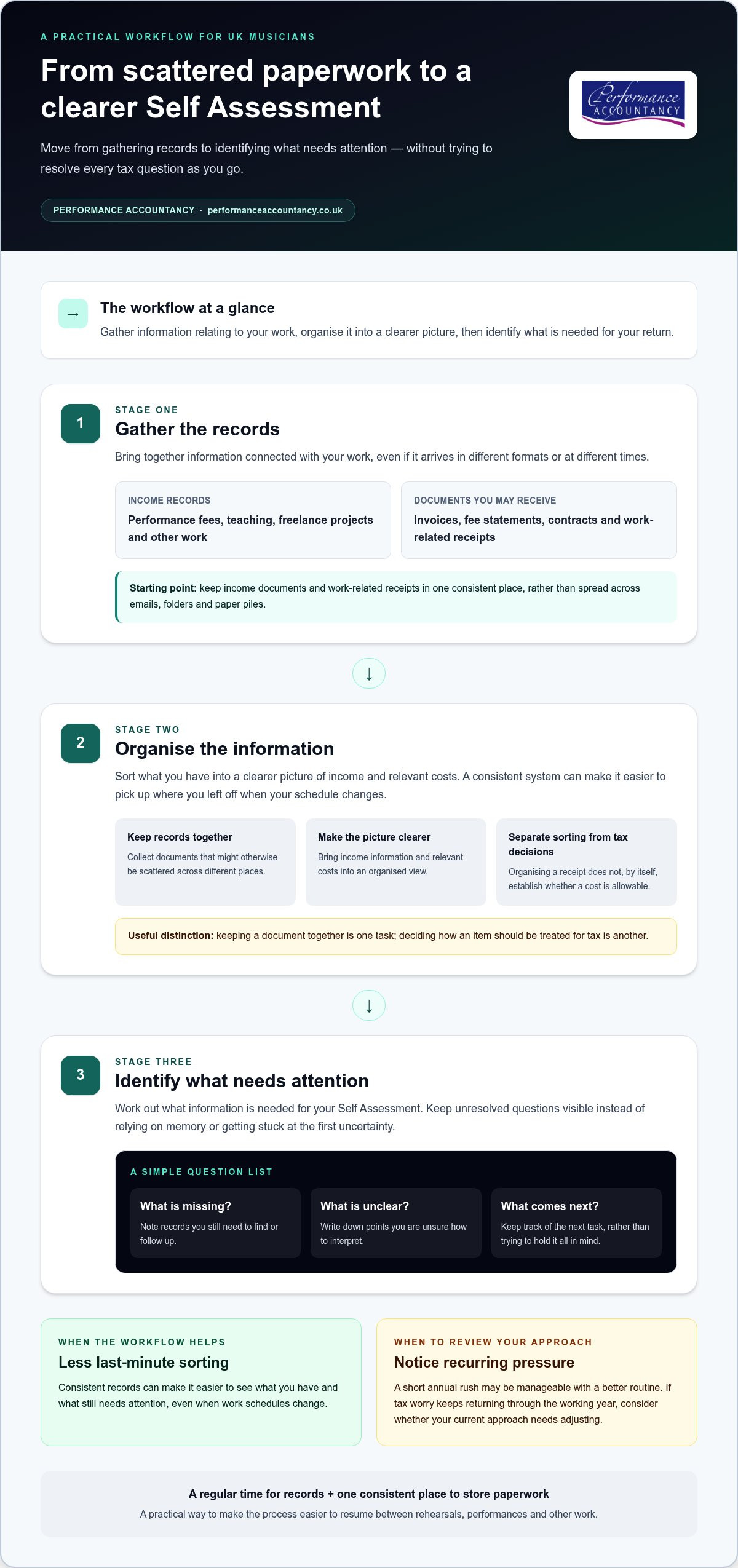
Preparing a return involves several connected tasks. You need to gather information relating to your work, organise it into a clear picture of income and relevant costs, then work out what information is needed for your Self Assessment. If records have arrived in different formats or been put aside during a busy stretch, each step can involve another decision.
Leaving the sorting until close to a deadline can make the process feel more urgent. There may be less time to find a missing invoice or make sense of a payment record. That doesn’t mean a penalty is inevitable or that anything has gone wrong. It simply leaves less room to check what you have and follow up on unanswered questions.
Consistent records mean less last-minute sorting, even when your work schedule changes.
Where paperwork and attention tend to get tangled
An engagement might generate a contract or fee statement; another may involve an invoice you’ve raised yourself. You might also have receipts connected with your work, alongside records for teaching or other freelance activity. When these arrive at different times, they can end up spread across emails, folders and paper piles.
The records relevant to a return depend on your circumstances and working arrangements. Keeping documents together is one task; deciding how a particular item should be treated for tax is another. A receipt in a folder doesn’t, by itself, establish whether a cost is allowable. Separating the two questions lets you organise what you have without feeling you must resolve every tax judgement as you go.
How uncertainty can magnify the mental load
Uncertainty can turn a straightforward admin task into a loop: should I keep this, where should it go, and will I need it for my return? If you’re unsure what information to retain or how to group it, even opening the paperwork can feel like starting a larger job. The effort involves not just handling documents, but deciding what each one means and what to do next.
HMRC’s Self Assessment process requires you to report relevant information for your circumstances, but working out how your records fit together can still feel unfamiliar. A practical starting point is to keep income documents and work-related receipts in a consistent place, then write down questions separately rather than relying on memory.
For prompts on what to gather and how to prepare, use this musician tax return checklist. If you want help organising your accounts, Performance Accountancy provides specialist accounting support for performing arts professionals.
DIY tax or an accountant for musicians: which approach feels sustainable?
An accountant isn’t automatically necessary for every musician. The useful question is whether your current approach is clear and manageable throughout the year, not simply whether you can complete a return yourself. Consider the time involved, how confident you feel about your responsibilities and whether your records stay organised as your work changes.
| Area | Managing it yourself | Working with an accountant |
|---|---|---|
| Time | You set aside time to organise information and prepare your return. | You provide relevant records and information, with professional support on the accounting work agreed. |
| Confidence | You need to feel comfortable understanding what’s required and handling questions as they arise. | You can discuss tax and record-keeping questions with an accounting professional. |
| Record organisation | You’re responsible for keeping your paperwork accessible and in order. | You still provide records, while support can help structure the accounting process. |
| Professional support | You handle the process independently, using guidance where needed. | You have support from an accountant whose work can be matched to the services you need. |
When managing your own tax may still work
DIY may suit you if your circumstances are straightforward, you understand your responsibilities and you keep records in a way you can follow. Be realistic about the time involved, though. Count the small tasks across the year, not just the hours spent filing: gathering paperwork, organising it and returning to questions all take attention. If that workload feels manageable, self-management may remain a sensible fit.
When specialist accounting support may ease the workload
Changing work arrangements, recurring uncertainty or a growing admin backlog can be reasons to review your approach. So can repeatedly postponing records because they compete with rehearsal, teaching or paid work. A performing-arts specialist understands the context musicians work in, including varied engagements and portfolio careers. That context can make conversations about records and accounting more relevant to your working life, without assuming every musician has the same circumstances.
If you’re weighing up an accountant for musicians uk, first identify which parts of the process you want help with and which you’re comfortable managing. Performance Accountancy provides chartered accountancy services for performing arts professionals. Learn more about its accounting support for musicians and the practical help available for creative careers.
How to make musician tax admin feel more manageable, even before you delegate
You don’t need to clear an entire afternoon to make a start. A small routine can keep records moving between engagements, rather than leaving one large sorting job to compete with rehearsals or rest.
A small routine for keeping music-work records in order
Choose a regular admin moment that fits your schedule, perhaps after a teaching day or at the end of each week. Follow the same sequence each time:
- Gather: Bring together new income records and relevant supporting documents.
- Sort: Put them in one consistent place, using clear folders or labels that make sense to you.
- Record: Note income as it comes in, and retain documents so you can find them later.
- Flag: Write down anything you’re unsure about instead of trying to settle every tax question on the spot.
Your system can be paper-based or digital. The important thing is choosing a method you can return to and use consistently. Organising a receipt or recording a payment helps you track information; it doesn’t, by itself, decide how an item should be treated for tax. Keep that distinction clear, and save a short list of questions for your accountant or relevant HMRC guidance.
Making Tax Digital for Income Tax may affect some self-employed people, depending on eligibility and the rules in force. Requirements and dates can change, so check current HMRC guidance for your circumstances rather than relying on an old note or assumption.
What to review if the admin still follows you offstage
After trying a routine, take stock. Is paperwork still building up? Do you regularly lose time working out what to do next, or find tax tasks following you into time set aside for music and rest? These patterns can show whether your system needs refining or whether you’d benefit from support.
Decide what you’re happy to keep doing, such as gathering documents, and what you’d like help with. You may want to maintain day-to-day responsibility for your records while getting support with bookkeeping, Self Assessment or other accounting work. The right balance depends on your working arrangements and needs.
If you’re considering an accountant for musicians uk, specialist knowledge of performing careers can make conversations more relevant to the realities of your work. Explore specialist accounting support for musicians and decide which parts of your tax admin you’d like help to organise.
How an accountant for musicians in the UK can bring the numbers into rhythm
Specialist accounting support can turn separate tax tasks into a clearer process. Depending on how you work and what you need, support could include bookkeeping, preparing a Self Assessment tax return, VAT returns or limited company accounts. You don’t need every service. Start by identifying which responsibilities apply to your circumstances and where professional support would be useful.
What specialist support can cover for a working musician
For a self-employed musician, bookkeeping helps keep financial records in order, while Self Assessment support covers preparing the relevant return from the information gathered. VAT returns or limited company accounts may be relevant to some musicians, depending on their arrangements. Performance Accountancy provides bookkeeping, Self Assessment tax returns, VAT returns and limited company accounts for performing arts professionals. The services that are relevant to you depend on your situation.
Performance Accountancy specialises in performing-arts professionals, including musicians. Its founder is a Chartered Accountant with a professional operatic background, bringing first-hand familiarity with the demands and irregular rhythms of a performing career. That context helps ground accounting conversations in how musicians work.
For an example of related guidance for another performing profession, read this guide to Self Assessment tax returns for actors. The details of your own return depend on your circumstances, but the example shows how tax information can be considered in a performing-arts context.
A calmer next step: decide what you want to hand over
Before exploring support, write down the tasks that take the most effort. Is it keeping records up to date, understanding what information is needed for Self Assessment or managing VAT paperwork? Then mark what you’re content to continue doing and what you’d like help with. A short list gives you a practical starting point without requiring you to decide everything at once.
A specialist conversation can focus on your work, your current records and the tasks you want help with. It doesn’t mean handing over every part of your finances by default. It means identifying which accounting support fits your arrangements, whether you need help with a return, bookkeeping or another relevant compliance task. If you’re looking for an accountant for musicians uk, take the next step at a pace that feels right: Explore specialist accounting support for performers.
Choose a tax routine that leaves room for your music
Doing your own tax doesn’t have to be a problem, but the time and attention it asks of you should feel manageable. A regular record-keeping habit makes paperwork easier to pick up, while recurring uncertainty or a backlog may be a sign to rethink how you handle it.
There’s no single right choice for every musician. Consider what you’re comfortable managing, where your time is going and which tasks you’d prefer to discuss handing over. If you’re looking for an accountant for musicians uk, specialist context matters. Performance Accountancy focuses on performing arts professionals and is led by a Chartered Accountant with a professional operatic background.
Explore what specialist support could look like for your working life at Performance Accountancy. Whether you continue managing your records yourself or decide to share the load, choose a clear next step that keeps admin in its place and your creative work centre stage.
Frequently Asked Questions
Is doing your own taxes stressful for musicians?
It can be, particularly if paperwork competes with rehearsals, performances or rest. Irregular work may mean gathering information from different engagements and returning to tax tasks between busy periods. That pressure doesn’t automatically mean you’ve made a mistake. If tax admin repeatedly affects your concentration or takes up time you’d set aside for music, try adjusting your record-keeping routine or consider professional support.
Can musicians do their own Self Assessment tax return?
Yes, musicians can prepare and submit their own Self Assessment return if they’re required to file one and feel confident managing the process. This involves gathering relevant income and expense information, organising records and completing the return accurately for your circumstances. If your income comes from several kinds of work or you’re unsure how information should be treated, seek guidance rather than trying to resolve every question alone.
When should a musician consider hiring an accountant?
Consider an accountant if tax tasks regularly create uncertainty, your records are building up or admin is taking time away from work and rest. Changing work arrangements can also make it harder to keep track of what information belongs together. An accountant isn’t essential for every musician. If your circumstances feel straightforward and you’re confident managing your records and return, doing it yourself may remain manageable.
What does an accountant for musicians in the UK do?
An accountant for musicians in the UK can help organise bookkeeping and prepare Self Assessment tax returns. Depending on your working arrangements, support may also cover VAT returns, limited company accounts or Making Tax Digital. Performance Accountancy specialises in accountancy for performing arts professionals, including musicians, and is led by a Chartered Accountant with a professional operatic background. The relevant support depends on your circumstances and needs.
How can musicians make tax admin less overwhelming?
Choose a regular time that fits around your work, then gather new income records and relevant supporting documents. Sort them into a consistent place, record information as it arrives and keep a short list of questions for your accountant or HMRC guidance. Brief, repeated sessions can make paperwork easier to manage than leaving everything for one catch-up. Keep organising records separate from deciding how items should be treated for tax.
Does using an accountant mean I no longer need to keep records?
No. An accountant can support tasks such as bookkeeping and preparing a return, but you’ll still need to provide information and keep relevant records. A consistent system for storing income documents, invoices and supporting paperwork makes it easier to answer questions and share what’s needed. Agreeing which tasks you’ll handle and which you’d like support with keeps responsibilities clear while leaving you involved in your financial records.