Why does a simple tax return feel more daunting than a grand theatrical debut? For most performers, the leap from the studio to the spreadsheet is the hardest transition of the day. With over 80% of the industry working as freelancers, mastering tax for ballet dancers UK is a vital professional skill, yet it is rarely taught in the academy. You are likely juggling irregular income from guest contracts and teaching whilst facing the eye-watering costs of physio, pointe shoes, and travel.
We understand that the fear of an HMRC enquiry can be just as stressful as a physical injury. You deserve the peace of mind that comes with a perfectly balanced set of books. This guide is designed to take the “headache” out of your administration, showing you exactly how to navigate self-assessment and maximise your tax efficiency through legitimate professional expenses. We will break down the latest 2026/27 regulations and provide a simple, rhythmic system for record-keeping that fits around your rehearsal schedule.
Key Takeaways
- Identify whether your performance work falls under PAYE or self-employment and understand exactly when your earnings trigger the mandatory requirement to register with HMRC.
- Master the “wholly and exclusively” rule to claim for professional costs like physio and pointe shoes, ensuring you stay compliant with tax for ballet dancers UK regulations.
- Navigate the administrative hurdles of international touring, including how to handle Foreign Entertainers Unit (FEU) rules and reclaim tax paid on overseas guest appearances.
- Transition from the “annual shoebox” of receipts to a streamlined digital system in preparation for Making Tax Digital (MTD) requirements starting in 2026.
- Discover the benefits of working with a specialist who understands the unique rhythm of a dancer’s career to ensure your financial planning is as precise as your technique.
Understanding Your Tax Status: Are You a Self-Employed Ballet Dancer?
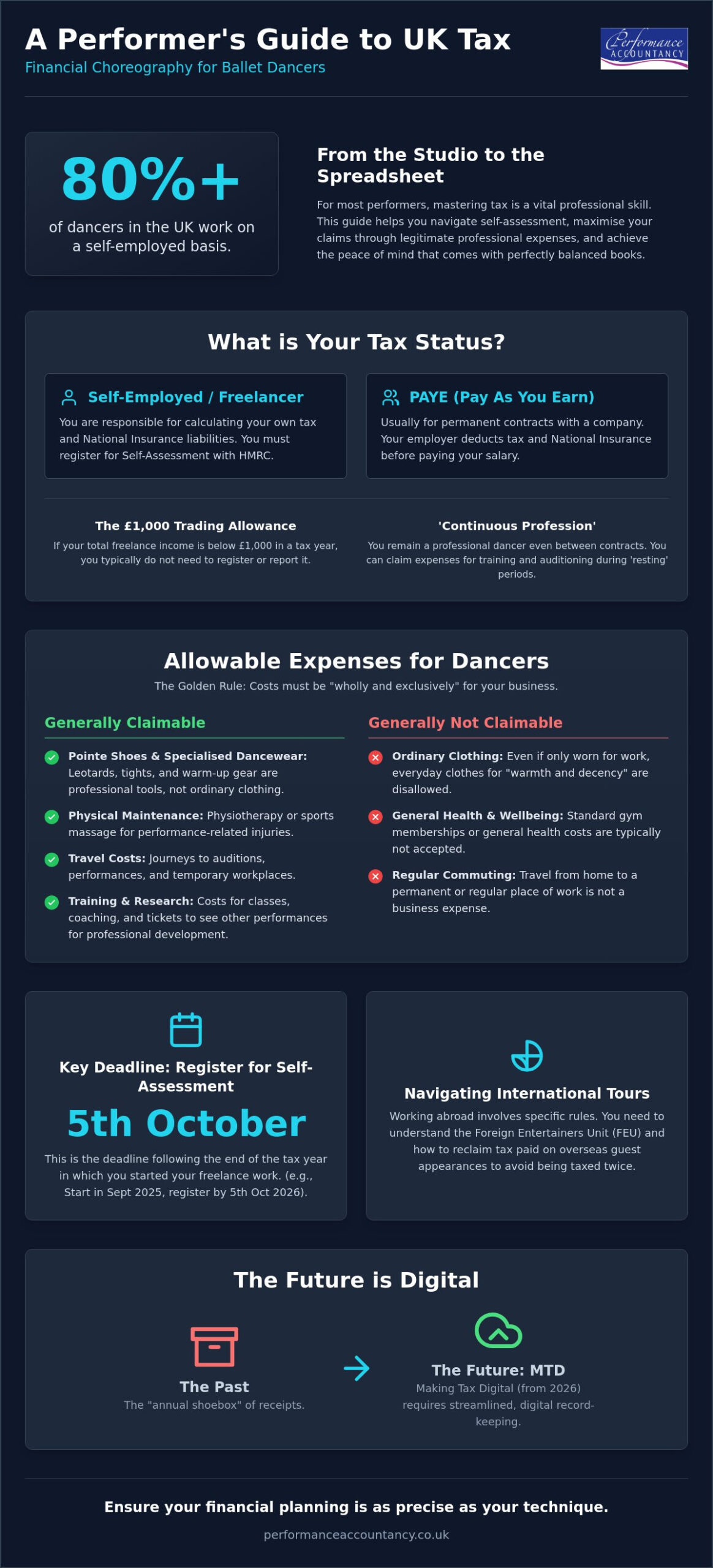
Determining your employment status is the first step in mastering tax for ballet dancers UK. In the dance world, the lines often blur between being a “company member” and a “freelance artist.” If you are on a permanent contract with a major company, you are likely handled via PAYE (Pay As You Earn), where tax and National Insurance are deducted before your salary hits your bank account. However, with over 80% of dancers and choreographers working as self-employed professionals, most will need to navigate the UK Tax System Overview independently. This means you are responsible for calculating your own liabilities and making payments to HMRC twice a year.
HMRC provides a £1,000 “Trading Allowance” each tax year. If your total income from freelance performances, guest teaching, or choreography stays below this threshold, you generally don’t need to report it. Once you cross that £1,000 mark, registration for Self-Assessment becomes mandatory. Many performers operate in a “hybrid” space; they might have a part-time PAYE teaching job whilst simultaneously taking on freelance commercial projects. HMRC views these as separate streams. It’s your responsibility to ensure the freelance portion is accurately declared, even if your main income feels “taxed at source.”
To qualify as a business in the eyes of the tax office, there must be a clear “intent to make a profit.” While the arts can feel like a labour of love, HMRC requires you to treat your career with the same commercial rigour as any other small business. This distinction is vital; it transforms your “hobby” into a professional practice that can legitimately claim expenses and offset losses.
The “Resting” Period and HMRC
Gaps between contracts are a reality of the performing arts. HMRC accepts the concept of a “continuous profession,” meaning you remain a professional dancer even during periods without active contracts. As long as you are actively seeking work, training, or auditioning, your business remains “open.” This allows you to continue claiming allowable expenses, such as studio hire or daily classes, even when you aren’t currently drawing a fee. It maintains the financial rhythm of your career during the quiet periods.
Registering for Self-Assessment
The deadline to register for Self-Assessment is 5th October following the end of the tax year in which you started working for yourself. If you began freelancing in September 2025, you must register by 5th October 2026. Missing this date can lead to “failure to notify” penalties that eat into your hard-earned fees. Performance Accountancy simplifies this initial setup. Led by Louise, a former professional performer, we handle the HMRC registrations and paperwork, taking the “headache” out of the process so you can focus on your next audition.
Allowable Expenses: What Can Ballet Dancers Claim for Tax?
The “Wholly and Exclusively” rule is the golden thread running through the entire tax for ballet dancers UK landscape. For an expense to be deductible, it must be incurred solely for your business as a performer. If a cost serves a dual purpose, benefiting you personally as well as professionally, HMRC may reject it. This is where the nuance of the HMRC Allowable Expenses for Entertainers guidelines becomes essential for protecting your profit margins.
Clothing is a classic example of this complexity. The landmark Mallalieu v Drummond ruling established that ordinary clothes used for “warmth and decency” are not tax-deductible, even if you only wear them for work. However, ballet is different. Your leotards, tights, and tutus are clearly costumes or specialised equipment. Pointe shoes, which can cost upwards of £80 and last only a few performances, are legitimate professional tools. Even warm-up gear, designed specifically to prevent injury during rehearsal, falls into this category. If you’re unsure whether your latest kit purchase counts, speaking with an accountant who understands the stage can provide the clarity you need.
Physical maintenance is another vital area for dancers. While general health costs are usually disallowed, specific treatments like physiotherapy or sports massage for a performance-related injury are often accepted. Your body is your instrument; keeping it in tune is a business necessity. HMRC generally allows these costs when they are required to get you back on stage or maintain the high level of fitness your specific contracts demand.
Training, Classes, and Professional Development
Maintaining your technique is not optional. Daily open classes and professional coaching sessions are fully allowable as they maintain your existing skills. While general gym memberships are often contested, specific Pilates or Yoga sessions can be claimed if they are part of a structured professional conditioning programme. Researching your craft is also deductible. This includes theatre tickets for shows relevant to your genre and industry subscriptions like Equity or Spotlight, which are essential for staying connected to the market.
Travel, Auditions, and Touring
Travel costs can quickly spiral. You can claim for travel to auditions, rehearsals, and performances, provided the location is not a permanent base. If you are on tour, the “temporary workplace” rule applies. This allows you to claim travel to various venues and “subsistence” costs, which is the extra money spent on meals whilst working away from home. Keeping a meticulous log of these journeys is the best way to satisfy HMRC during a review and ensure you aren’t leaving money on the table.
Navigating Complexities: International Tours and Limited Companies
International tours are the pinnacle of a performance career. They also bring a unique set of financial hurdles that can leave even the most seasoned soloist feeling dizzy. When you perform outside the UK, you encounter foreign withholding tax. This is often managed by the Foreign Entertainers Unit (FEU). Essentially, the host country might take a cut of your fee before it ever reaches your pocket. It’s a frustrating experience to see your hard-earned fee diminished before you’ve even left the stage.
You don’t have to lose that money forever. Through double taxation treaties, you can often claim this back or offset it against your UK bill. HMRC’s own HMRC guidance on employment status for performers clarifies how these international roles are viewed by the authorities. It’s a complex area where tax for ballet dancers UK requires a specialist eye to ensure you aren’t paying more than your fair share across two different jurisdictions. We help you navigate these treaties so your international guest appearances remain as profitable as they are prestigious.
Choreographers often find themselves at a crossroads sooner than performers. Because they deal with intellectual property, royalties, and sometimes hiring their own cast, the financial structure of their business needs more protection. A choreographer’s income might be more “lumpy” than a dancer’s. This makes certain tax-planning strategies more effective, as they move from being a simple service provider to a creator of assets.
The Limited Company Decision
Transitioning from a sole trader to a Limited Company is a major leap. It offers limited liability and potential tax savings, particularly if your annual profits consistently exceed £50,000. However, it comes with a significantly higher administrative burden. You’ll need to file annual accounts with Companies House and manage more complex payroll requirements. We specialise in managing Limited Company accounts for high-earning dancers, ensuring the transition is as seamless as a well-executed transition in a Pas de Deux.
VAT for the Performing Arts
As of April 2026, the VAT registration threshold stands at £90,000. If your taxable turnover hits this mark, registration is mandatory. For many freelancers, the Flat Rate Scheme is a brilliant time-saver. It allows you to pay a fixed percentage of your turnover to HMRC rather than tracking VAT on every single small purchase. This is especially helpful when dealing with international performance fees, where VAT rules can vary depending on where the “supply of service” actually takes place.
Making Tax Digital (MTD) and Modern Record Keeping
The era of the “annual shoebox” is drawing to a close. For many, the tradition of gathering a year’s worth of crumpled receipts every January is a stressful performance they’d rather skip. With the introduction of Making Tax Digital (MTD) for Income Tax, this process is becoming more structured. From 6 April 2026, self-employed individuals with a gross income over £50,000 must keep digital records and send quarterly updates to HMRC. This shift is a significant change in how you manage tax for ballet dancers UK, moving from a once-a-year sprint to a steady, manageable rhythm.
While quarterly reporting might sound like more work, it’s designed to reduce the “year-end headache.” Digital bookkeeping gives you a real-time view of your finances. You’ll know exactly how much you’ve spent on pointe shoes or physio without waiting for your accountant to tally up the totals months later. Choosing “creative-friendly” software is key. You need a system that understands the irregular nature of performance fees and guest contracts, rather than a rigid corporate tool that feels like a mismatch for your career.
Organising Your Digital Records
Transitioning to a digital system doesn’t have to be chaotic. Follow these three steps to find your financial flow:
- Step 1: Separate your bank accounts. Never mix your personal grocery shopping with your professional studio hire. Having a dedicated business account makes digital tracking effortless.
- Step 2: Use receipt-scanning apps. Capture your expenses on the go. Snapping a photo of a receipt whilst on tour means you’ll never lose a deduction to the bottom of a dance bag again.
- Step 3: Schedule a monthly “admin hour.” Treat your finances like a rehearsal. Spending sixty minutes once a month to categorise your digital records keeps the system running smoothly.
Performance Accountancy’s MTD Support
We understand that your priority is the studio, not the spreadsheet. Our team bridges the gap between your demanding rehearsal schedule and the evolving world of tax for ballet dancers UK. We don’t just provide software; we provide a system that works for performers. If you prefer to focus entirely on your craft, we offer bookkeeping services that handle the digital heavy lifting for you. We ensure your records are HMRC-compliant and that you are fully prepared for the 2026 changes. If you are ready to retire the shoebox and embrace a simpler way of working, explore our MTD IT support services today.
Why Specialist Accounting Matters for Your Dance Career
A generalist accountant might be brilliant at handling a local shop’s books, but they often struggle with the rhythmic complexity of a performer’s life. When you discuss tax for ballet dancers UK, you need someone who understands why you have three different contracts in three different currencies. You need a partner who recognises that your body is your primary business asset and that its maintenance isn’t a luxury. A specialist acts as a financial guardian, protecting your creative energy from the drain of administrative confusion. They know the difference between a standard shoe and a professional tool, ensuring your tax return is both compliant and efficient.
Smart financial planning is about more than just meeting a deadline; it’s about career longevity. Dancers often face shorter performance windows than other professionals. Maximising your tax efficiency now allows you to build a robust financial foundation for the future, whether that involves transitioning into choreography, teaching, or a new creative venture. By claiming every legitimate expense, from the studio hire mentioned earlier to specialised kit and training, you retain more of your income to invest back into your craft. It’s about making your money work as hard as you do in the studio.
The Performance Accountancy Difference
Louise’s background as a former professional opera singer means she has lived the life of a performer. She understands the specific “headache” of sorting through guesting fees whilst preparing for a major premiere. This unique perspective allows for tailored advice that a standard corporate firm simply cannot offer. We provide specialist support for ISM members and classical artists, ensuring your accounts reflect the reality of the UK dance sector. We speak your language. This means you don’t have to spend your precious rest days translating your career into “accountant-speak” for someone who doesn’t understand your industry.
Your Next Steps to Financial Clarity
Transitioning to a professional accounting system brings a profound sense of relief. No more late-night panics about HMRC deadlines or wondering if you’ve missed a vital deduction. Booking a consultation allows us to review your current tax position and build a system that fits your rehearsal schedule. We take the chaos of receipts and irregular payments and refine it into an organised, manageable structure. If you are ready to move from confusion to a state of organised calm, Contact us today to organise your dance finances. We will help you master the financial choreography of your career so you can stay focused on the stage.
Take Centre Stage with Financial Confidence
Mastering the choreography of your finances is just as vital as perfecting your technique in the studio. We have explored how identifying your employment status and tracking specialised expenses, from pointe shoes to physiotherapy, can significantly reduce your HMRC liabilities. As the industry moves toward digital record-keeping in 2026, establishing a rhythmic system for your accounts now will prevent a last-minute scramble when the curtain closes on the tax year. Managing tax for ballet dancers UK requires a specialist eye that understands the unique pressures of a performance career.
Performance Accountancy was founded by Louise, a Chartered Accountant and former professional performer who knows exactly what it’s like to balance guest contracts with administrative “headaches.” We specialise in MTD and self-assessment for the performing arts, providing dedicated support for ISM members and classical artists across the UK. You don’t have to navigate these complex regulations alone. Let us handle your tax return so you can stay in the spotlight. With your finances in expert hands, you can focus on the artistry and longevity of your career with complete peace of mind.
Frequently Asked Questions
Do I need an accountant if I am a dancer in a permanent company?
If your only source of income is a permanent contract handled via PAYE, you usually don’t need to file a tax return. However, many company dancers also guest perform, teach, or choreograph on a freelance basis. If these additional earnings exceed £1,000 in a tax year, you must register for self-assessment. A specialist accountant ensures these multiple income streams are balanced correctly whilst maximising your professional deductions.
Can I claim for my gym membership as a professional ballet dancer?
HMRC generally rejects claims for standard gym memberships because they are considered to have a “dual purpose” for general health and fitness. To stay compliant with tax for ballet dancers UK regulations, it is better to focus on claiming for professional daily classes, studio hire, and specialised conditioning like Pilates. These are more easily defended as being incurred wholly and exclusively for your professional performance career.
What happens if I forget to claim an expense on my tax return?
You can usually amend your self-assessment tax return for up to twelve months after the original filing deadline. If you find a misplaced receipt for pointe shoes or travel costs after you’ve submitted your return, there is no need to panic. We can help you file a formal amendment with HMRC to ensure you receive the tax relief you are entitled to, protecting your hard-earned fees.
How much does a specialist tax return for a dancer cost?
The cost of a professional tax return depends on the complexity of your financial life, such as whether you have international guesting contracts or operate as a limited company. Whilst specialist fees reflect the niche industry expertise provided, they are often offset by the tax efficiencies identified through legitimate professional expenses. We suggest contacting a specialist for a quote that reflects your specific performance and teaching schedule.
I am an international dancer working in the UK; what are my tax obligations?
Your obligations depend on your residency status and how many days you spend in the country. If you are here on a long-term contract, you are typically taxed on your worldwide income, whilst short-term guest artists may face different withholding rules. Navigating tax for ballet dancers UK as an international performer is complex, so seeking advice early is vital to avoid double taxation and ensure compliance.
Can I claim for “stage make-up” and hair products for performances?
Yes, you can claim for stage make-up and hair products used exclusively for your professional work. These are viewed as tools of the trade rather than everyday personal items. Keep your receipts for heavy-duty foundations, theatrical lashes, and specialised styling products required for the stage. These costs are legitimate business deductions that help reduce your overall tax bill at the end of the year.
What is the deadline for filing my self-assessment tax return in 2026?
For the 2025/26 tax year, the deadline for filing your online self-assessment return and paying the tax you owe is midnight on 31 January 2027. If you are newly self-employed, you must register with HMRC by 5 October 2026. Missing these deadlines can result in automatic penalties, so it’s important to keep your financial records organised throughout the rehearsal and performance season.
Do I need to keep physical receipts if I use a digital bookkeeping app?
No, you don’t need to retain physical paper receipts if you have captured a clear, legible digital image of them in an HMRC-compliant app. HMRC accepts digital records as valid proof of your business expenses. This makes managing your finances much simpler whilst touring, as you can snap a photo of a receipt in the dressing room and discard the paper immediately.