What if your ISM membership subscription was the key to unlocking a suite of professional expenses that your current accountant is missing? You’ve likely felt the frustration of explaining why a specific stage outfit or a niche piece of equipment is a legitimate business expense, only to be met with a blank stare from a traditional firm. It’s exhausting to manage irregular income streams whilst worrying about the looming shadow of Making Tax Digital (MTD) for Income Tax; it is even worse when you feel your creative expenses are being misunderstood. We know that for a professional musician, the boundary between life and art is thin, which often makes bookkeeping a constant headache.
This guide will show you how to claim the maximum tax deductions for ISM members and ensure your records are fully compliant with HMRC’s evolving rules. You’ll discover how specialist accounting support can protect you from enquiries and transform your financial admin from a source of anxiety into a state of organised calm. We will break down the specific deductions available to you and provide a clear path toward a stress-free digital transition, allowing you to focus on the performance rather than the paperwork.
Key Takeaways
- Understand why your ISM membership is a fully allowable professional expense, forming the foundation of your strategy for tax deductions for ISM members.
- Identify which specific costs, from instrument repairs to touring subsistence, qualify as “wholly and exclusively” for your trade to maximise your allowable claims.
- Get ahead of Making Tax Digital (MTD) requirements by transitioning to a digital record-keeping system that fits the irregular rhythm of a musician’s life.
- Protect yourself from HMRC enquiries by learning to avoid common red flags, such as using estimated figures or falling into the “duality of purpose” trap.
- Discover the value of partnering with a specialist who understands the creative sector’s unique financial landscape to achieve a state of organised calm.
Navigating Tax Deductions for ISM Members in 2026
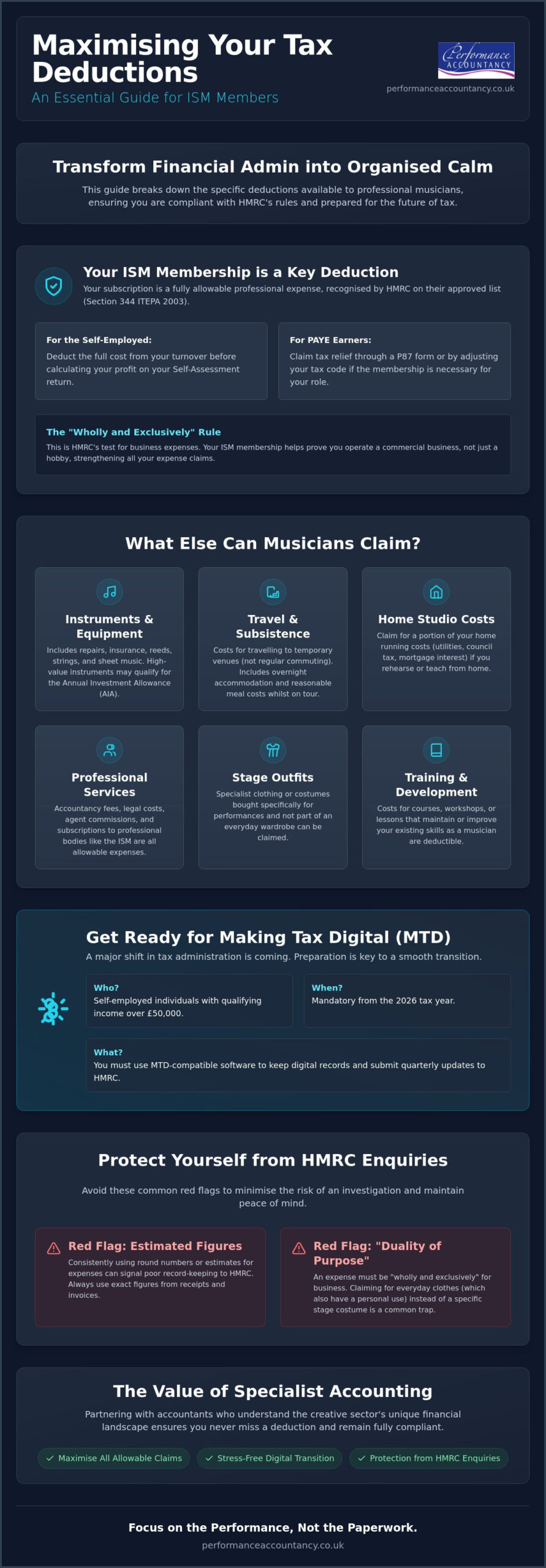
The 2026 tax year marks a significant shift for the creative community. With the mandatory arrival of Making Tax Digital (MTD) for those with qualifying income over £50,000, your administrative rhythm is about to change. Amidst these new digital requirements, your membership with the Independent Society of Musicians (ISM) remains a steadfast pillar of your professional identity. For self-employed musicians, the annual subscription is far more than just a gateway to legal support and insurance; it’s a fully allowable professional expense. HMRC recognises that maintaining professional standards and staying connected to industry developments is essential for your trade.
If you’re a freelancer filing a Self-Assessment return, you can deduct the full cost of your membership from your turnover before calculating your profit. However, if you’re a PAYE earner, perhaps working as a salaried music teacher alongside your performing career, the process is slightly different. You’ll need to claim tax relief through a P87 form or by adjusting your tax code, provided the membership is necessary for your role. Identifying the correct path ensures you don’t leave money on the table, especially as frozen tax thresholds mean every pound saved on your tax bill matters more than ever.
Is My ISM Membership Tax Deductible?
HMRC maintains a specific list of approved professional bodies under Section 344 of the Income Tax (Earnings and Pensions) Act 2003. The ISM is firmly on that list. This means your subscription qualifies for relief because it’s deemed necessary for the performance of your duties. If you’ve missed claiming this in previous years, you can typically claim back tax on subscriptions for the last four tax years. Some musicians worry that the inclusive insurance benefits might complicate the deductible status, but since these benefits are intrinsic to the professional membership, the entire fee remains a valid part of your tax deductions for ISM members. It’s a clear win for your 2026 tax efficiency.
The “Wholly and Exclusively” Rule for Musicians
To qualify for tax deductions for ISM members, an expense must be incurred “wholly and exclusively” for the purposes of your trade. This is the gold standard HMRC uses to separate professional outgoings from personal lifestyle choices. Being an ISM member provides tangible proof that you’re operating a commercial business rather than pursuing a hobby. It signals to HMRC that you’re invested in professional development and industry compliance. As we move into the 2026/27 tax year, documenting your renewal is vital. Ensure your digital bookkeeping software captures the invoice date and payment clearly. This small act of discipline helps build the “organised calm” necessary to survive any future HMRC scrutiny.
Allowable Expenses: What Musicians Can Claim Alongside Membership
Your ISM membership acts as a professional passport, but the journey to true tax efficiency involves mapping out every allowable expense. Beyond your subscription, the list of potential tax deductions for ISM members is extensive, yet often under-utilised. Every reed, string, and sheet music score is a legitimate business cost. If you’re investing in a high-value instrument in 2026, the Annual Investment Allowance (AIA) remains a powerful tool, potentially allowing you to offset the entire purchase price against your profits in the year of acquisition. This is a far more efficient route than traditional depreciation methods, providing immediate relief for your cash flow.
Travel and subsistence present a trickier rhythm to master. HMRC distinguishes between ‘commuting’ to a regular place of work, such as a school where you teach weekly, and travelling to a temporary venue for a performance or audition. The latter is fully deductible, including overnight accommodation and reasonable meal costs whilst on tour. If you spend significant hours rehearsing or teaching from a home studio, don’t overlook the ‘use of home’ deduction. Whether you use the flat-rate simplified expenses or calculate a precise percentage of your utilities and mortgage interest, this claim can significantly reduce your taxable profit. For those feeling overwhelmed by these calculations, our specialist ISM member accounting services can help you strike the right balance between compliance and maximum relief.
Instruments, Equipment, and Consumables
Your instrument is your livelihood, and HMRC acknowledges this through various relief mechanisms. Maintenance and repairs, from bow rehairing to piano tuning, are essential outgoings. Crucially, instrument insurance is a non-negotiable deduction; it protects your trade’s primary asset. For smaller, recurring items like digital software subscriptions or instrument consumables, keep every digital receipt. The official government guidance on allowable expenses confirms that these must be incurred ‘wholly and exclusively’ for your business to qualify. Even professional development costs, such as coaching sessions or scores for a new role, sit firmly within this category.
Performance-Specific Costs: Stage Clothes and Grooming
The ‘duality of purpose’ rule is where many creative professionals stumble. HMRC argues that if an item of clothing could reasonably be worn for a non-professional occasion, it isn’t deductible. This makes everyday ‘smart’ clothes a no-go. However, concert dress that is clearly a ‘uniform’ for the stage, such as formal tails, specific orchestral blacks, or elaborate operatic gowns, is usually allowable. Grooming costs like hair and makeup are rarely deductible unless they are specifically for a filmed performance or a high-profile photo shoot where a particular ‘look’ is a contractual requirement rather than a personal choice.
The Transition to Making Tax Digital (MTD) for ISM Professionals
The curtain is rising on a new era of tax administration. From 6 April 2026, the traditional once-a-year scramble to meet the January deadline will be replaced by a more frequent, digital rhythm. If your total gross income from self-employment exceeds £50,000, you’ll be required to join the Making Tax Digital (MTD) for Income Tax Self-Assessment (ITSA) regime. This isn’t just a minor tweak to the rules; it’s a fundamental shift in how you document your professional life. It requires you to keep digital records and provide quarterly updates to HMRC using MTD-compatible software.
For many, this feels like an unwanted encore after a long tour. However, the move to digital filing is designed to reduce errors and provide a clearer picture of your liabilities throughout the year. The income threshold is set to drop to £30,000 from 6 April 2027, meaning most established professionals will eventually be part of this system. Transitioning early allows you to refine your bookkeeping process and ensures you’re capturing every possible tax deductions for ISM members without the stress of a looming deadline. Relying on disconnected spreadsheets is no longer a viable strategy, as HMRC now mandates “digital links” between your source data and your final submission.
Quarterly Updates and the End of Period Statement
Under MTD, your tax year will be divided into four distinct quarters. You’ll need to submit a summary of your business income and expenses to HMRC within a month of each quarter’s end. The timeline for the 2026/27 tax year looks like this:
- 7 August 2026: First quarterly update due.
- 7 November 2026: Second quarterly update due.
- 7 February 2027: Third quarterly update due.
- 7 May 2027: Fourth quarterly update due.
- 31 January 2028: Final declaration and payment due.
Organising your receipts whilst on the road is the biggest hurdle. Using mobile apps to photograph receipts for instrument repairs or subsistence as they happen ensures nothing is lost amongst your sheet music. This real-time approach turns a chaotic year-end task into a series of manageable, bite-sized updates. It moves you away from the anxiety of “estimated” figures and toward a state of financial clarity.
Choosing MTD-Compliant Software for Musicians
While platforms like Xero or QuickBooks are excellent tools, they aren’t instinctively designed for the performing arts. A generic setup won’t understand why a conductor needs to claim for a specific set of scores or why an actor’s travel to a remote filming location isn’t a standard commute. This is where specialist ISM member accounting services become invaluable. We don’t just point you toward software; we configure your chart of accounts to reflect the unique nature of your expenses. This ensures that your tax deductions for ISM members are correctly categorised from the moment you hit “save.” By automating the link between your bank account and your accounting software, you eliminate the “data dump” headache and maintain a state of organised calm, even during your busiest performance seasons.
Avoiding HMRC Enquiries: Common Mistakes for Performing Artists
HMRC’s gaze is sharper than a conductor’s baton. Their sophisticated “Connect” AI system is now specifically trained to identify anomalies within the performing arts sector. One of the most frequent triggers for an enquiry is the use of “estimated” or rounded figures. If your professional expenses consistently end in zeros, it signals a lack of precise record-keeping that invites unwanted scrutiny. Precision is your best defence. By ensuring your tax deductions for ISM members are backed by digital evidence, you transform a potential headache into a state of organised calm.
Duality of purpose remains the primary reason musician expenses are rejected. HMRC’s rule is strict: an expense must be “wholly and exclusively” for your trade. Whilst we discussed concert dress earlier, this principle extends to research trips and international auditions. If you’re travelling to Milan to study an operatic role, you must document your business case meticulously. Keep copies of audition invites, rehearsal schedules, and programmes. If the trip includes a holiday element, you cannot claim the travel costs; only the specific, identifiable business expenses like coaching fees are allowable.
Creative professionals also have access to specific reliefs like “averaging,” which helps smooth out the tax impact of irregular income streams. If your profits fluctuate significantly between tax years, you may be able to average your profits over two or five years. This is a complex area where a generalist might miss an opportunity to reduce your higher-rate liability. Our specialist ISM member accounting services ensure that these industry-specific reliefs are applied correctly to protect your hard-earned income.
The Risk of Private Use Adjustments
Claiming 100% of a shared utility is a major red flag. Whether it is your mobile phone, home internet, or car insurance, you must fairly apportion the business use. If you use your car to travel between teaching centres and performance venues, you cannot simply claim every mile; you must exclude the “private” elements of your journey. Keeping a digital mileage log is essential. A simple spreadsheet or app entry showing the date, destination, and professional purpose of each trip provides the rigorous evidence HMRC expects during a review.
International Touring and Withholding Tax
Touring abroad adds another layer of complexity through Foreign Entertainers Tax. If you’re performing in the US or Europe, the local tax authorities may withhold a percentage of your fee. It is vital to reconcile these foreign payments with your UK return to avoid double taxation. Your UK tax liability can often be reduced by the amount paid abroad, but only if the paperwork is handled with specialist expertise. Failing to claim these credits correctly is a costly mistake that many performers make when filing without niche support.
Specialist ISM Member Accounting Services by Performance Accountancy
Performance Accountancy was born from a dual passion for the performing arts and financial precision. Our lead is a Chartered Accountant who has also spent years on the operatic stage, providing a “Specialist Insider” perspective that traditional firms simply cannot match. We understand that your career doesn’t follow a nine-to-five rhythm; it’s a fluid mix of rehearsals, tours, and irregular income streams. Our goal is to translate that creative energy into a state of organised calm. By taking the administrative weight of HMRC compliance off your shoulders, we allow you to focus on what you do best: performing.
We support every stage of an artist’s career path. Whether you are a solo performer filing Self-Assessment Tax Returns or an established ensemble managing Limited Company Accounts, our services are tailored to your specific reality. We don’t just process numbers; we advocate for your financial health. We ensure that every allowable cost is captured, maximising tax deductions for ISM members while keeping you firmly on the right side of HMRC’s evolving digital requirements.
Why a Specialist Arts Accountant Beats a Generalist
A generalist accountant might understand a balance sheet, but they rarely understand the nuances of the creative sector. Do they know how to handle “per diems” from a European tour? Can they correctly categorise a “buy-out” fee for a commercial recording? We speak your language fluently. This industry-specific expertise is vital for ensuring your tax deductions for ISM members are robust enough to survive scrutiny. We provide bespoke guidance on MTD implementation, ensuring your digital records are structured to reflect musician-specific expenses from the outset. Our approach is always friendly and non-judgemental; we’re here to solve the “headaches,” not create new ones.
Getting Started: Your Path to Stress-Free Tax
Transitioning your financial records to a specialist firm is a straightforward process. We help you move from chaotic piles of receipts or disconnected spreadsheets into a streamlined, professional system. As you prepare for your 2026 tax return, having a structured approach is the best way to avoid the anxiety of a last-minute scramble. We provide the expertise and the digital tools necessary to make your bookkeeping a background task rather than a lead role in your life. If you’re ready to trade financial confusion for clarity, we invite you to take the first step toward a more manageable future.
Contact Performance Accountancy for a consultation to see how we can support your creative journey.
Striking the Right Note for Your Financial Future
Navigating the complexities of HMRC doesn’t have to be a solo performance. By identifying your professional costs and preparing for the digital shift of 2026, you’re setting the stage for long-term stability. Your professional identity is your greatest asset; protecting it with accurate records is simply good business. Whether you’re managing irregular tour income or preparing for quarterly digital updates, the right approach ensures you remain compliant whilst keeping more of what you earn.
Maximising tax deductions for ISM members requires more than just a list of receipts; it demands an “insider” who understands the creative sector’s unique rhythm. Performance Accountancy was founded by a Chartered Accountant with a professional operatic background to bridge this gap. We provide specialist support for MTD, Self-Assessment, and VAT, ensuring your Limited Company or freelance accounts are handled with precision. We take the administrative weight off your shoulders so you can focus on your art.
Discover our specialist ISM member accounting services and let us transform your administrative headaches into a state of organised calm. Your focus belongs on the stage; we’re here to ensure the paperwork never hits a sour note.
Frequently Asked Questions
Is my ISM membership fee fully tax deductible?
Yes, your ISM membership fee is a fully allowable professional expense for self-employed musicians. HMRC includes the ISM on its list of approved professional bodies under Section 344 of the ITEPA 2003. This means you can deduct the full subscription cost from your total turnover to reduce your taxable profit, ensuring you aren’t paying more tax than necessary on your professional affiliations.
Can I claim for music lessons and professional coaching on my tax return?
You can claim for music lessons and coaching as long as they serve to maintain or improve your existing professional skills. HMRC views these as legitimate professional development costs for those already in trade. However, learning a completely new instrument from scratch is usually seen by the tax office as a personal capital investment rather than a deductible business expense, so stick to claiming for your primary specialisms.
What stage clothes are considered allowable expenses by HMRC?
HMRC only allows claims for clothing that functions as a uniform or is unsuitable for everyday wear. This includes formal concert dress like tails and evening gowns, or specific theatrical costumes for a role. Smart suits or orchestral blacks that you could reasonably wear to a wedding are usually rejected due to the duality of purpose rule. We always recommend keeping specific receipts for items that are clearly for the stage.
Do I need an accountant if I am already an ISM member?
Whilst the ISM offers excellent legal and general advice, they don’t file your tax returns or manage your daily bookkeeping. A specialist accountant ensures full compliance with MTD and secures the maximum tax deductions for ISM members. We handle the complex filing requirements and digital link mandates that go beyond the general scope of membership benefits, providing the organised calm you need to focus on your performance.
How does Making Tax Digital (MTD) affect musicians in 2026?
From 6 April 2026, musicians with a gross income over £50,000 must use MTD-compatible software to keep digital records. You’ll need to submit quarterly updates of your income and expenses to HMRC rather than filing just once a year. This requires a shift toward real-time digital bookkeeping. The threshold will drop to £30,000 in April 2027, eventually bringing most professional performers into the digital reporting regime.
Can I claim for the cost of my home practice studio?
You can claim a proportion of your household bills if you use a specific area of your home as a practice studio or office. You can either use HMRC’s simplified flat-rate expenses or calculate the actual business percentage of your rent, mortgage interest, and utilities based on the room’s usage. It’s vital to be realistic with these percentages to avoid flagging an enquiry, especially if the room is also used for personal storage.
What happens if I forget to claim for my ISM membership in previous years?
You can typically claim back tax relief for the previous four tax years if you’ve missed out on your ISM subscription deduction. This is done by making a claim for overpayment relief or amending your previous Self-Assessment returns. It’s a simple way to recover tax deductions for ISM members that were overlooked in the past, putting money back into your creative practice where it belongs.
Are agent fees and commission tax deductible for actors and musicians?
Agent fees and commissions are fully tax deductible as they are incurred wholly and exclusively for the purpose of your trade. These costs are essential for securing work and managing your professional career. You must ensure these are recorded as a business expense against your gross income. Don’t simply report the net amount you receive in your bank account, as this can lead to inaccuracies in your total turnover figures.