
What if your most important performance of the year isn’t on a stage or in front of a camera, but inside a spreadsheet? For many performers, the thought of an HMRC letter is more terrifying than a forgotten line on opening night. It’s completely understandable to feel a sense of dread when faced with the “allowable expense” maze or the chaos of juggling PAYE theatre contracts with self-employed commercial work. You shouldn’t have to choose between your craft and your financial compliance. That’s why we’ve built this self-assessment checklist for actors UK to turn that administrative headache into a manageable, structured routine.
We’re here to ensure you don’t leave your hard-earned money behind the curtain by missing out on legitimate tax relief. This guide will walk you through every stage of the process, from identifying niche industry expenses like script research and vocal coaching to understanding the mandatory 2026 Making Tax Digital (MTD) requirements for those with a qualifying income over £50,000. We’ll break down the deadlines and the digital shift whilst ensuring you stay compliant. By the end, you’ll have a clear, stress-free path to filing your return with total confidence.
Key Takeaways
- Learn why a generic tax return approach often fails performers and how a tailored strategy prevents you from overpaying HMRC.
- Use our comprehensive self-assessment checklist for actors UK to gather essential documents like your P60, P45, and UTR without the usual last-minute panic.
- Discover exactly which professional costs qualify as “allowable” expenses, from headshots and Spotlight fees to audition travel, to maximise your tax relief.
- Navigate the 2026 Making Tax Digital (MTD) transition and “Payments on Account” to protect your cash flow and avoid costly late-filing penalties.
- Understand the value of partnering with a specialist accountant who understands the unique rhythm of a creative career and ensures your financial performance matches your artistic one.
Setting the Scene: Why Actors Need a Specialist Self-Assessment Checklist
A tax return is essentially your financial performance review for the year. For performers, UK tax returns are the mechanism through which you report various income streams and claim back professional costs. Using a generic template often leads to missed opportunities or, worse, unintended inaccuracies. A dedicated self-assessment checklist for actors UK is vital because your career doesn’t follow a linear 9-to-5 path. Standard checklists assume you’re selling physical goods, not auditioning for a major theatre production or filming a commercial on the other side of the country.
The 31st January deadline is the final curtain call for online filing and payment. Whilst it’s tempting to wait until the winter months, filing early provides a clear picture of your liabilities. It prevents the nasty surprise of a tax bill you haven’t saved for. Allowable expenses are the primary tool for maintaining your financial health. By correctly identifying costs that are “wholly and exclusively” for your craft, you ensure you only pay tax on your actual profits rather than your total earnings.
The Reality of the Freelance Actor Portfolio
Your income is often a complex mosaic. You might have PAYE earnings from a seasonal theatre contract, self-employed fees from voiceover work, and perhaps a small grant. HMRC treats performers differently than traditional sole traders because of these fluctuating streams. This requires a level of administrative discipline that can feel at odds with a creative lifestyle. Meticulous record-keeping is your best defence against an enquiry. Every train ticket to an audition and every script purchase forms part of your professional narrative. Without a specialist approach, it’s easy to lose track of these small but significant figures.
The Consequences of an Unorganised Tax Season
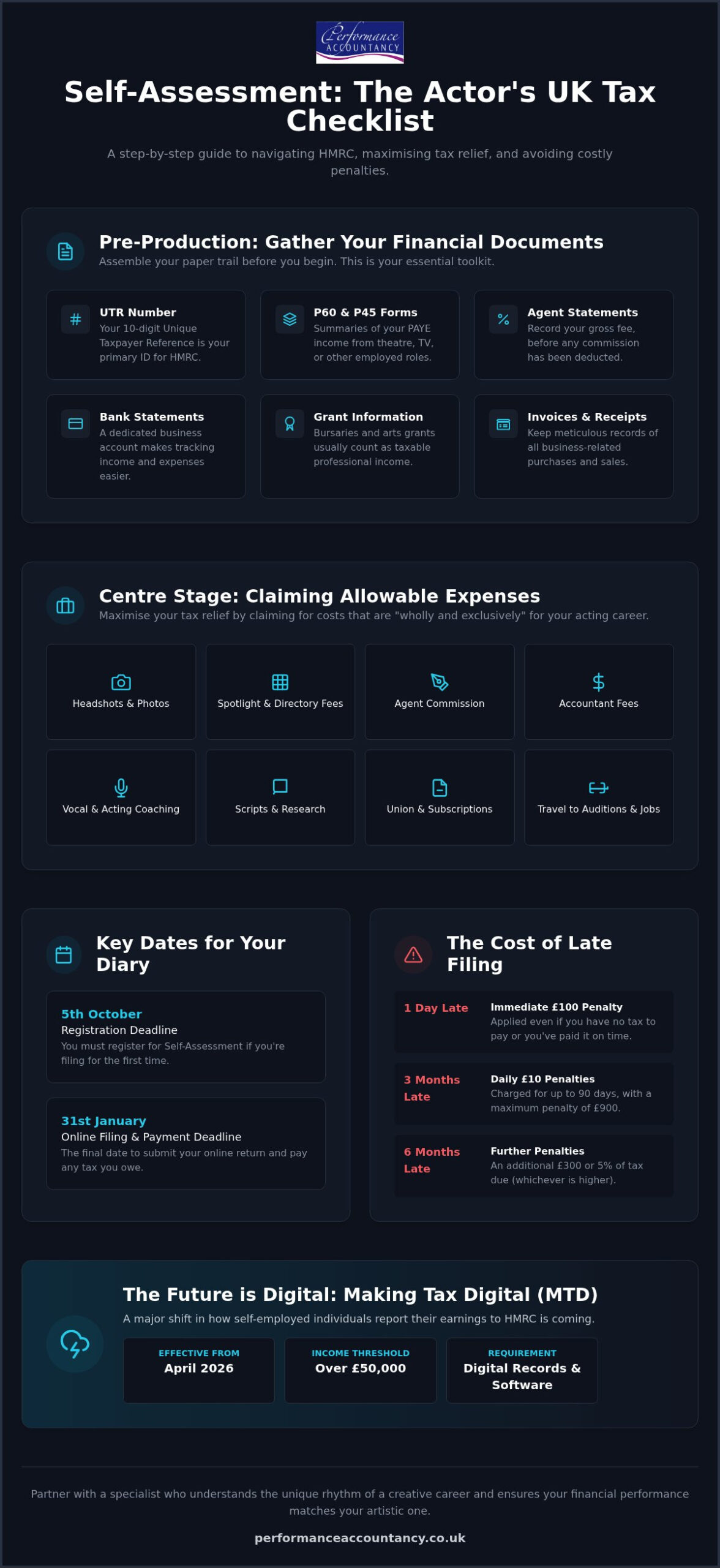
Missing the deadline isn’t just a minor slip; it’s expensive. HMRC issues an immediate £100 penalty if you’re even one day late. If you remain unorganised, these costs escalate rapidly. After three months, daily £10 charges apply, which can reach a maximum of £900. Beyond the financial cost, the mental “headache” of a disorganised tax season can drain your creative energy. Think of this self-assessment checklist for actors UK as your technical script. It ensures you hit every cue, from registering by 5th October to making your final declaration, allowing you to return to the stage with a clear head and a balanced book.
The Pre-Production Phase: Gathering Your Financial Documents
Before the cameras roll, there is the prep. In the world of tax, this means assembling your paper trail. Your Unique Taxpayer Reference (UTR) is the most critical piece of data; it’s the ten-digit code that identifies you to the tax office. If you’re new to the industry or haven’t filed before, the official HMRC guidance explains how to register and obtain this number. Think of it as your permanent cast ID for the UK tax system.
Unlike a standard office worker, your income likely comes from several directions. You’ll need your P60 for any long-running theatre or TV contracts that used PAYE, and a P45 for any roles that ended during the tax year. Don’t forget agent statements. These are often the most misunderstood documents. You must record the gross fee before your agent took their commission. If you’ve worked abroad, look for Foreign Entertainment Unit (FEU) forms, which show tax already deducted in other jurisdictions. Keeping these organised is the first step in any robust self-assessment checklist for actors UK.
Identifying Your Income Streams
Many performers juggle a “day job” alongside their creative pursuits. It’s vital to clearly separate these. PAYE income from a teaching job or a bar shift has already been taxed at source, whilst your self-employed fees for commercials or voiceovers haven’t. Meticulously track residuals and royalties from past projects; these are still taxable even if the work was completed years ago. Arts Council grants or bursaries also need to be declared, as they usually count as professional income rather than tax-free gifts.
Banking and Bookkeeping Basics
A dedicated business bank account is a simple way to protect your sanity. It keeps your supermarket shops separate from your singing lessons, making it much easier to spot your professional transactions when you’re summarising the year. Physical receipts have a habit of disappearing or fading in the bottom of a rehearsal bag. Take photos of everything and store them digitally. This isn’t just about being tidy; it’s about being ready for the shift toward digital record-keeping. If the administrative burden is dampening your creative energy, specialist tax returns for actors can turn that chaos into a clear, organised plan.
Wardrobe, Props, and Travel: Navigating Allowable Expenses for Actors
HMRC’s “wholly and exclusively” rule is the cornerstone of your tax return. If an expense isn’t solely for your acting business, it usually won’t pass muster. This is where many performers stumble, either by claiming too much or by being too cautious. According to official guidance on allowable expenses, you can only deduct costs that are essential to your trade. For a self-assessment checklist for actors UK, this means distinguishing between your personal life and your professional persona with clinical precision.
Grey areas like gym memberships or hair care often cause anxiety. Generally, HMRC views these as personal choices. Unless a specific contract requires a radical body transformation or a period-accurate haircut, these are rarely deductible. Theatre tickets, however, can often be claimed as “research” if they’re relevant to your current or prospective work. Travel is equally nuanced. Whilst you can’t claim for a regular commute to a long-term West End residency, travel to auditions, film sets, or varying touring venues is fully allowable. Keeping a mileage log for your car is essential, especially with the 2026/27 rate at 55p per mile for the first 10,000 miles.
Audition and Performance Costs
Professional tools are your biggest wins. Headshots, showreels, and self-tape equipment like ring lights and microphones are standard deductions. You should also include your agent’s commission, Spotlight fees, and union dues for Equity or the ISM. When it comes to wardrobe, the rule is strict. Everyday clothes for an audition aren’t deductible because they have a “dual purpose” of keeping you warm and decent. However, specific costumes or specialised items, such as dance shoes or period corsets used only for performance, are legitimate business costs.
The Home Office and Training
Your home isn’t just where you sleep; it’s where you learn lines and record voiceovers. You can claim a portion of your household bills or use the simplified flat rate of £26 per month if you work from home for 25 hours or more. Research costs are also vital. Scripts, professional books, and even streaming services like Netflix can be claimed if they’re used for character study or industry research. Training is allowed if it maintains your existing skills, such as a vocal masterclass or a regular screen-acting workshop. Using a self-assessment checklist for actors UK ensures these smaller, frequent costs don’t slip through the cracks, protecting your profit margins.
Filing Your Return: Deadlines, MTD, and Avoiding HMRC Penalties
Once you’ve ticked off every item on your self-assessment checklist for actors UK, the final act is the submission itself. Navigating the HMRC portal requires patience. You’ll need to input your income and expenses into the relevant sections, ensuring you don’t double-count any figures. Before you hit the “submit” button, review the summary page. It’s the best time to spot typos that could trigger an enquiry. A common shock for performers is “Payments on Account.” If your tax bill is more than £1,000, HMRC usually requires you to pay half of your estimated next year’s tax in advance. This can devastate your cash flow if you haven’t set aside enough from your previous contracts.
Timing is everything. For the 2025/26 tax year, the online deadline is midnight on 31 January 2027. However, the landscape is shifting. The 2026 calendar year marks a significant change in how the UK handles tax for high-earning creatives. It’s no longer just about one annual deadline; it’s about maintaining a digital rhythm throughout the year to avoid the £100 late-filing penalty that applies the moment you miss a cutoff.
Making Tax Digital (MTD) for Actors
From 6 April 2026, MTD for Income Tax becomes mandatory for self-employed individuals with a qualifying gross income over £50,000. This is a massive departure from the traditional annual return. You’ll be required to use MTD-compliant software to send quarterly updates to HMRC. The first deadline for the 2026/27 tax year is 7 August 2026. This shift demands a more “always-on” approach to your bookkeeping. Choosing software that integrates with your creative workflow is essential to ensure these updates don’t become a quarterly nightmare. If you’re feeling overwhelmed by these new digital requirements, our MTD IT services are designed to help performers transition smoothly without the technical stress.
Common Pitfalls and How to Dodge Them
Accuracy is your shield. A frequent error is forgetting to include interest from high-yield savings accounts; HMRC receives this data from banks and will notice if it’s missing. Never “guess” your figures. If you’ve lost a receipt for a train ticket, don’t invent a number. Use your bank statement to find the exact cost. If you realise you’ve made a mistake after filing, don’t panic. You can usually amend your return within twelve months of the original deadline. However, being proactive with your self-assessment checklist for actors UK prevents these errors from occurring in the first place, keeping your relationship with the tax office professional and drama-free.
Beyond the Spreadsheet: Why a Performance Arts Accountant is Your Best Supporting Act
A checklist provides the map, but a specialist accountant acts as your navigator. Whilst a generalist firm might understand the basics of a tax return, they often lack the “insider” perspective required to handle the irregular rhythm of a performer’s career. Performance Accountancy is led by a Chartered Accountant with a professional operatic background. This means we don’t just see numbers; we see the auditions, the touring schedules, and the complex contracts that define your life. We provide specialist tax returns for musicians and actors, ensuring that your financial filings are as precise as your stagecraft.
Handing over the administrative headache to a professional who speaks your language offers immense relief. We understand the nuances of ISM member accounting services and how to bridge the gap between your creative passion and your fiscal responsibility. A professional review often uncovers hidden relief opportunities that a standard self-assessment checklist for actors UK might miss. This could include specific nuances in VAT returns for international performers or identifying overlooked professional development costs that HMRC considers allowable for your specific niche.
When to Move from Sole Trader to Limited Company
As your career gains momentum, your financial structure may need to evolve. If your annual profits consistently exceed £50,000, the transition from a sole trader to a corporate structure often becomes tax-efficient. This move is particularly relevant given the 2026 MTD requirements, as managing limited company accounts provides a different layer of protection and professional standing. We help you weigh the increased administrative requirements against the potential tax savings, managing the transition seamlessly so you can stay focused on your next role. We’ll ensure your company remains compliant whilst maximising your take-home pay through structured salary and dividend planning.
Your Next Steps to Financial Clarity
The best time to organise your finances was yesterday; the second best time is today. We encourage you to use this self-assessment checklist for actors UK as your starting point to gather your documents and clear the mental clutter. Once you’ve assembled your P60s, agent statements, and expense receipts, the path to a stress-free filing becomes much clearer. Don’t let the fear of HMRC penalties or the confusion of MTD requirements stall your progress. You focus on the stage; we’ll handle the spreadsheets. If you’re ready to trade tax anxiety for organised calm, get in touch to discuss how we can support your unique career path.
Mastering Your Financial Performance
Your tax return doesn’t have to be a high-stakes drama filled with last-minute panic. By following a tailored self-assessment checklist for actors UK, you’ve already moved from administrative chaos toward a state of organised calm. You now understand how to separate your PAYE and self-employed income streams, which niche stage costs are truly allowable, and how to navigate the shift toward quarterly digital updates under MTD. These steps are the foundation of a sustainable, professional career in the arts.
If you’d rather spend your time in rehearsals than wrestling with HMRC spreadsheets, it’s time to bring in a specialist. At Performance Accountancy, we combine the technical expertise of a Chartered Accountant with the lived experience of a professional operatic performer. We are MTD experts who specialise in performing arts tax compliance, ensuring you stay protected whilst claiming every pound you’re entitled to. Organise your acting finances with Performance Accountancy and reclaim your creative energy for the work that matters most. Your financial health is the key to your creative longevity; take control today and make your next tax season a standing ovation.
Frequently Asked Questions
Is a gym membership tax-deductible for an actor in the UK?
No, in almost all cases. HMRC considers physical fitness a personal “dual purpose” benefit rather than a business necessity. Unless you’re a professional stunt performer or have a specific contract requiring a radical physical transformation, this remains a private expense. It’s a common point of confusion when using a self-assessment checklist for actors UK, but claiming it without a specific contractual mandate could trigger an enquiry.
Can I claim for theatre tickets and cinema subscriptions on my tax return?
Yes, provided they’re for professional research. Keeping up with industry trends, studying a specific director’s style, or watching a peer’s performance for a future role are all legitimate business activities. However, if you’re taking your family for a Saturday night out, that’s a personal cost. Meticulous notes on how each performance relates to your career will help justify these claims to the tax office if they ever ask.
How do I handle tax if I have both PAYE and self-employed acting work?
You must report both on your return. Your PAYE earnings and the tax already paid will be entered using your P60 or P45 data. Your self-employed income is recorded separately, allowing you to deduct allowable expenses from those specific profits. The system then calculates your total liability, taking into account the tax you’ve already contributed through your “day job” or seasonal theatre contracts.
What is the “Payments on Account” system and why is my tax bill so high?
This system requires you to pay half of your estimated next year’s tax bill in advance. It’s triggered if your current tax liability exceeds £1,000. HMRC assumes you’ll earn a similar amount next year and wants the money in two instalments: 31 January and 31 July. This can feel like a double-hit during your first profitable year, making cash flow management essential for every performer.
Can I claim for my hair and makeup as a professional performer?
Only if the costs are “wholly and exclusively” for a performance. Specialised stage makeup or hair styling for a specific role is deductible. However, everyday grooming, regular haircuts, and high-street cosmetics are generally disallowed because they provide a personal benefit. HMRC’s rule is strict: if you’d need the haircut or mascara for your normal life, it isn’t a business expense.
What happens if I miss the 31st January self-assessment deadline?
You’ll face an immediate £100 penalty. This fine applies even if you have no tax to pay or have already paid your bill in full. If the return is three months late, HMRC adds daily £10 penalties for up to 90 days. Interest is also charged on any late payments. Using a self-assessment checklist for actors UK helps you hit your cues and avoid these unnecessary costs.
How much can I earn before I need to register for self-assessment?
You can earn up to £1,000 per tax year via the Trading Allowance. If your gross self-employed income is below this threshold, you don’t need to register or file a return. Once you cross this £1,000 limit, you must register for Self-Assessment by 5 October following the end of the tax year. Don’t confuse profit with gross income; the threshold applies to your total receipts before expenses.
Do I need to keep physical receipts for all my acting expenses?
No, digital copies are perfectly acceptable. HMRC doesn’t require a shoebox full of fading thermal paper; a clear photo or scan of your receipt is sufficient. In fact, digital record-keeping is highly recommended as we move toward Making Tax Digital (MTD) requirements in 2026. Organising your receipts in a dedicated folder ensures you’re ready to provide evidence if HMRC ever requests a review.