
What if the very structure of your career is quietly draining your creative energy and your bank balance? For most actors and musicians, the debate over sole trader vs limited company for performers feels like a complex script written in a language they never studied. You’ve likely felt that familiar prickle of anxiety as an HMRC deadline looms, or wondered if a cancelled production could actually put your personal assets at risk. It’s exhausting to juggle a life on stage whilst worrying about the confusing gap between Corporation Tax and Income Tax.
We understand that you’d much rather be in the rehearsal room than buried under a mountain of administrative paperwork. This comparison will help you discover whether a sole trader setup or a limited company structure offers the best tax efficiency and protection for your unique career. You’ll gain a clear financial roadmap to lower your tax bill and secure your professional reputation.
We will examine the latest 2026/27 tax thresholds, the new requirements of Making Tax Digital for those earning over £50,000, and the specific moment when incorporating becomes the smartest move for your future.
Key Takeaways
- Understand the fundamental legal differences between operating as an individual or a separate corporate entity to choose the right foundation for your creative career.
- Compare Income Tax against Corporation Tax and dividend rates to determine which sole trader vs limited company for performers structure maximises your take-home pay.
- Learn how limited liability acts as a protective safety net for your personal assets during high-stakes productions and international tours.
- Prepare for the administrative shift of Making Tax Digital (MTD) and ensure you never miss an HMRC or Companies House deadline whilst your focus remains on your craft.
- Discover why a specialist insider who understands the irregular rhythm of the performing arts is essential for navigating complex tax regulations with confidence.
Setting the Stage: The Sole Trader vs Limited Company Dilemma for Performers
Choosing the right structure for your creative career is more than just a box-ticking exercise for HMRC. It is a fundamental decision that dictates how you are taxed, how much of your personal life is shielded from professional risk, and how you are perceived by the industry. Most artists begin their journey as sole traders by default, but as tours grow larger and contracts become more complex, the question of a sole trader vs limited company for performers becomes unavoidable. Understanding the different Business ownership structures in the UK is the first step in ensuring your financial safety net is as strong as your stage presence.
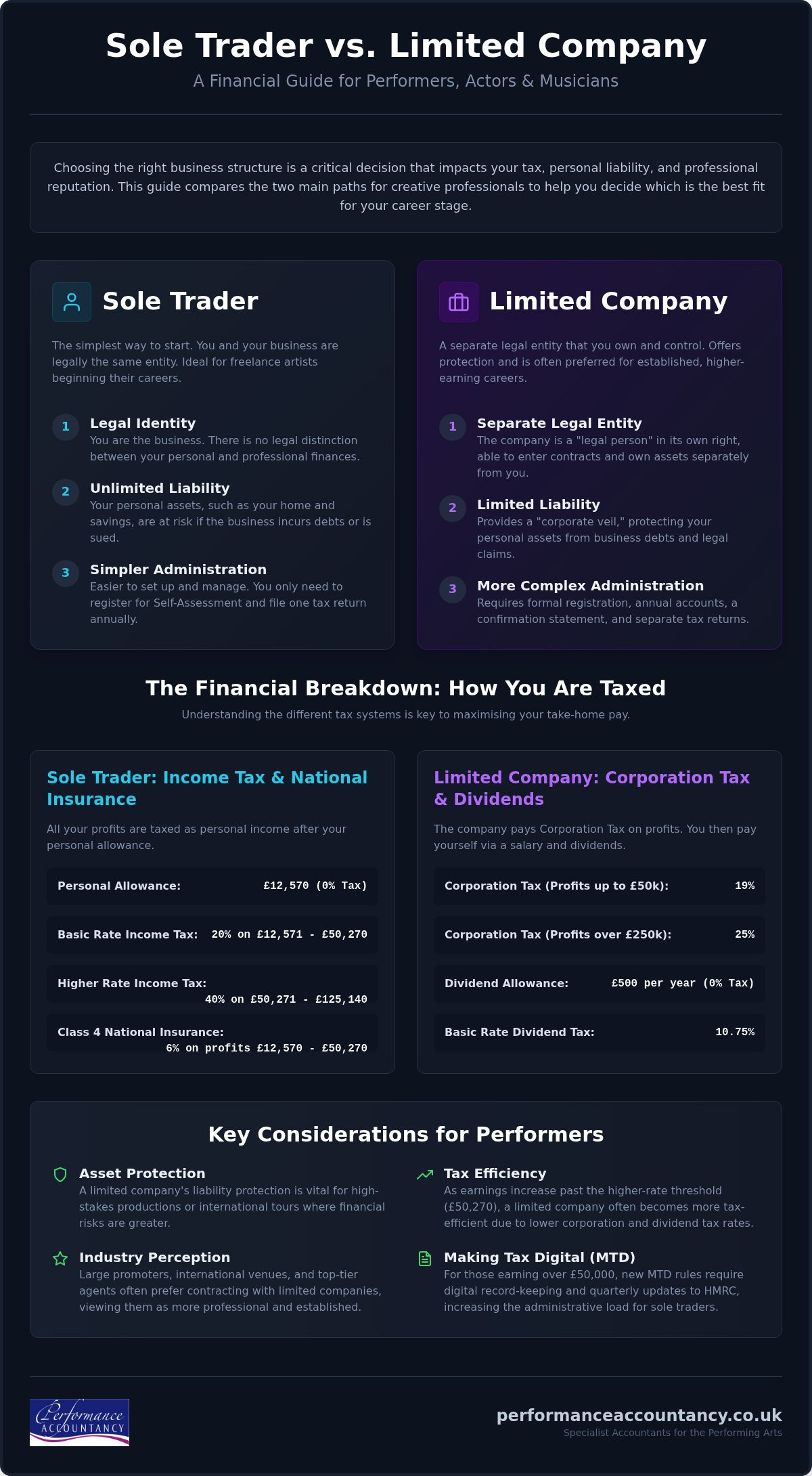
The core dilemma lies in the legal definition of who is actually doing the work. As a sole trader, you and your business are one and the same. When you incorporate a limited company, you create a “separate legal person.” This entity can sign contracts, own equipment, and even go into debt independently of you. This distinction creates the “corporate veil,” a legal barrier that protects your personal assets if a production or tour faces financial ruin. Whether you are an opera singer with a busy international schedule or a session musician with a mix of PAYE and freelance income, this choice will define your financial rhythm for years to come.
The Sole Trader: Simplicity for the Freelance Artist
For many performers, the sole trader route is the most logical starting point. It’s easy to set up; you simply register for Self-Assessment and keep track of your income and expenses. You own all the profits after tax, which makes your cash flow straightforward. However, this simplicity comes with a significant caveat: there is no legal distinction between your personal bank account and your professional debts. If a venue sues you or a tour equipment lease goes wrong, your home and personal savings are on the line. It’s an ideal path for those with lower overheads, but it offers the least amount of protection as your career scales.
The Limited Company: A Professional Shield for Your Career
Transitioning to a limited company marks the moment you stop being just a freelancer and start being a business owner. In this structure, you typically act as both a director and a shareholder. The sole trader vs limited company for performers debate often settles here for high earners because of the “limited liability” protection. If the company incurs debts it cannot pay, your personal assets are generally protected. Beyond the legal safety, there is a prestige factor. Many international venues, large-scale promoters, and top-tier agents prefer dealing with limited companies, viewing them as more permanent and professionally established entities. It requires more administration, but for a performer with growing liabilities, it provides a much-needed professional shield.
Tax, NI, and Dividends: Calculating the Cost of Your Craft
The financial choreography of your career depends heavily on how you handle the taxman. When weighing up sole trader vs limited company for performers, the arithmetic changes significantly once your earnings move past the basic rate band. For sole traders, your profit is taxed as personal income. After your £12,570 personal allowance, you’ll pay 20% tax up to £50,270, then 40% on anything up to £125,140. You also face Class 4 National Insurance at 6% on profits between £12,570 and £50,270, dropping to 2% on anything above that.
A limited company operates under a different rhythm. You pay Corporation Tax at 19% on profits up to £50,000, whilst profits over £250,000 are taxed at 25%. You then pay yourself through a mix of a low salary and dividends. Whilst the dividend allowance is just £500, the basic tax rate of 10.75% on dividends often makes this structure more tax-efficient for those with higher profits. Following official government guidance is vital to ensure you’re registered correctly for the right structure from the start.
Managing Fluctuating Income as a Sole Trader
Performers often face a “feast or famine” cycle. A lucrative West End contract or a successful tour might land you with a massive tax bill and “Payments on Account.” These are advance payments towards your next year’s tax, which can be a brutal shock to your cash flow if you haven’t set funds aside. As a sole trader, you must be diligent with allowable expenses to lower your bill. You can claim for agent fees, rehearsal spaces, instrument repairs, and even specific stage clothes that aren’t part of an everyday wardrobe. The simplicity of one annual Self-Assessment return is a plus, but it requires disciplined saving during the “feast” months.
Tax Planning Opportunities for Limited Companies
Companies allow you to “smooth” your income over several years. You can keep profits inside the business during a busy year and draw them out as dividends during a quieter spell. This prevents you from being pushed into the 40% higher-rate tax bracket unnecessarily. Furthermore, pension contributions made directly from your company are a highly efficient way to reduce your Corporation Tax bill. This flexibility turns your finances into a manageable roadmap rather than a source of anxiety. If this sounds like a complex performance, our team can help you organise your limited company accounts to ensure you’re keeping as much of your hard-earned money as possible.
Protection and Prestige: The Legal Realities of the Corporate Veil
While tax savings often take centre stage, the legal protection of your personal life is the true headline act. The “corporate veil” isn’t just legal jargon; it’s a protective layer that separates your professional liabilities from your personal assets. When debating sole trader vs limited company for performers, you must consider the weight of the contracts you sign. If you sign as an individual, you are personally responsible for every penny of debt. If you sign as a director of a limited company, the company holds that burden. This distinction provides a level of peace of mind that allows you to focus on your craft without the looming fear of personal bankruptcy.
Beyond protection, there is the undeniable “Prestige Factor.” In the competitive world of the performing arts, perception is reality. Large-scale venues, international festival organisers, and high-end agents often view a limited company as a sign of a serious, established professional. It suggests a level of permanence and financial stability that a freelance individual might lack. For those seeking guidance for creative professionals, it’s clear that incorporation can open doors to higher-tier contracts that are simply not available to sole traders. This structure also simplifies the management of intellectual property, allowing royalties and performance rights to be held and managed by the company, which can be beneficial for long-term succession planning.
Risk Management for Touring Musicians and Actors
Touring is inherently risky. Equipment can be damaged, venues can close, or a production might simply fail to sell enough tickets. If you are a sole trader, your personal savings are the collateral for these risks. A limited company ensures that any business debt remains within the business entity. Whilst insurance is vital for both setups to cover public liability and professional indemnity, a company structure adds an extra layer of structural security. The corporate veil acts as a robust backstage barrier, ensuring that if a production’s finances collapse, the drama stays on the stage rather than following you home to your personal bank account.
International Considerations and VAT
Working abroad adds layers of complexity, particularly regarding withholding tax and performance visas. A limited company can often simplify these issues, as many countries have clearer tax treaties for corporate entities than for individuals. When it comes to VAT, performers with high turnover can benefit from the Flat Rate Scheme, which simplifies record-keeping and can sometimes lead to a small tax saving. Additionally, when applying for visas in territories like the US, having a corporate structure can bolster your case as a leading professional in your field. This level of organisation proves to immigration officers and international promoters alike that you are a serious business entity with a professional track record.
The Admin Encore: Managing Deadlines and Making Tax Digital (MTD)
The administrative side of a performing arts career often feels like a never-ending rehearsal for a show you didn’t audition for. When comparing a sole trader vs limited company for performers, the “admin encore” is where the two paths diverge most sharply. Sole traders have historically enjoyed a relatively quiet annual cycle, climaxing with the 31 January Self-Assessment deadline. However, the introduction of Making Tax Digital (MTD) for Income Tax on 6 April 2026 is set to change that rhythm forever. It’s no longer just about one big push in January; it’s about staying organised throughout the year.
The 2026 MTD Roadmap for Performers
If you’re a sole trader with a gross annual income over £50,000, the old ways of annual reporting are ending. From April 2026, you’ll be required to keep digital records and send quarterly updates to HMRC. The first submission deadline is 7 August 2026 for the quarter ending 5 July 2026. This move towards digital taxation is a significant shift, requiring compatible software like Xero or FreeAgent. Whilst the income threshold is set to lower to £30,000 from April 2027, the immediate pressure is on higher-earning performers to digitise their bookkeeping now. Missing these quarterly beats can lead to HMRC penalties that eat into your hard-earned profits.
Limited Company Statutory Obligations
Running a limited company involves a more complex choreography of deadlines. You aren’t just reporting to HMRC; you’re also answerable to Companies House. Every year, you must file a Confirmation Statement, which carries a £50 digital fee as of February 2026. You’ll also need to prepare full Annual Accounts and a CT600 (Corporation Tax return). Whilst you don’t strictly need a Company Secretary, you must maintain a Registered Office and keep meticulous board minutes. This ensures that the “corporate veil” mentioned earlier remains legally intact.
Bookkeeping for a company is non-negotiable. Every receipt must be accounted for to justify the dividends you draw. Attempting “DIY” accounting often leads to missed deductions, like specific travel expenses or instrument insurance, and can result in costly errors. Choosing between a sole trader vs limited company for performers means accepting a different level of paperwork. The administrative burden is higher for companies, but with the right support, it becomes a manageable background track. If you’re feeling overwhelmed by the upcoming changes, we can provide specialist MTD support and limited company accounts to keep your finances in perfect sync.
Choosing Your Financial Lead: Why a Specialist Arts Accountant Matters
Deciding between a sole trader vs limited company for performers is a pivotal moment, but the data is only half the story. A generalist accountant might understand a spreadsheet, but they often struggle with the irregular pulse of a creative career. They may not realise that an opera singer’s travel expenses aren’t just “commuting,” or that a session musician’s home studio requires a specific tax treatment. This is where a “Specialist Insider” becomes your most valuable backstage ally. Performance Accountancy was founded by a Chartered Accountant with a professional operatic background, ensuring that your financial advice is rooted in a deep understanding of the stage.
The performer lifestyle involves unsociable hours, global travel, and a mix of income streams that would leave a high-street firm baffled. We bridge the gap between creative expression and rigid compliance. Whether you are balancing a West End contract with private teaching or managing a complex international tour, we ensure your financial structure supports your growth rather than stifling it. We handle the administrative “headache” so you can remain focused on your craft, providing a steady, logical path through the noise of HMRC regulations.
ISM Member Accounting and Niche Support
We take pride in offering tailored support for members of the Incorporated Society of Musicians (ISM). Our specialist ISM Member Accounting Services are designed to address the unique tax reliefs and rebates available specifically to the arts. Conductors, dancers, and soloists often face specific withholding tax issues when working abroad; we provide a reassuring voice and expert guidance to navigate these hurdles. By speaking the language of the theatre and the concert hall, we ensure no allowable expense is missed and every deduction is maximised.
From Confusion to Organised Calm
The transition from a sole trader to a limited company should feel like a seamless set change, not a technical disaster. We help you find the right “rhythm” for your career, identifying the exact moment when incorporation offers the best protection for your assets and your reputation. Our goal is to move you from a state of administrative anxiety to one of organised calm. If you are ready to take the next step in your professional journey, you can Book a consultation with Performance Accountancy to find your best structure. Let us help you build a financial roadmap that is as ambitious as your performing arts career.
Orchestrating Your Financial Future
Navigating the sole trader vs limited company for performers choice is about more than just comparing tax bands; it’s about building a sustainable foundation for your art. Whether you require the simplicity of a sole trader setup for your early career or the robust legal protection of a limited company for high-stakes international tours, the right structure ensures your personal assets remain shielded. With the significant shifts of Making Tax Digital arriving in April 2026, staying digitally organised is no longer optional for the modern artist.
As a Chartered Accountant with a professional operatic background, I understand that your creative rhythm shouldn’t be interrupted by the stress of HMRC deadlines. We provide bespoke support for ISM members and performers across the arts, translating complex financial compliance into a clear, manageable roadmap. Let us handle the accounting headache — contact Performance Accountancy today.
Your focus belongs on the stage, not the spreadsheet. Let’s work together to ensure your finances are as polished and professional as your next performance.
Frequently Asked Questions
Is it better to be a sole trader or a limited company for a musician in 2026?
It’s better to choose based on your profit levels and the scale of your professional risk. For musicians with profits exceeding £50,000, a limited company often provides superior tax efficiency and protection. However, sole traders enjoy lower administrative costs and simpler reporting. When considering sole trader vs limited company for performers, you should also factor in whether you are touring internationally, which might make a company structure more prestigious to foreign venues.
What is the income threshold for switching to a limited company?
There isn’t a legal income threshold, but £50,000 in annual profit is generally the point where incorporation becomes financially attractive. At this level, the tax savings from taking dividends usually outweigh the increased costs of accountancy and Companies House fees. If your income is below this, the simplicity of a sole trader setup is often more practical. We recommend reviewing your “run rate” annually to see if a structural change is needed.
Can I change from a sole trader to a limited company later in my career?
You can certainly transition from a sole trader to a limited company at any stage of your career. Many performers begin as sole traders and “incorporate” once they land a major contract or start a high-cost production. This process involves registering with Companies House and moving your professional contracts into the new entity’s name. It’s a natural progression that reflects the growth and increasing complexity of your creative business.
Do I pay myself a salary or dividends as a limited company director?
Most directors pay themselves a combination of a small salary and regular dividends. This “sweet spot” strategy involves taking a salary just high enough to maintain your National Insurance record whilst keeping it below the tax threshold. You then draw the remainder of your income as dividends, which are taxed at lower rates than standard income. This dual approach is one of the primary reasons the sole trader vs limited company for performers debate often leads to incorporation for high earners.
What are the main disadvantages of being a limited company for an actor?
The main disadvantages include a significantly higher administrative workload and a loss of financial privacy. Actors must file annual accounts and confirmation statements with Companies House, which are then available for public viewing. You’ll also face higher accountancy fees to manage these statutory requirements. For those who prefer a “set and forget” approach to their finances, the burden of running a company can feel like an unwanted second job.
How does Making Tax Digital (MTD) affect freelance performers?
Making Tax Digital (MTD) requires you to keep digital records and submit quarterly updates to HMRC using compatible software. Starting 6 April 2026, this applies to sole traders and landlords with a gross annual income over £50,000. It replaces the old annual Self-Assessment cycle with a more frequent reporting rhythm. This change aims to reduce errors, but it requires performers to be much more disciplined with their bookkeeping throughout the year.
Can I claim for stage clothes and instruments as a limited company?
You can claim for instruments and stage clothes, provided they are used exclusively for your professional performances. Instruments are usually treated as capital assets, allowing the company to claim capital allowances to reduce its Corporation Tax bill. Stage clothes must be “costumes” or items not suitable for everyday wear. Buying these through your company is often more tax-efficient than purchasing them personally from your post-tax income as a sole trader.
Do I need a separate business bank account as a sole trader?
You don’t legally require a separate business bank account as a sole trader, but it is highly recommended for clarity. Mixing your grocery shopping with your rehearsal hall fees makes bookkeeping a nightmare and increases the risk of missing allowable expenses. A dedicated account ensures your professional “ledger” is clean, which is especially helpful when preparing for the new MTD requirements. It also projects a more professional image when you’re paying agents or suppliers.