
Imagine you’re backstage, trying to snap a photo of a crumpled receipt for a train ticket while your mind is already on the opening bars of the second act. For many, the shift toward mtd for vat for performers and the upcoming 2026 income tax changes feels like a relentless distraction from the spotlight. You didn’t train for years to become a professional bookkeeper, yet the pressure to stay compliant with HMRC’s digital demands is growing louder.
We understand that your career doesn’t follow a nine-to-five rhythm and your finances are often as complex as a multi-layered score. It’s natural to feel anxious about quarterly updates or choosing the right software whilst balancing international travel. This guide will show you how to master these digital requirements without sacrificing your creative energy. You’ll find a clear roadmap for 2026 compliance, ensuring you can keep your records accurate and your focus exactly where it belongs: on your craft.
Key Takeaways
- Distinguish between the current requirements for mtd for vat for performers and the upcoming 2026 income tax deadlines to stay ahead of HMRC’s schedule.
- Discover why manual data copying is being phased out in favour of “digital links” and how this change affects your everyday bookkeeping.
- Learn to manage the “touring headache” by digitising multi-currency expenses and categorising irregular royalty payments within a quarterly reporting framework.
- Identify how to calculate your total qualifying income from all creative sources and select MTD-compatible software that suits a life on the road.
- Explore how working with a specialist who understands the unique rhythm of the performing arts can transform tax compliance from a chore into a manageable routine.
What is Making Tax Digital for Performers?
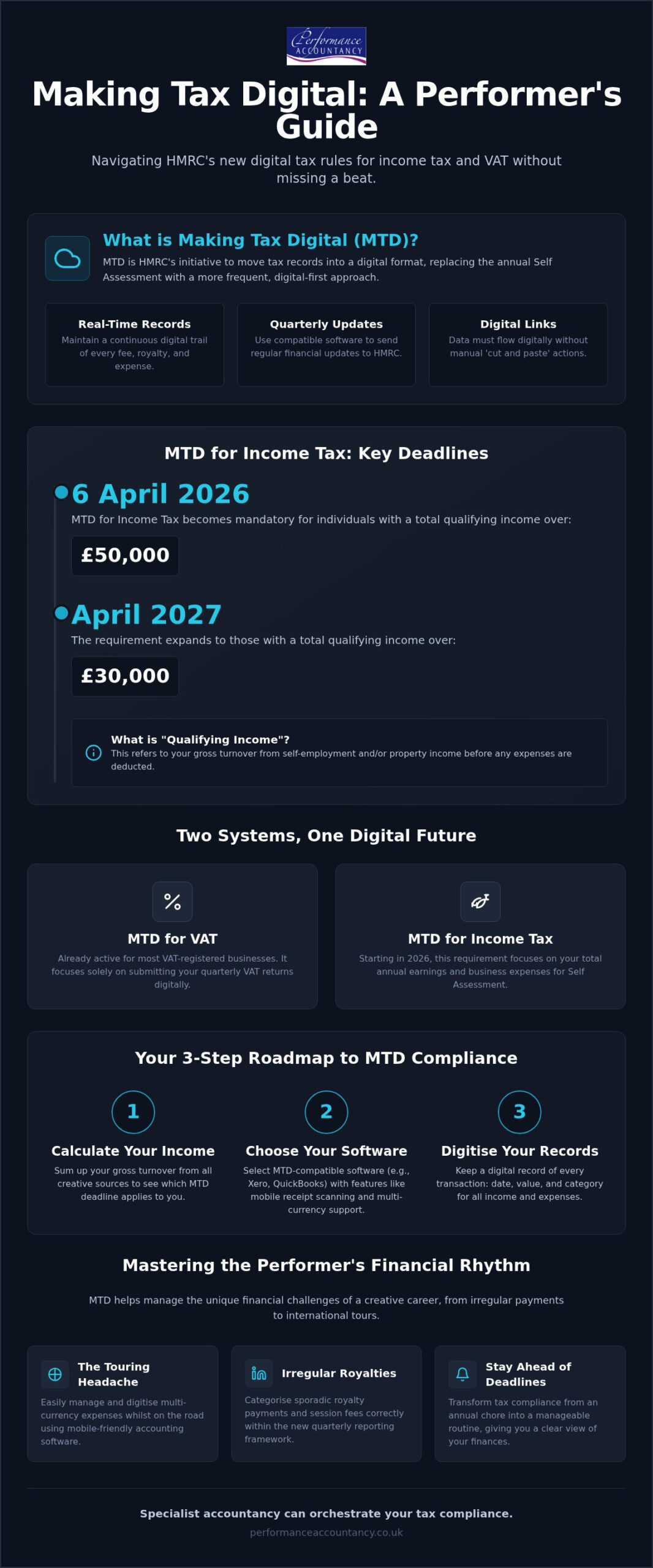
HMRC is fundamentally changing how creative professionals report their earnings. Making Tax Digital (MTD) is the official initiative to move all tax records into a digital format, replacing the traditional annual Self Assessment with a more frequent, digital-first approach. For performers, this means your financial records must be kept in real-time using functional, compatible software. This isn’t just about filing a return; it’s about maintaining a continuous digital trail of every fee, royalty, and expense you incur.
The performing arts sector demands a more tailored approach than a standard office-based business. Your income streams are often irregular, consisting of royalties, session fees, and performance contracts that may span different tax years. Managing mtd for vat for performers requires understanding how these unique payments fit into a digital framework. The core requirement is simple: you must use software to send quarterly updates to HMRC, ensuring your digital records are a true reflection of your professional activities without the need for manual data entry.
The 2026 Deadlines: When Does it Affect You?
The countdown has begun. On 6 April 2026, the first phase of MTD for Income Tax Self Assessment (ITSA) becomes mandatory for those with a qualifying income over £50,000. By April 2027, this expands to anyone earning over £30,000. Keep in mind that “qualifying income” refers to your gross turnover before expenses are deducted. Waiting until the last minute often leads to a frantic backstage scramble. Organising your digital records early ensures you aren’t caught out when the curtain rises on these new regulations.
MTD for VAT vs. MTD for Income Tax
Understanding the distinction between these two requirements is essential for a smooth transition. If you are already VAT-registered, you are likely already using mtd for vat for performers to submit your quarterly returns. MTD for Income Tax is a separate requirement that focuses on your total annual earnings and business expenses. Over time, these two systems will harmonise, creating a unified digital strategy for all your tax liabilities. This integration helps prevent errors and provides a clearer picture of your financial health, allowing you to spend less time on admin and more time on your craft.
The Transition from Paper to Digital Bookkeeping
For years, many performers have relied on a trusty spreadsheet or a physical folder of receipts to survive the January tax season. Under the new HMRC regime, these manual methods are no longer sufficient. The shift to digital bookkeeping isn’t just a technical change; it’s a move toward “digital links.” This means that once a piece of data is recorded, it must flow through to HMRC without any manual intervention or “cut and paste” actions. According to the official guidance on MTD for VAT, your software must be capable of creating these unbroken chains of information.
Transitioning to digital provides a clearer picture of your financial performance in real-time. Instead of waiting until the end of the tax year to see if your tour was actually profitable, you can monitor your margins as you go. This changes the emotional experience of tax from a once-a-year panic into a steady, manageable quarterly rhythm. It’s like rehearsal; frequent, small sessions are always more effective than a single, high-stakes cramming session before opening night. Embracing mtd for vat for performers early allows you to refine your financial rhythm before the 2026 mandates begin.
Choosing the Right Software for Your Craft
For a freelance creative, the best software is one that lives in your pocket. You need mobile receipt scanning to capture expenses for instrument strings or train tickets the moment you buy them. If you are already managing your accounts, you might consider platforms like Xero or QuickBooks. For those who prefer to keep their bespoke Excel sheets, “bridging software” can act as the digital link required to send your totals to HMRC, though it lacks the real-time insights of a full cloud-based suite. Your software must also be robust enough to handle foreign performance fees and currency conversions if you work internationally.
Digital Record-Keeping: What You Must Store
You must store a digital record of every transaction, including the date, value, and tax category. This applies to everything from large commission fees to small costs like stage makeup or costume repairs. While you can keep the original paper receipts, the digital version is what counts for compliance. In the context of HMRC’s 2026 requirements, a digital record is a permanent, electronic entry of a financial transaction that remains linked within your accounting software until it reaches the tax authorities. If you’re feeling overwhelmed by the technical setup, our team can help you organise your digital bookkeeping to suit your specific performance schedule.
Navigating the Creative Rhythm: Royalties, Tours, and MTD
Creative income rarely follows a steady beat. One month you’re managing a windfall from a streaming royalty cheque, and the next, you’re navigating a lean period between contracts. This irregular pulse is exactly why the rigid quarterly structure of Making Tax Digital can feel intimidating. However, the system is designed to handle these fluctuations. When recording royalties, it’s vital to categorise them correctly within your software to ensure your quarterly summaries reflect your actual cash flow rather than just a random spike in earnings. Proper digital tagging ensures that HMRC sees the context of your income, rather than just the raw numbers.
Managing the “touring headache” is another area where digital tools prove their worth. When you’re hopping between venues in Paris, Berlin, and London, keeping track of expenses in Euros and Pounds can become a logistical nightmare. Digital bookkeeping software simplifies this by automatically converting foreign currency transactions using the correct exchange rates. This ensures your records for mtd for vat for performers remain accurate without you having to manually calculate every coffee or train ticket bought abroad. It turns a mountain of crumpled receipts into a streamlined digital trail.
A common pitfall for performers is the treatment of agent fees. If your agent takes a 20% cut before the money hits your bank account, you must record the gross performance fee as income and the commission as an expense. Recording only the net amount received creates a mismatch between your digital records and your contracts, which could trigger an HMRC inquiry. Similarly, mixed-use expenses like home studios or rehearsal spaces require careful digital tagging. Your software should allow you to split these costs easily, ensuring you only claim the professional portion of your rent or utilities. This precision protects you whilst ensuring you claim every penny you’re entitled to.
Quarterly Updates: Not a Full Tax Return
It’s a common misconception that every quarterly update is a high-stakes final declaration. In reality, these are merely digital summaries of your income and expenses for that three-month period. Think of them as progress reports rather than a final exam. By submitting these regular snapshots, you gain a clearer forecast of your eventual tax bill. This prevents the traditional “January surprise” where you’re suddenly hit with a liability you hadn’t budgeted for. The Final Declaration, which happens after your fourth quarter, is where you make any necessary adjustments and claim your final reliefs.
International Performance and VAT
Working abroad introduces complex “Place of Supply” rules that can baffle even the most organised creative. Digital tracking makes it significantly easier to identify where your services were technically performed and whether UK VAT applies. For those already using mtd for vat for performers, your software can help manage VAT on international touring costs and track any withholding tax deducted by foreign jurisdictions. This level of digital transparency ensures you don’t overpay tax or miss out on reclaiming legitimate business costs incurred while working on the global stage.
Practical Steps to Get MTD Ready for 2026
The transition to a digital-first tax system doesn’t have to be a solo performance. Getting ready for the 2026 mandate begins with a clear-eyed review of your total qualifying income. This figure includes everything you earn from self-employment, whether it’s performance fees, private teaching, or income from a rental property. Remember, HMRC looks at your gross turnover, not your final profit. If your total income from these sources exceeds £50,000, you must be ready for the first phase on 6 April 2026. For those earning over £30,000, your start date follows on 6 April 2027. Identifying your category now prevents a last-minute scramble when the deadline looms.
Selecting the right tools is your next priority. You need MTD-compatible software that fits a life spent in rehearsals and on trains. A dedicated business bank account is also essential. By separating your personal grocery shops from your professional costume repairs, you create a clean digital feed that flows directly into your accounting software. This simple move eliminates hours of manual sorting later. If you’re unsure which platform suits your specific needs, our team provides specialist MTD IT support for performers to help you find the perfect fit.
The “On-the-Road” Bookkeeping Strategy
Bookkeeping shouldn’t feel like a second job. The most effective strategy for busy creatives is to digitise as you go. Use mobile apps to scan receipts immediately after an audition or a performance. Making this a habit prevents the “shoe-box syndrome” where paperwork piles up until it becomes overwhelming. Set aside ten minutes each week to curate your digital transactions and ensure everything is categorised correctly. If you’re touring in areas with poor internet connectivity, most modern software will store your scans locally and sync them once you’re back on the grid.
Avoiding Common MTD Pitfalls
The biggest risk to a smooth transition is maintaining “fragmented records.” Keeping some expenses on paper and others in an app breaks the digital link that HMRC requires. This inconsistency makes mtd for vat for performers far more difficult to manage and increases the risk of errors. You should also be aware of the new points-based penalty system. Whilst HMRC has announced a grace period for the 2026/27 tax year regarding late quarterly updates, a £200 penalty will apply once you accumulate four points from 2027/28 onwards. Staying organised from day one is the best way to protect your finances and your creative time.
How Performance Accountancy Orchestrates Your Tax
Performance Accountancy isn’t your typical high-street firm. Our founder’s background in professional opera means we speak your language and understand the unique cadence of a creative career. We know that your “business” doesn’t happen in an office; it happens in rehearsal rooms, on sound stages, and in concert halls across the globe. This specialist insider perspective allows us to translate rigid HMRC requirements into a manageable rhythm that fits your lifestyle. We don’t just provide a service; we act as a protective guardian of your financial accuracy, ensuring that the complexities of tax never dim your creative spark.
Our tailored support covers the entire digital journey. We assist with the initial software selection and setup, ensuring your digital feeds are correctly linked to your business accounts. From there, we manage the technical crescendo of your quarterly submissions and final declarations. By taking the lead on mtd for vat for performers and the upcoming income tax changes, we free you to focus on your next role or concert. You won’t need to spend your downtime deciphering accountant-speak. We provide the clarity you need to move forward with confidence, knowing your compliance is in expert hands.
Specialist Support for ISM Members
We are proud to provide dedicated ISM member accounting services, offering a bespoke level of support to members of the Incorporated Society of Musicians. This partnership allows us to integrate specialist industry knowledge directly into your digital tax strategy. We understand the specific nuances of music-related expenses, from instrument insurance to professional subscriptions. Having a peer who understands the irregular nature of session fees and performance contracts provides a level of peace of mind that generic firms simply cannot match. It’s about more than just numbers; it’s about shared values and a deep respect for the arts.
Beyond MTD: Holistic Financial Support for Artists
Digital record-keeping is a powerful tool for your long-term career planning. The data gathered through MTD allows us to provide better advice on whether transitioning to a limited company is the right move for your growing career. We use these real-time insights to help you plan for the “gaps” between contracts, ensuring you have a clear picture of your financial health throughout the year. Whether you need assistance with limited company accounts or a simple self-assessment, we ensure your finances are as polished as your performance. You can organise your digital tax with Performance Accountancy today and get back to what you do best.
Master Your Digital Debut
The shift to Making Tax Digital represents a significant change in the rhythm of your professional life, but it doesn’t have to be a source of anxiety. By understanding the 2026 deadlines and moving away from fragmented paper records now, you protect your creative time and your peace of mind. Remember that qualifying income includes all your professional streams; maintaining unbroken digital links is the key to staying on HMRC’s good side. Transitioning early allows you to refine your bookkeeping habit before the spotlight of mandatory compliance truly shines.
Whether you’re already managing mtd for vat for performers or preparing for the new income tax mandates, having a specialist insider in your corner makes all the difference. As a Chartered Accountant with a professional operatic background, I understand the unique challenges of a life on stage. We provide expert MTD transition support tailored specifically to the performing arts, translating complex regulations into clear, manageable steps. Let us handle the digital drama—contact Performance Accountancy today. You’ve spent years perfecting your craft; let us ensure your finances are just as polished. Your next great performance deserves your full attention.
Frequently Asked Questions
Do I need to sign up for MTD if I am already VAT registered?
Yes, you must already be signed up for Making Tax Digital for VAT if you are registered. While MTD for Income Tax is the new requirement for 2026, the VAT rules have been mandatory for some time. If you’ve been filing manually, you need to switch to compatible software immediately to avoid penalties. This ensures your records meet the digital link requirements HMRC expects from every creative professional.
Can I still use spreadsheets for my music business under MTD?
You can still use spreadsheets, but they must be connected to HMRC via bridging software. This software acts as the digital link required to transmit your data without manual copying. However, many performers find that dedicated accounting apps offer better real-time insights into their touring profitability. It’s often easier to ditch the complex formulas in favour of a system that automates the heavy lifting for you.
What happens if I miss a quarterly update deadline?
HMRC is introducing a points-based penalty system for late submissions. For the 2026/27 tax year, there is a grace period where penalty points won’t be issued for late quarterly updates. From April 2027, you’ll accumulate one point for each missed deadline. Once you hit four points, a £200 fine is triggered. Staying organised early helps you avoid these unnecessary costs whilst you focus on your rehearsals.
How much does MTD-compliant software typically cost for a freelancer?
Costs for MTD-compliant software vary depending on the features you need, such as multi-currency support for international tours. Most basic packages for freelancers range from £10 to £30 per month. Some providers offer stripped-back versions specifically for sole traders with simpler requirements. It’s a small investment that pays off by reducing the time you spend on admin and ensuring your digital records are fully compliant with HMRC standards.
Does MTD for Income Tax change how much tax I actually pay?
No, the new rules only change how and when you report your income, not the final calculation of your tax bill. Your total liability is still based on your annual profits and the standard tax bands. The main benefit is that quarterly updates give you a clearer view of what you owe throughout the tax year. This helps you set aside the right amount, preventing a financial headache when the final payment deadline arrives.
I am an actor with multiple small income streams; how does MTD apply to me?
MTD applies based on your total qualifying income from all self-employed sources combined. If your income from acting, teaching, and commercial work exceeds the £50,000 threshold in 2026, you must comply. It doesn’t matter if each individual stream is small; it’s the aggregate gross turnover that counts. We can help you consolidate these various streams into a single, organised digital record that satisfies the requirements for mtd for vat for performers.
Can my accountant submit my MTD updates on my behalf?
Yes, your accountant can manage and submit your quarterly updates for you. This is often the most reassuring path for busy performers who would rather spend their time on stage than in a spreadsheet. We can set up the digital links between your bank feed and our software, allowing us to review and file your summaries accurately. It ensures your compliance is handled by a specialist who understands the nuances of the arts.
What are the exemptions from Making Tax Digital for performers?
Exemptions are quite limited and usually apply only to those who are “digitally excluded” due to age, disability, or remote location. If your qualifying income remains below the £30,000 threshold by 2027, you won’t be required to join MTD for Income Tax yet. However, mtd for vat for performers has no lower threshold; if you are VAT registered, you must comply regardless of your annual turnover.