
Imagine opening an envelope from HMRC just as your latest tour ends, only to find a “Payment on Account” bill demanding half of next year’s tax before you have even booked your next gig. It is a heart-sinking moment that many creatives know all too well. We understand that life in the performing arts rarely follows the steady beat of a monthly salary. Mastering irregular income tax management UK is about more than just compliance; it is about protecting your peace of mind whilst you focus on your craft. You shouldn’t have to choose between your rent and the taxman simply because your income flows in unpredictable peaks and troughs.
This guide provides a clear roadmap to help you navigate the “feast or famine” cycle with the precision of a well-rehearsed score. You will learn how to build a foolproof system for setting aside tax money, identify the professional expenses that actually reduce your bill, and ensure you never face an HMRC penalty again. We will break down the 2026/2027 tax thresholds and digital record-keeping requirements, showing you how to transform financial chaos into a structured path toward stability and higher take-home pay.
Key Takeaways
- Understand why the “feast or famine” cycle of creative work requires a tailored approach to ensure your financial stability matches your artistic passion.
- Learn how to navigate the “Payment on Account” system so you are never blindsided by unexpected tax bills during a quiet period between gigs.
- Discover the “Three Pot” strategy for irregular income tax management UK, helping you organise your earnings for tax, living costs, and career reinvestment.
- Identify commonly overlooked allowable expenses specifically for performers, from agent fees to professional insurance, to maximise your take-home pay.
- Recognise the benefits of partnering with a specialist accountant who understands the unique professional landscape for ISM and Equity members.
Mastering the Rhythm: Why Irregular Income Tax Management Matters
The life of a performing artist is rarely a steady metronome. It’s a series of crescendos and silences, where one month you’re headlining a West End production and the next you’re waiting for the phone to ring. This “feast or famine” reality makes irregular income tax management UK a vital skill rather than a chore. Most financial advice is built for the 9-to-5 worker who receives a predictable payslip every month, but for musicians, actors, and dancers, the pulse of income is far more erratic. When your earnings fluctuate wildly, a standard “save 20 percent” model often falls short. It fails to account for the personal allowance or the sudden jump into higher tax bands during a particularly successful tour.
Financial unpredictability carries a heavy psychological weight. The constant “headache” of wondering if you’ve saved enough for HMRC can stifle the very creativity that fuels your career. True creative freedom doesn’t come from ignoring the numbers; it comes from building a structure that supports your art. By adopting a proactive approach, you transform tax from a looming shadow into a manageable part of your professional rhythm. It is about taking something chaotic and refining it into an organised system that protects your peace of mind whilst you are on stage or in the rehearsal room.
The Perils of the “Gig-to-Gig” Mindset
It is easy to treat a large performance fee as pure profit, especially if it arrives after a lean period. However, spending your gross income during the “feast” months is a dangerous game. This mindset often leads to “famine” tax debts where you’re forced to pay for last year’s success with this year’s empty pockets. The timing of performance fees rarely aligns with HMRC’s rigid deadlines. You might receive a significant payout in April, but the tax isn’t due until the following January. Without a dedicated strategy for irregular income tax management UK, that money often vanishes into daily living costs or tour expenses long before the taxman comes calling. Ignoring your tax obligations whilst focused on a demanding touring schedule is a recipe for a stressful January.
HMRC and the Creative Professional
HMRC maintains a very clear boundary: regardless of your artistic passion, they view you as a business. To them, your sheet music is a business asset and your performance fee is turnover. This requires a shift in perspective. You must maintain business-like records even when your “office” is a dressing room or a recording studio. A foundational step in this process is understanding the UK tax return system and how it uniquely affects those with non-linear earnings. Specialist accounting serves as the bridge between your creative world and the rigid world of compliance. It ensures that your records are not just accurate, but tailored to the specific nuances of the performing arts, moving you from a state of confusion to one of organised calm.
The Payment on Account Trap: Understanding HMRC’s Timing
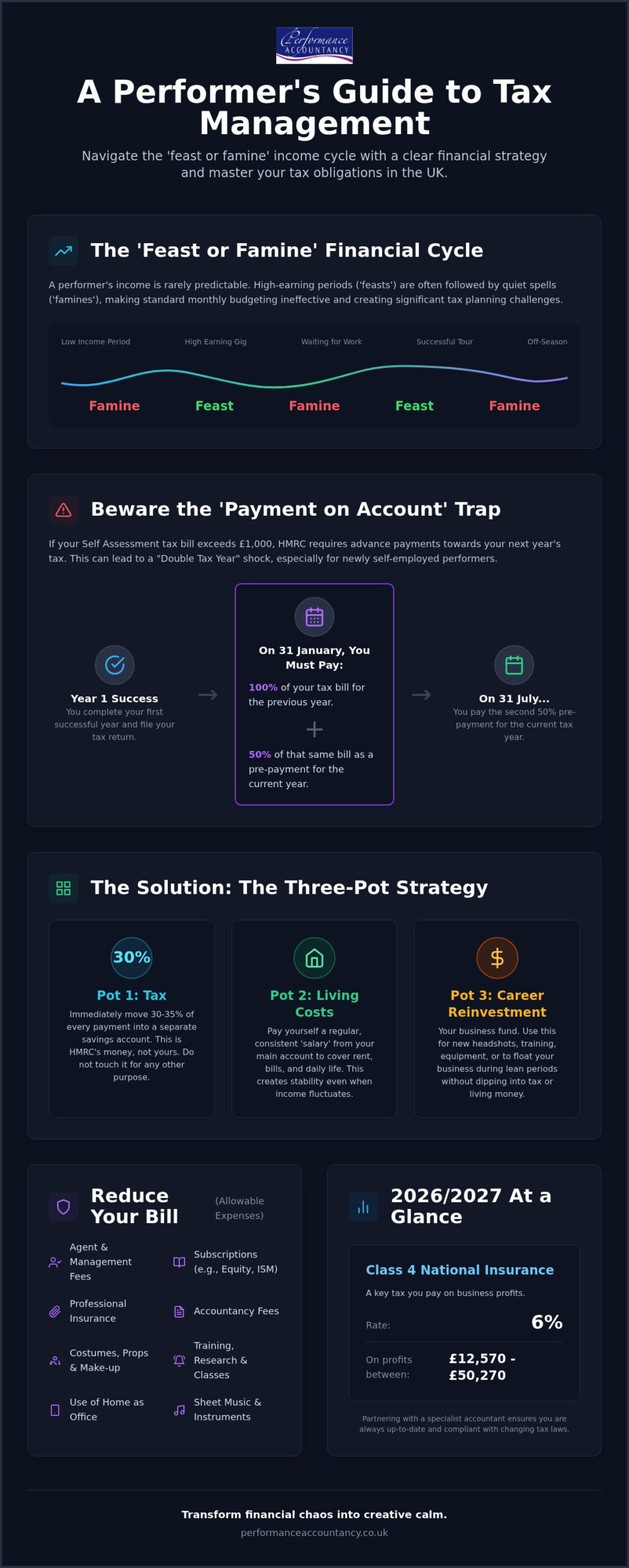
For many performers, the first major tax bill feels less like a routine administrative task and more like a sudden, jarring stage direction you didn’t prepare for. The Payment on Account system is essentially HMRC’s way of asking for your tax before you have even earned the money. If your self-assessment tax bill is more than £1,000, you are typically required to pay two instalments toward your next year’s bill. Each payment is half of your previous year’s tax total. For those still mastering irregular income tax management UK, this creates a significant cash-flow shock known as the “Double Tax Year.”
This phenomenon hits new freelancers particularly hard. In your first year of significant earnings, you aren’t just paying for the year that has passed. On 31 January, you must pay 100% of your previous year’s tax, plus an additional 50% as a down payment for the current year. When you add Class 4 National Insurance, which is 6% on profits between £12,570 and £50,270 for the 2026/2027 tax year, the total amount due can be staggering. Without a rehearsed strategy to set aside these funds, your creative career can feel like it is constantly playing catch-up with the treasury.
The 31st January and 31st July Cycle
The tax calendar moves with a rigid cadence that ignores the fluid nature of the performing arts. By midnight on 31 January 2027, you must pay your balancing payment for the 2025/26 year and your first payment on account for 2026/27. The second payment on account is due by midnight on 31 July 2027. This July date is a common pitfall for touring artists or those at summer festivals. Missing these deadlines is a costly mistake. HMRC applies late payment interest immediately, and penalties increase the longer the debt remains. Consulting official HMRC guidance on Self Assessment can help you track these dates, but building the habit of saving as you earn is what ultimately secures your stability.
When to Ask for a Reduction
There are moments when your income drops significantly. Perhaps a long-running contract ended, a tour was postponed, or you took time off for professional development. In these instances, you have the right to ask HMRC to reduce your payments on account. This can provide immediate financial relief, but it must be handled with care. If you under-estimate your income and reduce your payments too far, HMRC will charge interest on the shortfall once your actual return is filed. A specialist who manages Self-Assessment Tax Returns can help you calculate a realistic figure. This proactive step ensures you keep more of your money during lean months whilst avoiding the “interest trap” that catches many unguided professionals.
Strategic Cash Flow: Organising Your Finances Between Gigs
Managing your finances when your income arrives in bursts requires a shift from “spending what is in the bank” to acting as your own payroll department. The most effective irregular income tax management UK strategy is the “Three Pot” system. This method treats every performance fee not as a windfall, but as a resource to be divided. By splitting every payment the moment it hits your account, you create a buffer that protects your art from the volatility of your bank balance.
Instead of a generic savings goal, you should calculate an “Effective Tax Rate” tailored to your specific earnings bracket. A flat 20% often leaves performers short, as it ignores Class 4 National Insurance contributions (currently 6% on profits between £12,570 and £50,270) and the potential jump into the 40% higher-rate band. Setting aside 25% to 30% of every fee into a dedicated tax pot ensures that when the January deadline arrives, the funds are already waiting in the wings. For more detailed rules on what you owe, you can refer to HMRC guidance on self-employment to stay ahead of the curve.
- Pot 1: The Salary Pot. This is your “clean” money for rent, bills, and groceries.
- Pot 2: The Tax Pot. This is untouchable, holding your Income Tax and National Insurance.
- Pot 3: The Reinvestment Pot. A fund for new headshots, instrument repairs, or masterclasses.
The Digital Transformation of Bookkeeping
Transitioning to digital record-keeping is no longer just a “good idea”; it is becoming a regulatory necessity. From April 2026, self-employed individuals with a turnover of £50,000 or more must comply with Making Tax Digital (MTD) for Income Tax. This involves keeping digital records and submitting quarterly updates to HMRC. For a touring musician, paper receipts are a liability. Using MTD-compliant software or apps allows you to snap photos of receipts in real-time, ensuring that a coffee bought at a service station in Leeds doesn’t become a missed deduction in London. This shift from manual to digital creates a clear, audit-proof trail of your professional life. If you need step-by-step guidance on navigating the HMRC portal and MTD requirements, our self assessment help for musicians guide to HMRC login and filing walks you through the entire process.
Building a Financial Buffer
Maximising Reliefs: Allowable Expenses for the Performing Arts
Reducing your tax bill is the most direct way to keep more of your performance fees. In the context of irregular income tax management UK, understanding what you can legally deduct is just as important as saving for the bill itself. HMRC’s golden rule is that an expense must be “wholly and exclusively” for your trade. Whilst this sounds simple, the performing arts often blur the lines between personal and professional life. A generalist accountant might suggest claiming for stationery, but they might miss the cost of your Spotlight membership or the commission paid to your agent.
Agent and booking fees are almost always deductible. So are professional insurance policies for your instruments or public liability. Travel costs to auditions, rehearsals, and performances are also allowable, provided they aren’t part of a regular commute to a permanent place of work. Subsistence, which is the cost of meals whilst away from home on tour, can also be claimed. These deductions add up quickly. They significantly lower your taxable profit and ensure your hard-earned income stays in your pocket rather than HMRC’s.
The nuance of “dual-purpose” items often causes the most confusion. Stage makeup and costumes that you only wear for performances are deductible. However, everyday clothing or a haircut that you might also wear to a dinner party usually isn’t, even if you bought it specifically for a role. This is where the expertise of a specialist comes in. We understand the specific demands of the stage and screen, helping you navigate these grey areas with confidence. If you want to ensure you aren’t leaving money on the table, our team provides expert tax returns for Musicians, Opera Singers, and actors tailored to these industry specifics.
The Performer’s Expense Checklist
Keeping a running list of your professional outgoings prevents a last-minute scramble in January. Beyond the obvious travel and costumes, consider these commonly overlooked items:
- Professional Subscriptions: Membership fees for ISM, Equity, or specialised casting sites.
- Sheet Music and Scripts: Any materials purchased for rehearsals, auditions, or study.
- Instrument Maintenance: Tuning, repairs, strings, and rehearsal space hire.
- Home Office: A proportion of your household bills if you use a room for practice, score study, or administrative work.
Capital Allowances and Large Purchases
When you invest in high-value equipment, such as a grand piano, a professional cello, or a high-end recording studio setup, the rules shift from simple expenses to capital allowances. Instead of deducting the full cost from one year’s income, you might spread the relief over several years through depreciation. However, many performers can benefit from the Annual Investment Allowance. For the 2026 tax year, the Annual Investment Allowance is a relief that allows you to deduct the full cost of qualifying plant and machinery, such as instruments and equipment, from your profits before tax up to a specified limit.
Professional Harmony: How Specialist Accounting Secures Your Future
A generalist accountant might be excellent at balancing the books for a local café, but they often lack the “ear” for the complex rhythms of a performer’s life. When your income is a mosaic of royalties, performance fees, and teaching work, a standard approach simply won’t suffice. Effective irregular income tax management UK requires an accountant who understands that your professional world doesn’t have a fixed location or a predictable schedule. We help you move away from “survival mode”—where you’re constantly reacting to the next HMRC letter—toward a state of proactive financial planning. This shift allows you to view your finances not as a source of anxiety, but as a structured support system for your art.
By refining the chaotic flow of receipts and invoices into an organised system, you gain more than just tax savings; you gain the creative freedom to focus on your next role. Whether you are considering the transition to Limited Company Accounts or need to navigate the complexities of VAT returns for international touring, having a specialist partner ensures you aren’t playing a guessing game with your livelihood. We take the administrative “headache” out of the equation, replacing confusion with a steady, logical path forward.
The Specialist Insider Advantage
Performance Accountancy is led by a Chartered Accountant with a genuine operatic background. This means we don’t just see numbers on a screen; we understand the rehearsals, the travel, and the unique pressures of the creative sector. We speak the language of the ISM and Equity, ensuring your tax returns reflect the reality of your professional life. This insider perspective is vital when navigating the specific nuances of the performing arts, such as the HMRC averaging rules that can help smooth out the tax impact of a particularly successful year. By combining professional authority with creative empathy, we act as a rigorous guardian of your financial accuracy whilst remaining a friendly guide through the regulatory landscape.
Next Steps for Your Tax Management
The path from financial overwhelm to organised calm starts with a single, decisive step. As the 31 January 2027 deadline approaches, now is the time to gather your digital records and review your strategy for irregular income tax management UK. Don’t wait for the “famine” period to address your finances; early preparation is the best defence against the “Payment on Account” trap. Organising your records now ensures you have a clear view of your effective tax rate before your next contract begins. If you are ready to move from confusion to clarity, scheduling a consultation to review your irregular income strategy is the most effective way to secure your financial future. Ensure your finances are as polished as your performance with Performance Accountancy.
Take Centre Stage with Financial Confidence
Mastering the rhythm of your career means more than just hitting the right notes on stage; it requires a robust system for irregular income tax management UK. We have explored how the “Three Pot” system can stabilise your cash flow and how identifying industry-specific expenses can significantly reduce your tax liability. By understanding the timing of HMRC’s deadlines, you can avoid the stress of unexpected bills and focus entirely on your next creative project.
As a Chartered Accountant led practice with deep roots in opera, theatre, and classical music, we understand the unique challenges of a life in the arts. Whether you need help with your Self-Assessment or are an ISM member looking for specialist accounting services, we are here to provide the structure you need. Book a consultation with our specialist arts accountants to ensure your finances are as polished as your performance. You deserve to pursue your passion without the constant “headache” of tax compliance.
Frequently Asked Questions
How much should I set aside for tax if my income is irregular?
You should aim to save between 25% and 30% of every performance fee to cover your liabilities safely. This percentage accounts for the 20% basic rate of Income Tax plus Class 4 National Insurance contributions, which are 6% on profits between £12,570 and £50,270 for the 2026/2027 tax year. Setting aside a higher amount during “feast” months ensures you aren’t left struggling when your income hits a seasonal lull.
Can I average my income over two years if I am a creative artist?
Yes, HMRC provides specific “averaging” rules for creators that allow you to smooth out your profits over two consecutive tax years. This is particularly useful if your income fluctuates by more than 25% year-on-year, perhaps due to a major contract or a quiet period of study. Averaging can prevent you from being pushed into a higher tax band in a single year, though the calculations are complex and often require specialist guidance.
What happens if I cannot afford my July Payment on Account?
You can apply to reduce your payments on account if you have a genuine reason to believe your profit for the current year will be lower than the previous one. This is a common part of irregular income tax management UK for performers whose contracts have ended or been delayed. You must be careful not to under-estimate too drastically, as HMRC will charge interest on any shortfall once your actual tax return is filed.
Is it better to be a sole trader or a limited company for my performance work?
Sole trader status is generally the most straightforward and cost-effective option for performers starting out or earning moderate amounts. Operating as a limited company can offer tax efficiencies if your profits are consistently high, but it brings significantly more administrative responsibilities and higher accountancy costs. The decision usually rests on your specific turnover, your plans for growth, and whether you need the protection of limited liability.
Do I need to register for VAT as a freelance musician or actor?
You only have a legal obligation to register for VAT if your taxable turnover exceeds the current threshold of £90,000 in a rolling 12-month period. Some performers choose to register voluntarily if they work primarily for VAT-registered organisations, as this allows them to reclaim the VAT paid on professional equipment and travel. However, voluntary registration adds a layer of quarterly paperwork that may not be worth the effort for everyone.
How does Making Tax Digital (MTD) affect performers with irregular income?
From April 2026, performers with a turnover of £50,000 or more must comply with MTD for Income Tax by keeping digital records and submitting quarterly updates. This shift means you can no longer wait until January to organise your finances; you’ll need a steady rhythm of digital bookkeeping throughout the year. Whilst it requires more frequent attention, MTD-compliant software provides a real-time view of your tax liability, helping you avoid end-of-year cash flow shocks. For a detailed walkthrough of how to navigate the HMRC login portal and meet your MTD obligations, our performance-ready guide to self assessment help for musicians covers every step of the filing process.
Can I claim for stage clothes and makeup on my tax return?
You can claim for clothing and makeup only if they are used “wholly and exclusively” for your professional performances. This includes specialised items like period costumes, evening wear for orchestral musicians, or heavy stage makeup that wouldn’t be used in daily life. Everyday clothing that could reasonably be worn off-stage is not an allowable expense, even if you bought it specifically for a role or an audition.
What records must I keep to satisfy HMRC during an audit?
HMRC requires you to keep organised records of all income and expenses for at least five years after the 31 January tax deadline. This includes invoices, digital receipts, bank statements, and records of any grants or royalties received. Maintaining a clear, chronological trail of your business transactions is essential for proving the “wholly and exclusively” nature of your claims should HMRC ever request a closer look at your accounts.