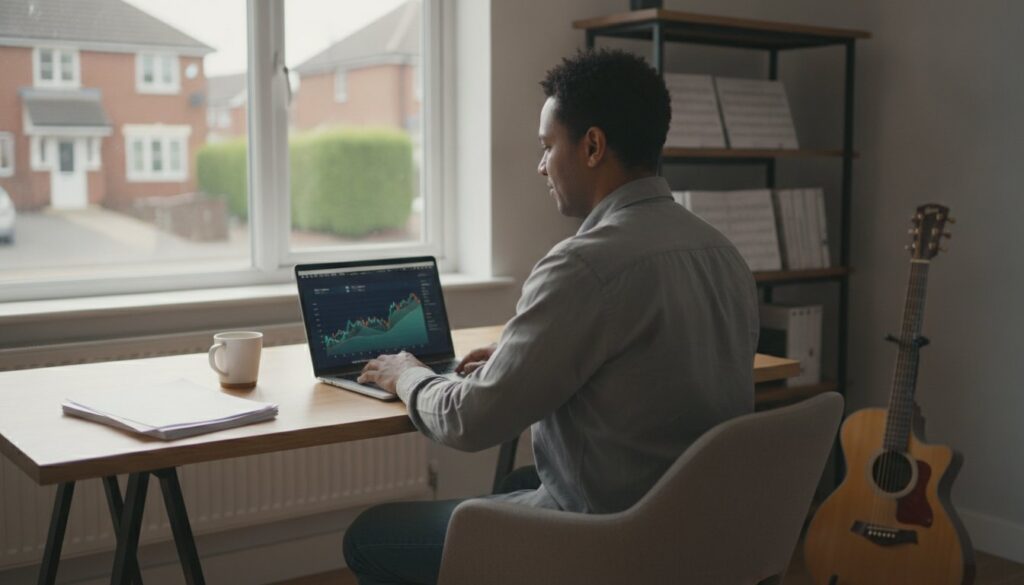
You’ve spent the morning perfecting a complex concerto in your spare room, but as you close the lid of the piano, a familiar anxiety creeps in. Is this space a professional studio in the eyes of HMRC, or just a bedroom with an expensive instrument in it? You probably didn’t join the profession to spend your evenings squinting at utility bills and floor space diagrams. It’s completely understandable that the intricacies of home office for musicians tax feel like a discordant note in your creative life, especially with the mandatory shift to Making Tax Digital for Income Tax starting in April 2026.
We’re here to help you find the right rhythm for your finances. This specialist guide is designed to help you master the art of claiming home office expenses, ensuring you maximise your tax relief whilst staying strictly compliant. We will provide a clear framework for choosing between the simplified flat rate and the actual costs method; we’ll also explain exactly how the new MTD requirements affect your quarterly reporting. By the end of this article, you’ll have the peace of mind that your practice room is working as hard for your bank balance as it does for your performance.
Key Takeaways
- Define exactly what qualifies as a workspace for performers and how the “wholly and exclusively” rule applies to your practice room or home studio.
- Compare the HMRC flat-rate scheme against the actual costs method to identify the most tax-efficient path for your specific living and working situation.
- Learn the precise formula for calculating the business proportion of your household bills to ensure your home office for musicians tax claim is robust and HMRC-compliant.
- Identify the “duality of purpose” risks that could invalidate your expenses or lead to unwanted Capital Gains Tax complications further down the line.
- Prepare for the 2026 Making Tax Digital transition by shifting from an annual tax return mindset to a streamlined, quarterly digital update process.
Setting the Stage: Can Musicians Claim Home Office Expenses?
For most professionals, a home office is a desk, a chair, and a laptop. For a musician, the reality is far more textured. Your “office” might be a soundproofed basement, a corner of the lounge where the harp lives, or a spare room filled with sheet music and recording gear. HMRC recognises that self-employed performers need a dedicated space to maintain their craft, meaning you can claim tax relief on the costs of running your home. However, the rules are governed by a strict principle: the expense must be incurred “wholly and exclusively” for the purpose of your trade. Understanding the nuances of home office for musicians tax is the first step toward ensuring you don’t leave money on the table or invite unnecessary scrutiny from the Revenue.
The Practice Room vs. The Admin Desk
It’s a common misconception that you can only claim for the time you spend on “admin” tasks like bookkeeping or digital marketing. In reality, your rehearsal space is a vital engine room for your career. Whether you’re mastering a difficult score or teaching a student via Zoom, that space is generating your professional income. If you use a room solely for music, the calculation is straightforward. If you use a dual-purpose space, such as a bedroom that doubles as a practice studio, you’ll need to apportion the costs based on the time spent working there. Business use within the home encompasses any activity essential to your professional output, from the pedagogical rigour of teaching a student to the private rehearsal time required for performance preparation.
HMRC’s Stance on Creative Workspaces
The “wholly and exclusively” rule remains the gold standard for compliance in 2026. This doesn’t mean a room must never be used for anything else; rather, it means you can only claim for the specific portion of costs that relate to your work. If you’re a freelancer, you have two primary routes: the Simplified Expenses method (a flat monthly rate) or the Actual Costs method (a detailed breakdown of bills). For those investing in high-end gear, you might also explore Capital Allowances for Equipment to offset the cost of instruments or recording hardware. Your eligibility depends heavily on your employment status. Whilst self-employed musicians have broad scope to claim, employees on fixed-term contracts face much tighter restrictions following the 2026 abolition of certain homeworking reliefs. Establishing your home as a genuine business centre is essential for protecting your claims during an enquiry.
Choosing Your Method: Simplified Expenses vs. Actual Costs
Deciding how to calculate your claim is like choosing between a solo recital and a full orchestral production. One is lean, straightforward, and requires minimal rehearsal; the other is complex and demanding but often results in a much richer outcome. When it comes to home office for musicians tax, HMRC offers two distinct paths. Your choice will depend on the tempo of your professional life at home and whether your “studio” is a dedicated creative sanctuary or a temporary setup on the dining table.
The Flat-Rate ‘Simplified’ Route
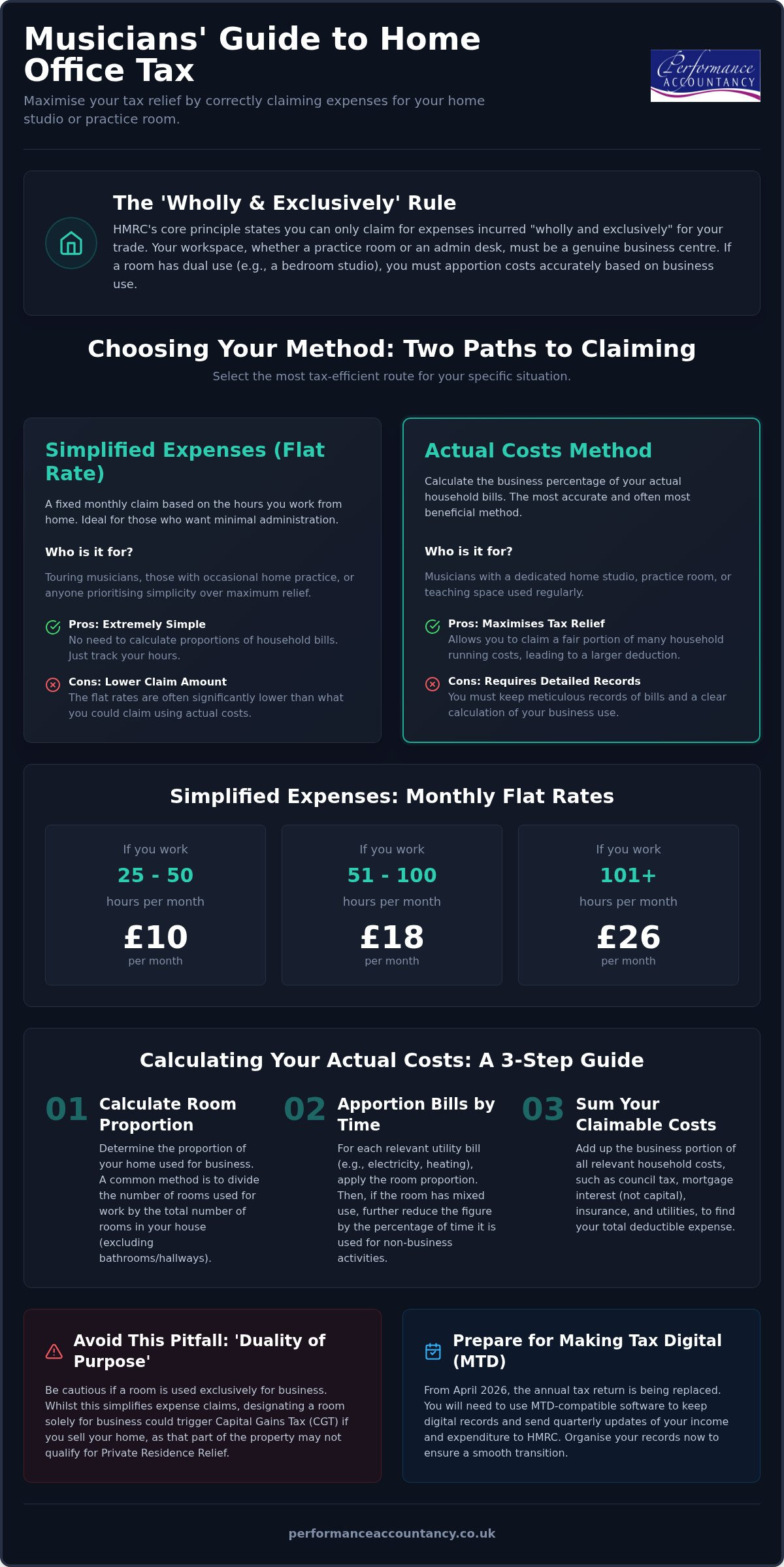
For those who prefer to keep their admin as light as a madrigal, the Simplified Expenses scheme is often the most attractive option. This method allows you to claim a flat monthly rate based on the number of hours you work from home each month, rather than meticulously tracking every utility bill. According to HMRC’s simplified expenses guidance, the rates for the 2026/27 tax year are tiered based on your usage. If you work between 25 and 50 hours a month, you can claim £10 per month. This rises to £18 for 51 to 100 hours, and £26 for those working 101 hours or more.
Whilst this approach is incredibly easy to manage, it’s often a blunt instrument. Many touring musicians default to this method because they spend significant time on the road and only use their home space for occasional practice or booking gigs. However, if your home is your primary workplace, these flat rates might not cover the true cost of your heating, lighting, and broadband. You trade maximum tax relief for the luxury of a simpler life.
The ‘Actual Costs’ Method for Dedicated Studios
If you have a room that is essentially a full-time practice room or recording studio, the “Actual Costs” method is almost certainly your best friend. This route allows you to claim a proportion of your actual household expenses, including rent, mortgage interest, council tax, and even repairs. It requires a bit more effort to calculate the business percentage of your home, but the financial rewards are usually far greater. This is particularly true for musicians who need to keep their studios heated and powered for long hours of teaching or recording.
Capturing these costs involves looking at your home as a whole and dividing the bills by the number of rooms or floor space used for work. Because utility prices remain high, the difference between a £26 monthly flat rate and a calculated percentage of a £300 energy bill can be substantial. If you find the prospect of these calculations a bit daunting, seeking specialist accounting for musicians can help you strike the right balance between compliance and maximum relief. The extra paperwork is usually worth the effort when it results in a significantly lower tax bill, providing much-needed financial harmony.
The ‘Actual Costs’ Calculation: A Step-by-Step Breakdown
Calculating your actual expenses can feel like reading a complex orchestral score for the first time. It looks daunting on the page, but there’s a clear, rhythmic logic to the arrangement once you understand the key. For many performers, this method is the most effective way to handle home office for musicians tax because it reflects the true cost of maintaining a professional workspace. Whether you’re soundproofing a basement or simply using a corner of the lounge, follow these five steps to find your total.
- Count your usable rooms: Identify every room in your home, excluding bathrooms, hallways, and kitchens.
- Assign business space: Decide which room, or what proportion of a room, is used for your musical work.
- Calculate time usage: If a room is dual-purpose, determine what percentage of the week it is used for professional practice or admin.
- Aggregate your bills: Total up your annual household expenditure, including utilities, insurance, and mortgage interest.
- Apply the percentage: Multiply your total bills by your business-use percentage to find your claimable amount.
The ‘Number of Rooms’ Formula
HMRC generally accepts a room-based calculation as a “fair and reasonable” way to divide your costs. To do this, you divide your total household bills by the number of usable rooms in your house. If you live in a five-room house (for example, three bedrooms, a lounge, and a dining room) and you use one bedroom exclusively as a studio, you start with a baseline claim of 20% of your bills. It’s a simple, elegant way to organise your figures.
However, many musicians use a room for both work and life. Let’s look at a practical scenario. Imagine you use one room in that five-room house as a practice space for 20 hours a week, but it serves as a guest bedroom the rest of the time. Your 20% room share is then adjusted by the time spent working. Since there are 168 hours in a week, and you work for 20, your final claim for that room would be approximately 2.4% of your total household bills. Accuracy here is vital for maintaining peace of mind during a potential HMRC enquiry.
What Bills Can You Actually Include?
The list of allowable expenses is broader than many realise, but it requires careful sorting. You can include a proportion of your rent or, if you’re a homeowner, the interest element of your mortgage. You cannot claim the capital repayment portion of your mortgage, as this is seen as an investment rather than a running cost. Council Tax and home insurance are also claimable, alongside your utilities like gas, electricity, and water. These costs have risen significantly, making the actual costs method increasingly attractive for those with high energy needs for recording gear or heating.
Broadband and telephone costs follow a similar logic. You’ll need to make a sensible estimate of your professional usage versus your personal “streaming and scrolling” time. If your career relies heavily on high-speed internet for remote sessions or teaching, ensure your records reflect this professional necessity. Organising these figures now will make the transition to quarterly digital updates much smoother as we approach 2026.
Avoiding the ‘Duality of Purpose’ Encore: Common Pitfalls
Mastering the “Duality of Purpose” rule feels like playing a difficult passage in an odd time signature. It is a balancing act. HMRC insists that for an expense to be deductible, it must be incurred solely for business. This creates a complex grey area for the performing artist whose home and workplace are inextricably linked. If your piano sits in the lounge, it serves as a tool for pedagogical rigour during the day and a centrepiece for family life in the evening. This dual usage doesn’t mean you can’t claim, but it does mean your documentation must be beyond reproach. The same principle applies beyond your home studio — understanding which costs qualify as audition expenses tax deductible in the UK is equally important for performers who regularly travel and prepare for work outside the home.
To satisfy an HMRC officer, you need to prove that your apportionment is fair. If you use the dining table for score study and admin, keep a simple log of those hours for a typical month. This evidence is vital when defending your home office for musicians tax claims. Precision is paramount. Without a clear record of when the “creative sanctuary” becomes a “domestic space”, the Revenue may argue that the primary purpose is private, potentially disqualifying the entire expense. If you feel overwhelmed by these distinctions, specialist tax support for musicians can help you categorise your space with confidence.
Soundproofing and Capital Allowances
The CGT Warning: Why ‘100% Business Use’ Might Hurt You
It is tempting to tell HMRC that your studio is used 100% for business to maximise your monthly relief. This is often a strategic mistake. If you designate a room as having no private use at all, you may lose a portion of your Private Residence Relief when you eventually sell your home. This could trigger a Capital Gains Tax (CGT) bill on the “business” percentage of your property’s value increase. Most specialist accountants recommend claiming for high business usage, perhaps 90%, whilst ensuring the room remains available for occasional domestic use. Keeping a guest bed or a bookshelf of non-music literature in the room is a simple way to maintain its dual-purpose status, protecting your long-term property investment whilst still securing significant short-term tax savings.
Organising Your Records for MTD: The Path to Tax Harmony
The traditional January scramble to tally up your home office for musicians tax claim is about to become a relic of the past. From 6 April 2026, the introduction of Making Tax Digital (MTD) for Income Tax marks the most significant change to the UK tax system in a generation. For self-employed musicians and performers with a qualifying income over £50,000, the old annual Self-Assessment return is being replaced by a more frequent, digital-first approach. This means providing HMRC with quarterly updates of your income and expenses, with the very first deadline falling on 7 August 2026.
This shift requires a new level of administrative discipline, but it doesn’t have to be a source of anxiety. Moving to a digital system ensures that your home office calculations are handled with precision throughout the year, rather than being guestimated at the eleventh hour. It’s about moving from a state of chaotic paperwork to a state of organised calm, allowing you to see a real-time picture of your tax liabilities and cash flow. Whilst the transition feels daunting, it provides a much clearer rhythm to your financial life.
MTD-Compliant Bookkeeping for Musicians
Manual spreadsheets and shoeboxes full of receipts will no longer satisfy HMRC’s requirements for digital record-keeping. You’ll need to utilise MTD-compatible software to track your household bills and professional expenses. This is actually a blessing in disguise for the busy performer. By using mobile apps to scan receipts for heat, light, and power as they arrive, you can instantly categorise the business portion of those costs. Modern accounting tools allow you to pre-set your home office percentage, automatically distilling your total expenditure into a compliant claim for each quarterly update. This automation reduces the administrative headache and ensures you never miss out on legitimate tax relief because of a lost utility bill.
Why Specialist Performance Accounting Matters
Navigating these regulatory changes is much easier when your accountant understands the difference between a rehearsal and a recording session. We don’t just see numbers; we see the irregular schedules and unique challenges of a creative career. As a practice led by a former opera singer, Performance Accountancy acts as a specialist insider, providing Chartered Accountant expertise tailored specifically for the performing arts. We are proud to support ISM members and performers across the UK, ensuring their transition to MTD is seamless and stress-free. Let us handle your Self-Assessment while you focus on the music, providing you with the peace of mind that your financial compliance is in expert hands.
Final Score: Achieving Financial Harmony in 2026
Securing the maximum relief for your workspace requires more than just a calculator; it demands a nuanced understanding of how your home functions as a creative engine room. Whether you choose the simplicity of flat rates or the precision of the actual costs method, the goal remains the same: protecting your hard-earned income whilst staying fully compliant. By mastering the home office for musicians tax rules now, you’ll be perfectly positioned for the mandatory shift to Making Tax Digital in April 2026. Moving from annual stress to quarterly digital clarity is the key to long-term financial stability.
As a Chartered Accountant led practice with specialist ISM member support, we understand the unique rhythm of the performing arts. We are here to bridge the gap between complex HMRC regulations and your creative career, providing expert guidance on MTD for Income Tax 2026. Book a consultation with our specialist arts accountants to ensure your finances are as finely tuned as your instrument. With the right systems in place, you can stop worrying about the paperwork and get back to the stage.
Frequently Asked Questions
Can I claim for my home office if I also rent a rehearsal studio?
Yes, you can still claim for a home office even if you rent external space for rehearsals. Many performers use an external studio for loud sessions but handle score study, admin, and lesson planning at home. As long as you can prove the “wholly and exclusively” nature of your home-based work, you are entitled to tax relief on that portion of your household costs. It is about where the work actually happens.
How do I calculate ‘hours worked at home’ for the simplified expenses method?
You calculate these hours by logging any time spent on professional activities, including practice, admin, and bookkeeping. For the home office for musicians tax simplified method, you only count hours where you are actively working. If you spend 60 hours a month rehearsing at home, you would qualify for the middle tier of £18 per month under the verified 2026/27 rates for 51 to 100 hours of work.
Does HMRC allow claims for cleaning costs of a home music studio?
HMRC allows you to claim for cleaning costs, provided they relate to your professional workspace. If you employ a cleaner for your whole house, you would apply your standard “business use” percentage to their total fee. For example, if your studio represents one room in a five-room house, you can claim 20% of the cleaning bill as a legitimate business expense to keep your workspace professional.
Can I claim for broadband if I only use it for downloading sheet music and admin?
Broadband is a claimable expense because it is essential for the modern professional musician’s career management. Even if you only use it for administrative tasks like downloading sheet music or managing your digital diary, you can claim a fair proportion of the bill. You must make a reasonable estimate of your business usage versus personal streaming to ensure your claim remains compliant with current HMRC guidance.
What happens if I use my home office for teaching private pupils?
Teaching pupils at home provides clear evidence of business usage and often justifies a higher claim for utilities. It establishes a “business centre” within your property, which is vital for the home office for musicians tax actual costs method. Ensure you log the specific hours spent teaching to support your apportionment calculations, as this activity clearly demonstrates that the space is being used for pedagogical purposes and professional income generation.
Is mortgage interest a legitimate home office expense for musicians?
Mortgage interest is a legitimate expense, but you cannot claim for the capital repayment part of your monthly bill. When calculating your actual costs, you must separate the interest from the principal repayment. This ensures you are only claiming for the cost of “using” the space rather than the cost of “buying” the asset. This distinction is critical for maintaining financial accuracy and protecting your claim during an enquiry.
How do I keep digital records for MTD if I don’t have a dedicated office?
You can maintain digital records for MTD by using compatible accounting software to categorise a percentage of your total household expenditure. Even without a dedicated room, you can scan your utility bills and apply a “fair and reasonable” percentage based on the time you spend working in shared spaces. This digital trail is essential for meeting the new 2026 quarterly update requirements for Income Tax Self Assessment.