Freelancers claiming use of home for business can usually deduct a fair, reasonable share of eligible household costs, based on how much of the home and how much time they use for work. Alternatively, if you work from home for at least 25 hours a month, HMRC’s simplified expenses rates are £10, £18 or £26 per month, depending on your hours.
It’s easy to assume that working at the kitchen table makes every household bill a business expense. The key to claiming use of home for business as a freelancer is separating business use from private use, so your claim reflects the work you actually do at home.
This guide explains which costs may qualify, how the space you use and the time you work affect the calculation, and what records to keep for Self Assessment. It also compares the flat-rate option with claiming actual costs, so you can choose a method that fits your freelance working pattern.
Key Takeaways
- Work out a fair business-use share of household costs, taking account of both the space used and time spent working there.
- If you work from home for 25 to 50 hours per month, HMRC’s simplified expenses rate is £10 per month.
- Separate business use from personal use when working out phone, broadband and other shared bills.
- Keep bills, receipts and working notes to support your figures if HMRC asks to see your records.
- Check whether you’re claiming as a sole trader or through a limited company, as the rules and methods differ.
What business expenses can you claim if you work from home?
Freelancers can claim eligible household costs in proportion to their business use, rather than treating the whole bill as a business expense. The calculation depends on the space used and the time spent working there.
Claimable household costs
Home-working costs may include a business share of rent, mortgage interest, council tax, utilities, internet and telephone bills. A fair claim can reduce your taxable profit, but personal use must stay out of the calculation.
If you have a mortgage, you can include the business proportion of the interest, not capital repayments. A tenant can claim a share of rent, but cannot treat their business as a separate tenant. For phone and broadband, base the claim on actual business use, not the room-based calculation used for household bills.
Apportioning costs between uses
Apportioning means dividing a household bill between business and private use using a fair, reasonable method. For heating and electricity, consider both the rooms used for work and how long those rooms are used for business.
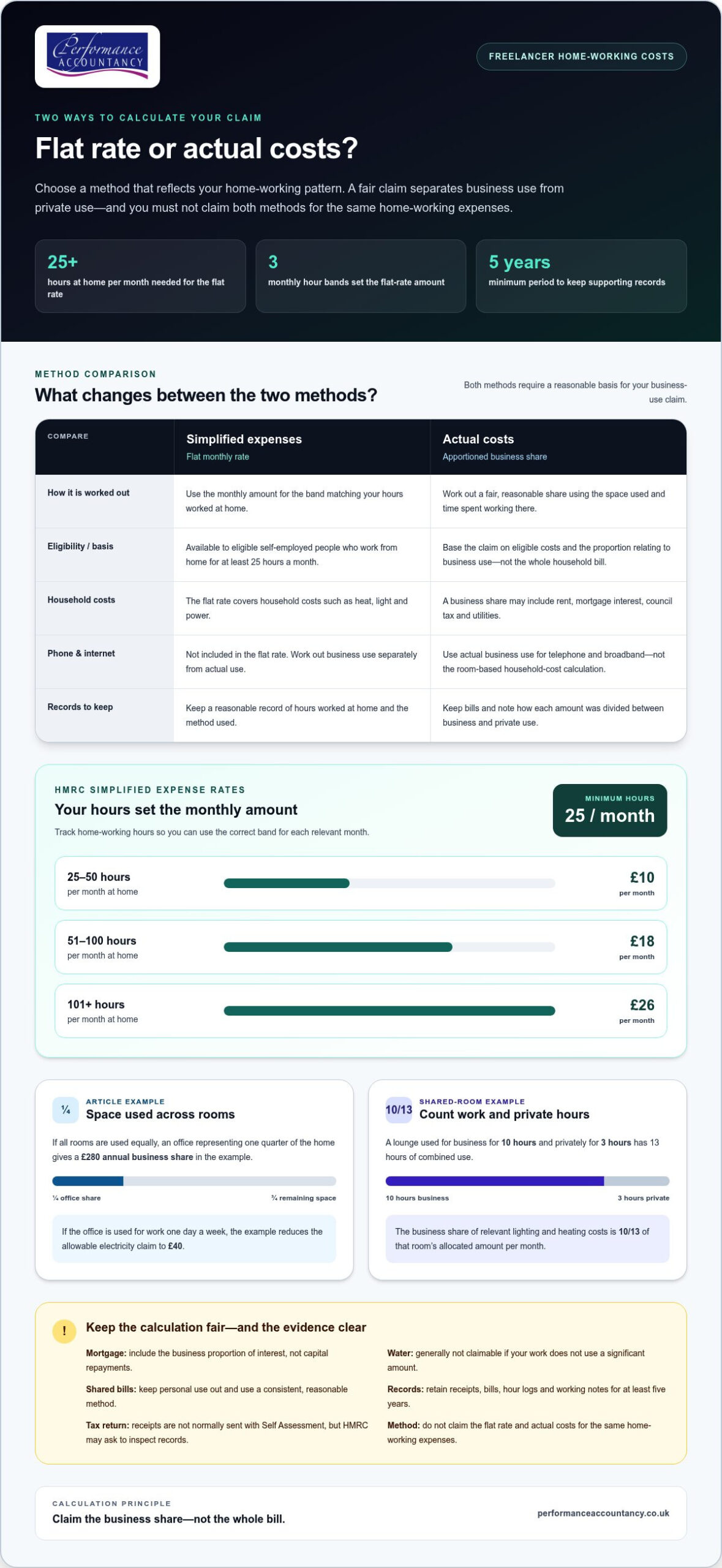
If all rooms are used equally, the office represents one quarter, giving a £280 annual business share. If the office is used for work one day a week, the example reduces the allowable electricity claim to £40.
For a shared room, count the hours it serves work and private life. If a lounge is used for business for 10 hours and privately for three, the business share of relevant lighting and heating costs is 10/13 of that room’s allocated amount per month. Keep the method consistent and record how you reached the proportion.
Can freelancers claim rent, mortgage interest, council tax, utilities and internet? Yes, you may claim a justifiable business proportion. Divide phone and broadband by actual business use. Household water is generally not claimable if your work does not use a significant amount.
What is the effect of claiming business use of home on capital gains tax when selling a home? If part of your home is used solely for business, capital gains tax may be due on that part when you sell. Shared use differs from setting aside a room exclusively for work.
Can claiming home business expenses affect your mortgage, home insurance or tenancy agreement? The tax calculation does not change those agreements. Distinguish a fair share of household costs from changing how you use the property, such as reserving a room solely for business.
Simplified expenses offer eligible home workers a flat-rate alternative to claiming actual costs. Whichever method you choose, make sure the figures reflect your working pattern and business share of costs, not simply the size of the bills. The next sections explain the flat-rate method, time-based calculations and records for your tax return.
Flat-rate home-working expenses
Simplified expenses give eligible self-employed people a flat-rate alternative to calculating actual household costs. The amount depends on how many hours they work from home, not the size of their bills.
Sole trader expense rules
A sole trader can use simplified expenses to claim a set amount for working from home instead of apportioning actual household costs. According to HM Revenue & Customs, this option is available only if you work from home for at least 25 hours a month.
The flat rate covers household costs such as heat, light and power. It does not include telephone or internet, so calculate the business share of those bills separately using actual use. This keeps allowable expenses aligned with the costs covered by the rate.
HM Revenue & Customs sets the home-working flat rate according to hours worked at home:
- For 25 to 50 hours per month, self-employed people can claim a simplified expense flat rate of £10 per month.
- For 51 to 100 hours per month, self-employed people can claim a simplified expense flat rate of £18 per month.
- For 101 or more hours per month, self-employed people can claim a simplified expense flat rate of £26 per month.
These rates are set by HM Revenue & Customs. Track your hours at home so you can use the right band for each relevant month, particularly if your freelance schedule changes between projects.
The flat rate can simplify your tax return, but it may not match the actual business share of your household costs. Compare the methods against your working pattern and eligible costs. Do not claim the flat rate and actual costs for the same home-working expenses.
Evidence for expense claims
Keep records showing your hours, chosen method and claim calculations. Even a flat-rate claim needs a reasonable record of the hours you work at home.
Keep a simple work-hour log alongside household bills and phone or internet statements. For actual-cost claims, retain the bills and note how you divided each amount between business and private use. Keep receipts, bills and supporting records for at least five years.
Freelancers do not normally send receipts with their Self Assessment tax return, but HMRC may ask to inspect records when checking it. A clear log and calculation provide a concise audit trail, rather than leaving you to reconstruct your claim from old calendars and inboxes.
If your creative work brings changing rehearsal, performance and home-working patterns, specialist tax support for creative freelancers can help organise the figures for Self Assessment.
Adjusting home cost claims for time spent working at home
Time spent working at home affects the business share of shared household costs. Sole traders can use simplified expenses, while limited companies need a costs-based calculation.
For a sole trader, the flat rate depends on monthly home-working hours: £10 for 25 to 50 hours, £18 for 51 to 100 hours, and £26 for 101 hours or more. These rates cover heat, light and power, not telephone or internet. Claim the business share of those bills separately using actual business use.
Record home-working hours consistently, especially when your freelance schedule changes between performances, rehearsals and administration. A monthly log can show which threshold applies, rather than relying on an estimate at the end of the accounting period. The simplified rate replaces the calculation of actual household running costs, it is not an extra claim on top.
A limited company cannot use the simplified expenses method for business use of home. It must calculate eligible costs, and a director can claim only expenses incurred entirely and solely for business reasons. According to HM Revenue & Customs, it will not challenge a limited company’s home-working cost claim of up to £6 per week, or £26 per month if paid monthly.
This HMRC figure is not the same as the sole-trader flat-rate bands. A company claim must relate to home-working costs, not personal expenses or unrelated business spending such as advertising. Keep the calculation separate in the company’s accounting records, together with its basis and supporting household costs.
How does occasional home working compare with a dedicated business room for tax claims? Occasional work in a shared room usually means apportioning costs by both room use and working time. A room reserved solely for business may support a larger space-based share, but exclusive business use can affect capital gains tax when you sell your home.
For actual costs, identify the eligible household bill, the business-use share of the premises and the time the space serves work. Mortgage interest may be included in the business proportion, but capital repayments cannot. For a shared phone or broadband service, use actual business use of the line, not the number of rooms.
Choose a method that suits your business structure and records. A sole trader can compare simplified expenses with actual costs, while a limited company needs to work from costs incurred for business. In either case, keep the hours log and calculation with relevant bills, so the claim has a clear trail for the tax return.
Keeping records and supporting evidence
A home-working claim needs a clear trail from household bills to the amount entered on your Self Assessment tax return. Freelancers do not normally submit receipts or other proof with the return, but HMRC may ask to inspect records when checking your figures.
Keep evidence of your costs and calculations together. A folder, spreadsheet or bookkeeping system can bring together bills, work-hour notes and the apportionment method used for each claim. Keep receipts, bills and supporting records for at least five years.
For each claim, make a record of:
- The household bill and the period it covers, such as an electricity bill or council tax statement.
- The total amount paid and the business proportion included in your expenses.
- The rooms used for work and how often you used each space for business.
- Your home-working hours, especially if you use a flat rate based on monthly hours.
- How you separated business phone or broadband use from personal use.
A short calculation note makes your figures easier to follow later. For actual costs, show the bill total, the space or time basis, and the resulting business share. If you use simplified expenses, record your hours worked from home each month and the rate band applied.
Keep records close to the activity they describe. For example, match an electricity bill to its calculation instead of relying on a year-end estimate. If your freelance schedule shifts between rehearsals, performances and home administration, note the working pattern for each relevant period.
Separate home-working costs from other business expenses and income in your bookkeeping. A dedicated household-cost category helps distinguish electricity, rent or council tax from equipment, travel or performance income. Use clear category names so each amount is easy to identify when preparing your tax return.
Phone and broadband need a separate business-use calculation because room-based apportionment does not determine their business share. Keep itemised bills or account statements with a note explaining how you identified work use. For example, a call record can help distinguish business calls from personal calls.
Use a consistent calculation method and keep the workings behind each figure. If you switch from actual costs to a flat rate, note when the method changed and retain records supporting each approach. This creates a clear trail from the original bill to the reported business expense, rather than leaving figures without context.
Sole trader and freelancer Self Assessment claims
For UK tax, a self-employed person is a sole trader or an individual in a business partnership. Owning and working alone in a limited company does not make you self-employed, so the company’s accounts and your personal Self Assessment have different roles. This distinction affects how you claim home-working costs.
Business expenses should relate to your trade, and mixed personal and business costs need to be apportioned reasonably. For household bills used for both personal and work purposes, claim only a reasonable, measurable business share. When claiming use of home for business as a freelancer, base the calculation on actual use, not on treating a room or bill as entirely business-related.
Telephone costs show how to separate mixed use. The allowable claim is £70, not the full bill. Apply the same principle to broadband: identify and record the work-related share instead of claiming personal use.
Your accounting method also affects equipment claims. A sole trader using cash-basis accounting can claim equipment and tools as allowable expenses. Under traditional accounting, equipment, machinery or business vehicles bought to keep for business use are claimed through capital allowances. Software used for less than two years, or paid through regular licence renewals, can be claimed as an expense.
Home costs can be claimed using simplified expenses by eligible sole traders and partnerships whose partners are all individuals. A limited company cannot use that simplified method. Compare the flat-rate home-working claim with actual costs, then choose the method that reflects your working pattern and records. Don’t claim the £1,000 trading allowance and expenses for the same income.
Enter allowable expenses in your Self Assessment tax return, which reports your business income and costs. Sole traders and freelancers report home-office expenses through the return annually, before the 31 January deadline. Keep the bills, hours records and workings that explain each amount, so your submitted figures match your supporting evidence.
Separate business costs from personal spending before completing your return. For a freelance performer, this might mean keeping home-working costs separate from travel to a usual workplace, which a sole trader cannot claim as a business expense. Everyday clothing and client hospitality are also not allowable expenses, even when connected with work.
Claiming use of home for business as a freelancer can also raise questions about how home costs fit alongside irregular creative income. Performance Accountancy offers Self-Assessment Tax Returns and Limited Company Accounts for performing arts professionals. If you need help preparing your return and organising the related figures, get support with your Self-Assessment Tax Return.
Performance Accountancy: Self-Assessment Tax Returns
Performance Accountancy supports performing arts professionals with Self-Assessment Tax Returns, including calculations for home-working expenses. If your income comes from a mix of performances, teaching and freelance work, we can help bring the figures together clearly.
Our tax returns for musicians, opera singers, actors, ballet dancers and conductors are tailored to those creative professions. For a limited company, Performance Accountancy also offers Limited Company Accounts and MTD IT, which cover different reporting responsibilities from a sole trader’s personal tax return.
If you’re ready to organise your return and home-working records, contact Performance Accountancy or visit performanceaccountancy.co.uk.
Make your next tax return easier to stage
Set up a simple routine for the next accounting period: keep home-working calculations with the records that explain them, and update them as your freelance pattern changes. This makes claiming use of home for business part of your regular admin, rather than a last-minute task before filing.
When you need help including these figures in your wider tax reporting, Performance Accountancy offers Self-Assessment Tax Returns, Limited Company Accounts and MTD IT. Our specialist work with performers helps connect the practical realities of creative income with the records behind your return.
Contact Performance Accountancy to discuss support with your tax reporting. A clear set of records is a strong cue for your next financial act.
Frequently Asked Questions
What are “allowable expenses”?
Allowable expenses are business costs you can deduct when working out taxable profit. A cost used only for business may qualify in full, while a shared household cost needs a clearly identified business portion. For example, split a phone bill covering personal and work calls according to business use. Keep the calculation with the bill so the amount in your accounts has a clear explanation.
What if bills are in joint names?
A bill in joint names does not make the full amount a business expense. Start with the household cost that relates to your business use, and keep the bill with a note explaining your calculation. If both people use the home for separate work, avoid counting the same business portion twice. A simple record of who uses the space and for what activity can make the split easier to follow.
What if the home is owned jointly?
Joint ownership does not by itself determine the business-use proportion. Base your claim on eligible costs and the part of the home genuinely used for your trade, using a calculation that reflects the space and its use. For mortgage interest, distinguish interest from capital repayments. Keep ownership and cost documents with your workings, so the claim relates to the expenses accounted for, not the property’s full value.
What is reasonable and not excessive?
A reasonable claim reflects actual business use and follows a consistent calculation, rather than relying on an arbitrary percentage. Consider which rooms support your work, how long they are used for business and whether costs also serve private purposes. For example, do not treat a shared lounge used for work during part of the day like a room reserved entirely for business. Keep enough workings to explain your chosen proportion.
What running costs can you include in your accounts?
Eligible running costs may include the business share of heating, electricity, rent or mortgage interest, council tax, telephone and broadband. Repairs may also qualify when they relate to the workspace, but distinguish business-only repairs from general household improvements. For example, a repair to a room used for work needs a business-use calculation if the room also serves private purposes. Record each cost under a clear account category.
Who can claim, and what for?
Sole traders and individual partners can claim eligible costs linked to their business activity. A limited company is a separate structure, so its home-working expenses follow company rules, not the sole-trader simplified method. Claims may cover identifiable business portions of household running costs and direct business expenses. The practical questions are who incurred the cost, what it was used for, and whether any private use can be separated.
How can UK freelancers claim home-working expenses on their tax return?
Work out the eligible business amount, then include it with your business expenses in your Self Assessment return. Keep the bills, usage notes and calculation that support the figure, and make sure the total agrees with your bookkeeping. If your income includes several kinds of freelance work, organise the home-working calculation separately from performance, teaching or other receipts. This makes the deduction easier to trace back to its evidence.
What are the HMRC simplified expenses flat rates for working from home?
According to HM Revenue & Customs, the simplified home-working rate is £10 per month for 25 to 50 hours, £18 per month for 51 to 100 hours, and £26 per month for 101 or more hours. You must work from home for at least 25 hours a month to use this method. Telephone and internet costs aren’t included, so calculate their business share separately.