
You’ve just taken your final bow on a gruelling national tour, but instead of celebrating, you’re staring at a shoebox of crumpled train tickets and wondering if your stage makeup genuinely counts as a business expense. It’s a familiar scene for many performers; the adrenaline of the stage is too often replaced by the cold dread of an approaching Self-Assessment deadline. Finding a specialist accountant for theatre actors UK isn’t just about outsourcing your paperwork. It’s about finding a partner who understands that your income doesn’t arrive in neat, monthly instalments and that your “resting” periods require as much financial choreography as your opening nights.
We know the tax system often feels like it was written for a different world, leaving you anxious about HMRC penalties whilst you’re busy in rehearsals. This article reveals how a specialist theatre accountant manages the unique financial rhythm of a performer’s life. You’ll discover how to navigate the new £50,000 MTD for ITSA thresholds, maximise your tax efficiency through niche allowable expenses, and build a structured plan that protects your finances during the gaps between contracts. It’s time to turn your financial headaches into an organised, compliant, and stress-free performance.
Key Takeaways
- Learn to navigate irregular income streams by setting aside structured tax reserves during your busiest performance runs.
- Discover which industry-specific costs, such as Equity subscriptions and stage-specific wardrobe, are genuinely allowable expenses.
- Compare the benefits of operating as a sole trader versus a limited company to find the most tax-efficient structure for your earnings.
- Stay ahead of HMRC’s 2026 Making Tax Digital requirements by partnering with a specialist accountant for theatre actors UK.
- Identify the essential qualifications and industry empathy required to choose a financial partner who truly understands the creative lifestyle.
The Unique Financial Rhythm of the UK Theatre Industry
Life in the theatre is rarely a linear progression. It’s a series of crescendos and quiet moments, where a six-month major production contract might be followed by several weeks of “resting” or a flurry of short-term commercial gigs. This irregular pulse makes managing your finances far more complex than a standard 9-to-5. You aren’t just managing one salary; you’re likely balancing PAYE income from theatre productions alongside self-employed earnings from voiceovers, teaching, or television appearances. For any accountant for theatre actors UK, the first challenge is untangling this web to ensure you aren’t overpaying tax across different income streams.
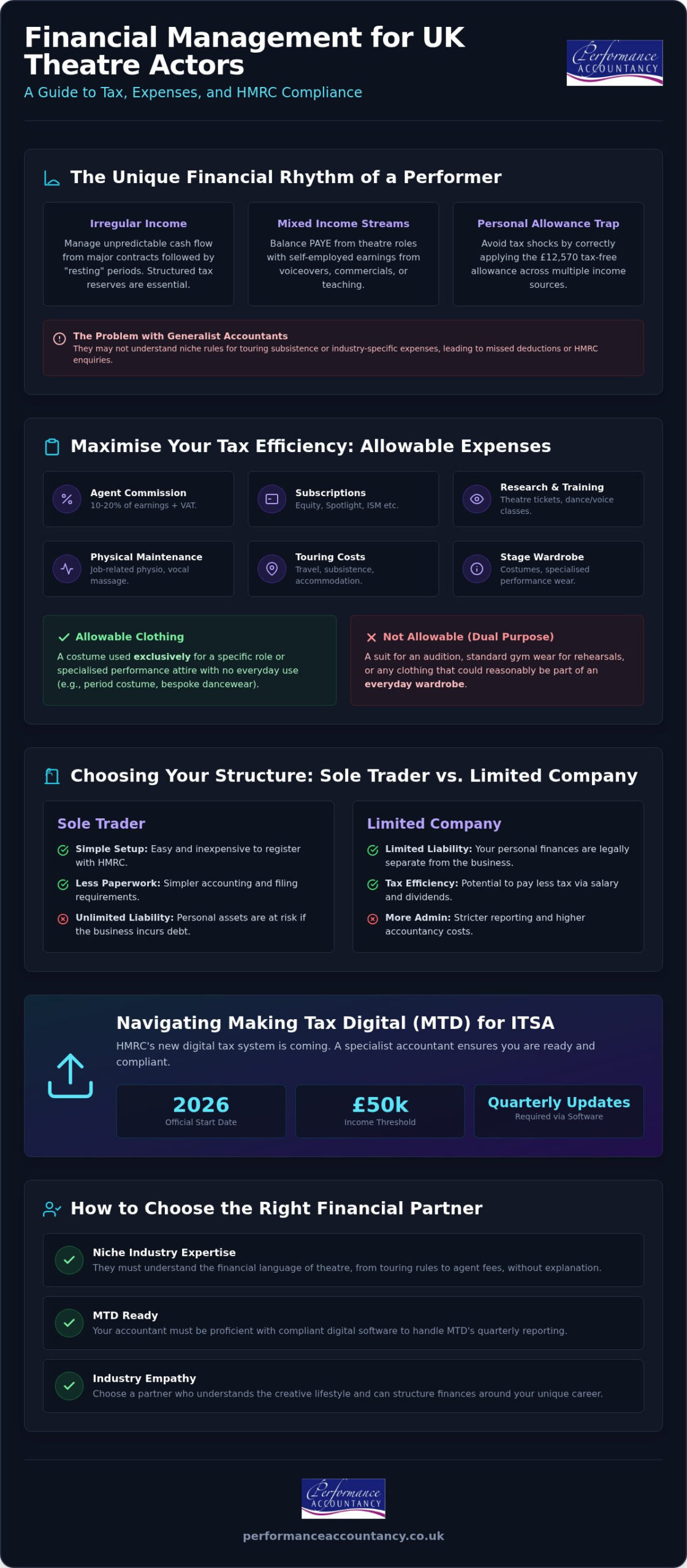
One of the most significant hurdles is managing your UK personal allowance. When your income is split between various employers and your own freelance business, it’s easy for your tax-free threshold of £12,570 to be applied incorrectly. This often leads to a nasty shock at the end of the tax year. A specialist understands how to structure these reserves, ensuring that when the curtain falls on a lucrative contract, you’ve already set aside the necessary funds for HMRC without compromising your lifestyle during quieter periods.
The Problem with Generalist Accounting for Actors
A high-street accountant might be excellent for a local shopkeeper, but they often struggle with the eccentricities of the performing arts. They might not realise that your subsistence claims whilst on a national tour are subject to specific rules, or that your “office” is often a dressing room or a train carriage. Without niche expertise, you risk missing out on legitimate deductions or, worse, triggering an HMRC enquiry because your expenses look “unusual” to a generalist. Choosing a dedicated accountant for theatre actors UK means working with someone who already knows the script of your professional life.
HMRC and the Performing Arts: A Delicate Balance
The “wholly and exclusively” rule is the gold standard for tax-deductible expenses, yet applying it to a creative career requires a nuanced touch. Is that gym membership for general health or a specific, physically demanding role? Does that haircut count as a business cost? Performance Accountancy acts as a bridge between your creative world and the rigid requirements of HMRC. We help you maintain rigorous records amidst the chaos of rehearsals, transforming a pile of receipts into a compliant, efficient financial structure that protects your earnings while you focus on your craft.
Allowable Expenses: Maximising Your Tax Efficiency
Every pound you spend on your career shouldn’t necessarily come out of your post-tax pocket. For a performer, the line between personal and professional life is often blurred; your “product” is yourself. Understanding HMRC guidance on allowable expenses is vital for ensuring you don’t leave money on the table. Legitimate deductions reduce your taxable profit, which in turn lowers your final tax bill. Common expenses for theatre professionals include:
- Agent Commission: Usually between 10% and 20% of your earnings, plus VAT.
- Professional Subscriptions: Fees for Equity, the Musicians’ Union, or the ISM, alongside casting platform costs like Spotlight.
- Research and Training: Theatre tickets to study contemporary productions, voice coaching, dance classes, and accent workshops.
- Physical Maintenance: Specific treatments like vocal massage or physiotherapy, provided they are directly related to a performance requirement.
The “Stage Wear” Myth vs. Reality
There is a common misconception that any outfit bought for an audition or a role is tax-deductible. HMRC applies a strict “dual purpose” test. If a piece of clothing could reasonably be worn as part of an everyday wardrobe, it’s generally not allowable. This includes suits for auditions or standard gym wear for rehearsals. To be fully deductible, clothing must be a costume used exclusively for a specific role or specialised performance attire that has no place in a conventional wardrobe.
Audition and Touring Costs
Touring is a staple of the UK theatre scene, but it brings a logbook’s worth of administrative challenges. When you’re working away from your home base, you can claim for travel and subsistence. This includes train fares, coach tickets, or mileage if you’re driving your own vehicle (currently 45p per mile for the first 10,000 miles). Subsistence covers the cost of modest meals whilst you are working on location or on tour.
Don’t overlook the “Use of Home” deduction. With the rise of self-tapes, your living room often doubles as a studio. You can claim a proportion of your household bills to account for the space used for rehearsals, filming auditions, and managing your admin. Partnering with a specialist accountant for theatre actors UK ensures you identify these niche deductions that generalists often miss, protecting your hard-earned income between contracts.
Sole Trader vs. Limited Company: Choosing Your Structure
Deciding how to legally structure your career is a pivotal moment that usually follows a significant uptick in your earnings. Most performers start as sole traders because the administrative burden is light; you simply track your income and expenses for an annual Self-Assessment. However, as your profile grows and those West End contracts or television residuals accumulate, the simplicity of being a sole trader can become a tax liability. This is where a specialist accountant for theatre actors UK helps you decide if it’s time to move from a solo act to a limited company production.
When is it Time to Incorporate?
The transition to a limited company often becomes tax-efficient when your annual profits consistently exceed £50,000. At this level, you hit the 40% higher-rate income tax band. By incorporating, your business pays Corporation Tax, which is currently 19% for profits up to £50,000. You then draw a combination of a small salary and dividends. This structure offers incredible flexibility for managing “resting” periods. You can choose to keep surplus funds within the company during a high-earning year and continue to pay yourself dividends during quieter months when you aren’t under contract.
You must also navigate the complexities of IR35. These off-payroll working rules are designed to ensure that freelancers aren’t acting as “disguised employees.” Theatre contracts can be particularly grey in this area, especially for long-running productions. A specialist will review your contracts to ensure your limited company status is robust and compliant, preventing costly challenges from HMRC later down the line.
VAT for Performers
If your total taxable turnover, including all performance fees and royalties, reaches the £90,000 threshold in a rolling 12-month period, VAT registration is mandatory. For many actors, this feels like an administrative mountain. It does, however, come with a silver lining. Whilst you must charge VAT on your services, you can reclaim the VAT you pay on professional costs like agent fees, equipment, and certain travel expenses.
Some high-earning performers may benefit from the Flat Rate Scheme, although its advantages have changed in recent years. Managing these quarterly returns doesn’t need to be a “headache” that distracts from your rehearsals. Modern, MTD-compliant software makes the process seamless. By working with an accountant for theatre actors UK, you can ensure your corporate structure is optimised for your specific mix of stage, screen, and residual income, allowing you to focus on your next role rather than your balance sheet.
Navigating Making Tax Digital (MTD) in 2026
The annual drama of the January tax return is about to undergo a significant script change. For years, performers have operated on a cycle of “closing night” panic, gathering receipts once a year to meet the Self-Assessment deadline. However, from 6 April 2026, the curtain rises on Making Tax Digital (MTD) for Income Tax. If your gross income from self-employment exceeds £50,000, you’ll be required to keep digital records and send quarterly updates to HMRC. This threshold is set to drop to £30,000 in April 2027, eventually reaching £20,000 by 2028. For many, this represents the biggest shift in tax behaviour in a generation.
Quarterly Updates: A New Way of Working
Instead of one big performance at the end of the year, MTD requires four smaller “financial rehearsals.” By submitting quarterly updates, you gain real-time visibility of your estimated tax liability. This is a game-changer for actors who often struggle to know exactly how much to set aside from a lucrative contract. It eliminates the “tax bill anxiety” that often strikes when you’re between roles. To stay compliant, your old manually updated spreadsheet will no longer suffice; HMRC requires software that can communicate directly with their systems via an API.
Organising receipts on the go is essential whilst you’re in the middle of a busy rehearsal schedule or touring the country. You don’t want to be untangling a year’s worth of expenses during your rare days off. By using digital tools, you can snap a photo of a train ticket or a script-printing receipt the moment you pay for it, ensuring nothing is lost in the chaos of a nomadic acting life.
The Role of Digital Bookkeeping
Modern accounting software allows you to integrate your bank account directly, meaning every transaction is automatically imported. You simply categorise your “allowable expenses” as they happen. This level of automation reduces the risk of human error and ensures you’re claiming every penny you’re entitled to. It also allows your accountant for theatre actors UK to provide proactive advice throughout the year, rather than just tallying up the past.
Transitioning to this digital-first approach can feel like a daunting technical rehearsal, but you don’t have to face it alone. We specialise in helping creative professionals bridge the gap between their artistry and these new digital requirements. If you’re feeling overwhelmed by the upcoming changes, our MTD IT services are designed to take the digital “headache” out of your hands, leaving you free to focus on your next opening night.
How to Choose the Right Accountant for Your Acting Career
Selecting the right accountant for theatre actors UK is about more than just finding someone to file your tax return. It’s a strategic choice that impacts your financial stability during those inevitable “resting” periods between contracts. You need a partner who understands that your career doesn’t follow a standard office rhythm. Always prioritise the “Chartered” status; it is a mark of rigorous training and high ethical standards that ensures your finances are protected. A generalist might offer a lower fee, but if they miss theatre-specific deductions or fail to account for complex international royalties, the cost to your pocket will be far higher in the long run.
Industry empathy is your greatest asset. Your accountant should understand the nuances of the entertainment sector, from the way agent commissions work to the specific rules surrounding subsistence whilst on tour. Avoid fee structures that feel like “front-row prices” for a basic, reactive service. A great accountant doesn’t just appear once a year in January. They should offer proactive tax reviews, helping you plan for the 2026 MTD changes and ensuring your structure remains efficient as your earnings fluctuate. This forward-thinking approach transforms accounting from a stressful chore into a structured financial plan.
Questions to Ask Your Potential Accountant
Before signing a contract, ensure you’re working with someone who truly speaks your language. Start by asking how many theatre clients they currently represent; a high number suggests they’re familiar with the industry’s specific tax codes. Inquire about their approach to MTD for Income Tax to ensure they have the digital tools to support you through the 2026 transition. Finally, ask them to explain how they handle residuals and international royalties. If they look confused by the concept of a foreign tax credit, they aren’t the right fit for a performer with a global reach.
The Performance Accountancy Advantage
We offer a unique “Specialist Insider” perspective that bridges the gap between the arts and finance. Performance Accountancy is led by a Chartered Accountant with a professional operatic background. This means we don’t need you to explain what an audition is or why you’re claiming for a specialised dialect coach. We provide tailored support for ISM members and classical performers, focusing on creating clarity and organised calm in your financial life. We act as both rigorous guardians of your accuracy and passionate advocates for your craft. Organise your theatre finances with a specialist today and ensure your financial performance is as strong as your stage presence.
Taking Centre Stage with Your Finances
Managing the financial rhythm of a creative career shouldn’t feel like a solo performance in an empty theatre. You’ve seen how identifying niche allowable expenses and choosing the right corporate structure can protect your earnings during “resting” periods. With the 2026 MTD shift approaching, transitioning to digital bookkeeping is no longer optional; it is a vital step in maintaining HMRC compliance whilst you’re on the road or in rehearsals.
Finding a specialist accountant for theatre actors UK ensures you have a partner who truly understands the fluid nature of the arts. Performance Accountancy is led by a Chartered Accountant and former professional opera singer, offering a unique “Specialist Insider” perspective and expert support for ISM members. We take the “headache” out of tax, replacing confusion with an organised, structured plan that keeps you focused on your craft.
Book a consultation with our theatre accounting specialists today to secure your financial future. You’ve mastered the stage; now it’s time to master your balance sheet with the same confidence and flair. Your next great performance deserves a financial foundation that is just as robust.
Frequently Asked Questions
Do I need a specialist accountant if I only work in theatre part-time?
Yes, even part-time performers benefit from specialist advice because theatre work often involves a complex mix of PAYE and self-employment income. A specialist accountant for theatre actors UK ensures your tax code is applied correctly across all roles, preventing you from overpaying on your freelance fees whilst your main employer handles your standard deductions. It’s about getting the structure right from the start, regardless of your total annual earnings.
What are the most common tax mistakes actors make in the UK?
One of the most frequent errors is failing to set aside a tax reserve from every contract payment, leading to a “tax bill headache” in January. Many performers also struggle with the “wholly and exclusively” rule, either claiming for everyday items or missing out on legitimate costs like script printing and accent coaching. Missing the 31 January deadline is another common pitfall that leads to immediate HMRC penalties.
Can I claim for my gym membership or dental work as an actor?
HMRC generally views gym memberships and dental work as having a “dual purpose” for both personal health and professional use. Consequently, these costs are rarely allowable unless you can prove they are strictly for a specific role and have no personal benefit. For example, a role requiring a specific physical transformation might justify certain training, but standard fitness is considered a personal choice. Always consult your accountant before assuming these costs are deductible.
How much does an accountant for theatre actors typically cost?
Fees vary depending on the complexity of your income streams and whether you operate as a sole trader or a limited company. Most specialist firms offer fixed-fee packages for Self-Assessment returns, which provides clarity and helps you budget for the professional support you need. Rather than looking for the cheapest option, focus on the value provided through expert tax savings and the peace of mind that comes from knowing your digital compliance is handled.
What happens if I work on a theatre production abroad?
Working internationally adds a layer of complexity involving foreign tax credits and double taxation treaties. You may have tax withheld in the country where you perform, but a specialist accountant for theatre actors UK can often claim this back or offset it against your UK bill. It’s vital to keep records of all foreign earnings and any tax already paid abroad to ensure you aren’t taxed twice on the same performance.
Is my agent’s commission tax-deductible?
Yes, your agent’s commission is a fully allowable business expense. Since this is a direct cost of securing work, you can deduct the full amount, including any VAT charged by the agency, from your gross earnings. Ensure you keep the commission statements provided by your agent as evidence. This deduction is one of the most straightforward ways to reduce your taxable profit and ensure your final bill is accurate.
How do I handle tax on residuals and royalties?
Residuals and royalties should be recorded as part of your self-employed turnover, even if they arrive years after the original performance. These payments are often subject to different withholding rules, especially if they come from overseas productions. We help you track these irregular streams, ensuring they are categorised correctly for your tax return so you don’t pay more than necessary on your long-term creative legacy.
What is the deadline for filing my actor tax return in 2026?
For the 2025/26 tax year, the final deadline for online Self-Assessment remains 31 January 2027. However, you must remember that Making Tax Digital (MTD) begins on 6 April 2026 for those earning over £50,000. This means you may need to submit digital quarterly updates throughout the year rather than waiting for a single annual deadline. Staying ahead of these dates is crucial for avoiding automatic HMRC penalties.