
Imagine you’ve just finished a gruelling tour. Your bank account is a patchwork of session fees and royalties, and you’re staring at a shoebox of receipts for everything from reed replacements to hotel stays. It’s a common scene, but the stress of managing these fragments shouldn’t overshadow your creative output. Finding an expert accountant for self-employed musicians who truly understands the difference between a rehearsal and a recording session is often the missing piece of your professional puzzle.
We know that tax returns often feel like a foreign language compared to the score on your stand. You’re likely feeling the weight of unpredictable income streams and the looming anxiety of Making Tax Digital (MTD) requirements starting in April 2026. This guide will show you how a specialist chartered accountant who understands the rhythm of a performer’s life can transform your compliance from a headache into a streamlined asset. We will explore exactly what counts as an allowable expense for auditions and touring, how to navigate HMRC’s digital shifts, and the best ways to structure your finances for long-term career stability and total peace of mind.
Key Takeaways
- Discover why generalist firms often struggle with the complexities of royalties and residuals, and how a specialist insider protects your creative time.
- Get ahead of the Making Tax Digital (MTD) mandate starting in April 2026 by moving from chaotic annual filings to a structured, quarterly digital rhythm.
- Master the “wholly and exclusively” rule to maximise your claims on instrument repairs, touring costs, and other industry-specific allowable expenses.
- Partnering with a dedicated accountant for self-employed musicians ensures you receive expert guidance on when to transition from a sole trader to a limited company structure.
- Benefit from a professional partnership that understands the unique pressures of the performing arts, offering tailored support that protects your long-term career growth.
Why Generalist Accountants Often Miss the Mark for Musicians
Many high-street firms view your career through the lens of a traditional nine-to-five. They look for monthly payslips and predictable outgoings. For a performer, this “square peg, round hole” approach is a recipe for frustration. Standard accounting software often fails to capture the nuances of a performer’s life, such as the distinction between a touring per diem and taxable income. Numbers alone don’t tell your story.
A specialist accountant for self-employed musicians understands that your income isn’t just a single figure. It’s a complex composition of royalties, residuals, and performance fees. If your advisor doesn’t grasp the “wholly and exclusively” rules as they apply to the arts, you risk overpaying tax. A generalist might see a trip to a specialist outfitter as personal spending, whilst an insider knows it’s essential stagecraft. They might miss the fact that your evening dress isn’t just “clothes” or that a trip to a remote rehearsal space is a legitimate business journey.
The Problem with Irregular Income Cycles
A standard monthly salary mindset simply doesn’t apply when you’re working on project-based contracts. One month you might be flush with a West End run fee; the next, you’re waiting for royalties to trickle in. This volatility makes managing “payments on account” particularly tricky. A specialist helps you navigate these lean months by forecasting tax liabilities based on your actual industry rhythm, rather than assuming next year will look exactly like last year. Whether you are balancing a teaching portfolio with solo recitals or managing a complex sole trader business structure, an expert ensures your cash flow remains steady and your tax efficiency is maximised.
Beyond the Numbers: Speaking the Language of the Arts
Your accountant should be someone who knows that a “sit-probe” isn’t a medical procedure and an audition tour isn’t a holiday. When your advisor understands the costs of instrument insurance, professional coaching, and rehearsal room hire, the administrative “headache” begins to fade. This empathy for the creative lifestyle reduces the friction between your art and your obligations. Performance Accountancy bridges this gap by providing more than just tax returns; we offer a professional structure that supports your creative growth. By speaking your language, a specialist accountant for self-employed musicians identifies opportunities for tax relief that others overlook, such as specific deductions for sheet music, agent commissions, or publicity photos. This moves you from a state of administrative chaos to one of organised calm.
Mastering HMRC Compliance: Making Tax Digital and Irregular Income
The days of the annual “January scramble” are numbered. HMRC is fundamentally changing how you interact with your finances, moving away from the traditional once-a-year submission of Self Assessment tax returns. For many, the transition to Making Tax Digital (MTD) for Income Tax represents a significant shift in administrative rhythm. Instead of one deadline, you’ll soon face a quarterly cycle of digital updates. Having a specialist accountant for self-employed musicians ensures this transition doesn’t disrupt your creative flow; it simply becomes part of your professional backstage routine.
Organisation is no longer a luxury; it’s a regulatory requirement. For those whose turnover approaches the £90,000 threshold, VAT compliance adds another layer of complexity. Many performers find the VAT Flat Rate Scheme beneficial, as it simplifies record-keeping whilst potentially offering a small financial surplus if your business expenses are low. We help you determine if this structure suits your specific touring and recording profile, turning a complex obligation into a manageable, structured process.
Quarterly Reporting: A New Rhythm for Your Finances
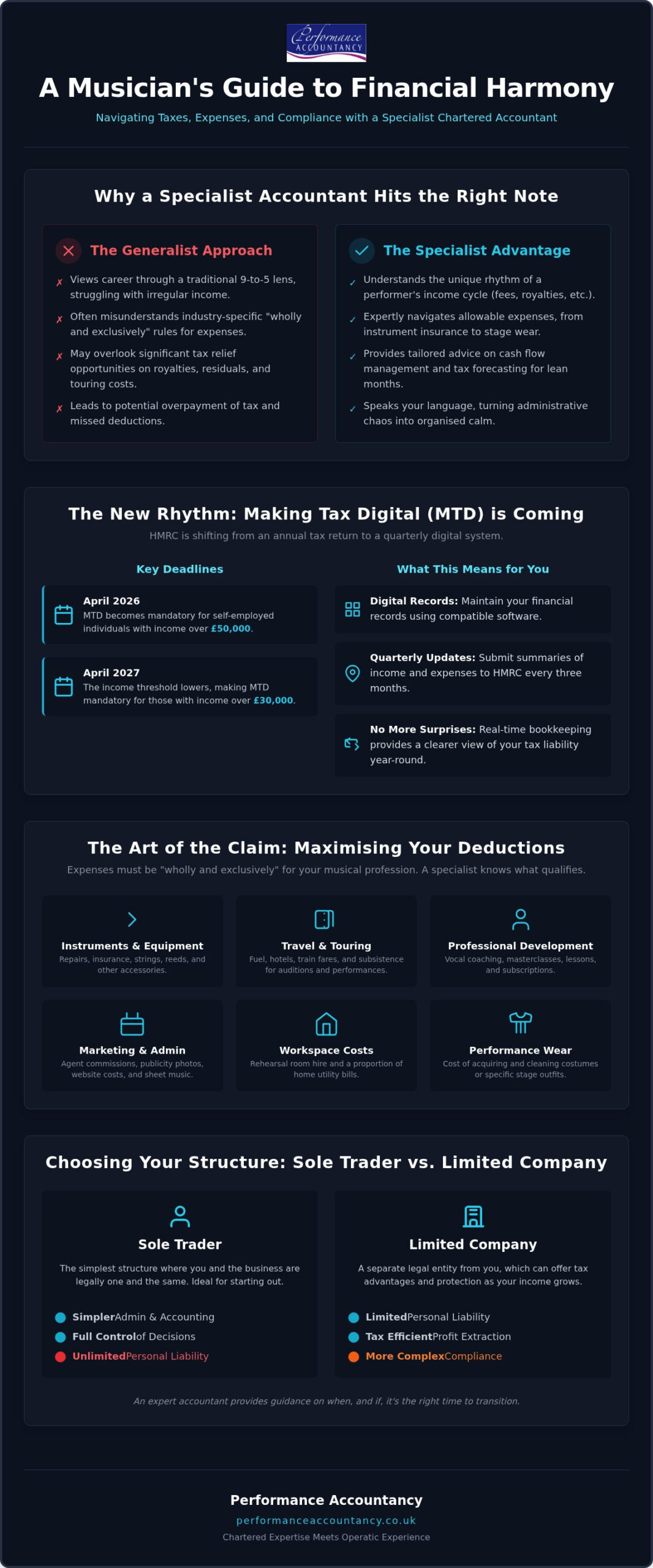
From April 2026, MTD for Income Tax becomes mandatory for self-employed individuals with a qualifying income over £50,000. This threshold lowers to £30,000 in April 2027. You’ll need to use functional compatible software to keep digital records and send quarterly summaries of your income and expenses to HMRC. Whilst this sounds daunting, real-time bookkeeping offers a clearer view of your career’s profitability. It eliminates year-end surprises and allows for more accurate tax planning. Moving from chaos to organised calm is much easier when you work with a specialist partner who understands the digital tools best suited to the performing arts.
Managing Multiple Income Sources
Musicians rarely have a single stream of revenue. You might have P60 income from a part-time teaching post at a conservatoire, alongside self-employed fees from orchestral deps and streaming royalties from older recordings. Ensuring these streams don’t result in overpayment of National Insurance or tax requires a keen eye. International tours introduce further variables, such as foreign withholding tax. We verify that any tax paid abroad is correctly offset against your UK liability to prevent double taxation. Whether it’s physical merchandise sales or digital residuals, a specialist accountant for self-employed musicians ensures every pound is captured accurately and every relief is claimed. This level of detail provides the total peace of mind you need to focus on the music, rather than the paperwork.
The Art of the Claim: Specialist Allowable Expenses for Performers
HMRC’s “wholly and exclusively” rule is the cornerstone of any tax return, yet its application in the performing arts is rarely black and white. For a generalist, a pair of black trousers is just clothing. For an orchestral player, they are essential stage uniform. Navigating these “dual purpose” grey areas is where a specialist accountant for self-employed musicians proves their worth. We don’t just tally receipts; we build a robust case for why your professional image and technical precision require specific investments. This expertise covers often-overlooked costs like agent commissions, professional laundry for concert dress, and subscriptions to bodies like the ISM or Musicians’ Union. Without this niche knowledge, you’re likely paying more to the taxman than you truly owe.
Allowable expenses for musicians are the essential investments required to maintain your professional standard, preserve your instrument, and deliver every performance with technical and artistic excellence.
Travel, Touring, and Subsistence
Travel is often the largest variable in a performer’s budget. Whilst your commute to a regular teaching job is typically non-deductible, travel to auditions, rehearsals, and varied venues is a legitimate business expense. If you’re touring, you can claim for “subsistence”, which is the reasonable cost of food and drink whilst working away from home. Transporting heavy equipment or bulky instruments like a double bass or harp requires specific logistics; these costs are fully claimable. We help you track mileage and parking fees accurately to ensure you aren’t leaving money on the stage. This methodical tracking turns a potential administrative headache into a streamlined professional asset.
Instruments, Equipment, and the Home Studio
Buying a professional-grade instrument is a major career milestone and a significant financial outlay. You can often write off the full cost in the year of purchase using the Annual Investment Allowance (AIA), which currently sits at £1,000,000 for the 2026/27 tax year. For smaller items like music lessons, scores, reeds, and strings, these are treated as revenue expenses. If you use a room in your house for practice, score study, or administrative work, you can claim a proportion of your household bills. Calculating this “use of home” deduction requires a rhythmic approach to square footage and hours used, ensuring you maximise your relief whilst remaining firmly compliant with HMRC’s expectations.
Sole Trader or Limited Company? Choosing the Right Structure
Deciding how to structure your professional life is a bit like choosing the right ensemble for a performance. You need the right fit for the venue and the repertoire. For most performers starting their career, the sole trader route is the natural opening movement. It’s simple, but as your career reaches a higher crescendo, the tax-efficiency of a limited company might take centre stage. An expert accountant for self-employed musicians doesn’t just look at this year’s turnover; they look at your tour schedule, your royalty projections, and your long-term ambitions.
The Sole Trader Path: Simplicity and Control
Most musicians begin as sole traders because the administrative burden is relatively light. You and the business are legally the same entity, making the Self-Assessment process straightforward. However, this simplicity comes with personal liability. If the business incurs debts, your personal assets aren’t protected. Whilst this is rarely a concern for a solo performer with low overheads, it’s a factor to monitor as your contracts grow in scale. A specialist accountant for self-employed musicians helps you manage this transition, ensuring you don’t remain in a structure that has become tax-inefficient or unnecessarily risky as your income climbs.
The Limited Company: Credibility and Tax Planning
As your profits ascend, the limited company structure offers significant tax-planning opportunities. From April 2026, the Small Profits Rate of Corporation Tax remains at 19% for profits up to £50,000, whilst the Main Rate is 25% for profits over £250,000. By operating as a company, you can pay yourself a combination of a lower salary and dividends, the latter of which carries a £500 tax-free allowance for the 2026/27 tax year. This structure provides a “corporate veil,” separating your personal finances from the business. It also allows you to retain profits within the company during a “bumper” year of touring to supplement your income during a quieter recording or rehearsal phase.
However, this path brings increased Director responsibilities. You must file formal Year End Accounts with Companies House and manage a more complex administrative programme. The decision to switch shouldn’t be based on a single good year, but on a sustained career trajectory that justifies the extra compliance costs. If you’re unsure which path fits your current rhythm, we can provide professional guidance on your business structure to ensure you’re always operating at peak efficiency.
Ultimately, your structure should support your career growth, not hinder it. Whether you’re an opera singer with international contracts or a session musician with a portfolio of teaching and performing, the right framework provides the professional foundation you need. We move you from the chaos of uncertainty to a state of organised calm, allowing you to focus on the performance whilst we handle the structural precision.
Performance Accountancy: Where Chartered Expertise Meets Operatic Experience
Choosing an accountant for self-employed musicians often feels like a compromise between technical skill and industry understanding. Performance Accountancy removes that trade-off. We combine the rigorous authority of a Chartered Accountant with the firsthand experience of a professional operatic background. This isn’t just a business; it’s a practice built on the belief that performers deserve advisors who speak their language and respect their time. We take the administrative “heavy lifting” of VAT returns and Self-Assessment off your desk, allowing you to dedicate your energy to the stage. Our approach is designed to be protective and reassuring, acknowledging that whilst your income may be irregular, your compliance must be steady.
We provide a specialist insider perspective that generalist firms simply cannot match. Whether you are an opera singer, a conductor, or a session player, we understand the specific nuances of your career. We provide bespoke support for ISM members and professionals across the classical and operatic world, ensuring that your unique tax profile is managed with precision. Our goal is to move you from the persistent “headache” of administrative tasks to a state of organised calm where your financial structure supports your long-term creative growth.
A Peer-to-Peer Partnership
When you work with us, you aren’t just a client number in a database. You’re a peer. Having an accountant for self-employed musicians who has actually stood on a professional stage changes the conversation entirely. We don’t need you to explain why a rehearsal period in a different city is a business expense; we’ve lived it. This shared experience allows for tailored financial planning that respects the fluid nature of the performing arts whilst maintaining the security of Chartered oversight. We ensure all statutory obligations are met with the same technical excellence you bring to your own performances.
Getting Started: Your Path to Financial Clarity
Distance is no barrier to professional support. We work with artists nationally across the UK through seamless digital collaboration, making it easy to manage your affairs whilst on tour or in the recording studio. Our onboarding process is the direct antidote to chaos. We take your scattered records and refine them into a streamlined professional asset. From managing the complexities of MTD for Income Tax to filing Limited Company accounts, we provide a clear, methodical path forward. We handle the technical details of HMRC compliance so you can focus on the music. It’s time to organise your performance finances with Performance Accountancy today and experience the relief of a truly specialist partnership.
Take Centre Stage with Financial Confidence
Your career is built on technical precision and creative expression. Your finances should be no different. By mastering the nuances of allowable expenses and preparing for the digital shifts of MTD, you move away from administrative anxiety. Whether you’re refining your business structure or simply looking to claim every legitimate deduction for your touring equipment, the right support is vital. Choosing a dedicated accountant for self-employed musicians ensures that your financial backstage is as polished as your performance.
Performance Accountancy brings a unique blend of Chartered authority and deep expertise in the classical and operatic sectors. As a practice led by a former performer, we offer specialist ISM member accounting services that generalist firms simply don’t understand. We’re here to handle the technical complexity whilst you focus on your craft. It’s time to stop the January scramble and start a new rhythm of organised calm. Secure your financial future with a specialist arts accountant today and give your career the professional foundation it deserves. Keep creating, keep performing, and let us handle the rest.
Frequently Asked Questions
Do I really need a specialist accountant for self-employed musicians?
A specialist accountant understands the industry-specific “grey areas” that generalist firms often miss. Whilst a high-street practice treats you like a traditional small business, a specialist accountant for self-employed musicians grasps the complexities of royalty cycles, residuals, and touring per diems. This niche expertise ensures you don’t overpay tax through missed deductions. It provides the reassurance of working with an advisor who understands the rhythm of your career and speaks your professional language fluently.
What are the most common tax-deductible expenses for musicians in the UK?
Common deductible expenses include instrument repairs, insurance, sheet music, and agent commissions. You can also claim for rehearsal room hire, professional subscriptions like the ISM, and travel to auditions or venues. Under the Annual Investment Allowance, you can write off 100% of the cost of qualifying equipment, such as a new instrument or studio gear, in the year of purchase. Tracking these smaller revenue costs alongside larger capital outlays is essential for maximising your tax efficiency.
How does Making Tax Digital (MTD) affect me as a freelance performer?
Making Tax Digital (MTD) requires you to keep digital records and submit quarterly updates to HMRC using compatible software. From April 2026, this becomes mandatory for those with a qualifying income over £50,000. In April 2027, the threshold lowers to £30,000. This shift moves you away from a single annual deadline to a more structured, frequent reporting cycle. It’s designed to reduce errors and provide a real-time view of your tax liability throughout the year.
Can I claim for stage clothes and “theatre blacks” on my tax return?
You can claim for stage clothes only if they are used “wholly and exclusively” for your performances. Items like “theatre blacks,” concert gowns, or specific costumes that you wouldn’t wear in your daily life are typically allowable. However, HMRC often challenges claims for “normal” clothing, even if you only wear it on stage. A specialist accountant for self-employed musicians helps you justify these expenses by demonstrating the professional requirement of the garment for your specific craft.
Is it better to be a sole trader or a limited company as a musician?
Most performers start as sole traders due to the lower administrative burden and simplicity of Self-Assessment. As your income grows, a limited company may become more tax-efficient by allowing you to take a combination of salary and dividends. This structure also offers limited liability, protecting your personal assets from business debts. The right choice depends on your current turnover and your projected career trajectory; it’s a decision that requires careful, personalised analysis of your portfolio.
What records do I need to keep for my musician tax return?
You must keep accurate digital records of all income and expenditure, including invoices, receipts, and bank statements. It’s vital to maintain a log of business mileage for touring and travel to auditions or rehearsals. Under MTD rules, these records must be stored digitally to ensure they are ready for quarterly submissions. Keeping your paperwork organised in real-time prevents the January headache and ensures you have the evidence required if HMRC ever requests a review of your affairs.
How much does a specialist musician accountant cost?
The cost of a specialist accountant varies based on the complexity of your income streams and the level of support you require. Whilst fees are a consideration, the true value lies in the tax savings and peace of mind they provide. A specialist often identifies reliefs that a generalist might overlook, effectively paying for themselves through increased tax efficiency. We focus on providing a professional structure that supports your career growth without the stress of administrative chaos.
Can I claim for the cost of music lessons and professional coaching?
You can typically claim for music lessons and professional coaching if they are intended to maintain or update your existing professional skills. HMRC views these as revenue expenses because they are necessary for your ongoing performance standards. However, if the training is to learn a completely new instrument or a skill unrelated to your current professional work, it may be treated differently. We help you categorise these costs correctly to ensure you remain fully compliant whilst maximising your relief.