
For a professional ballet dancer, a trip to the physiotherapist isn’t a weekend indulgence; it’s a critical maintenance cost for your primary business asset. It’s frustrating when traditional accountants treat your pointe shoes or Pilates sessions as personal hobbies rather than professional necessities. You’ve spent years perfecting your technique, yet the annual scramble to understand tax for ballet dancers UK often feels like a clumsy rehearsal for a performance you never signed up for.
We understand that your income doesn’t always flow in a predictable rhythm, making budgeting feel like a constant balancing act. This guide is designed to provide a clear choreography for your finances, ensuring you stay HMRC compliant while keeping more of your hard-earned pounds. We’ll explore the specific allowable expenses that apply to your craft, the upcoming April 2026 Making Tax Digital (MTD) requirements for those with a turnover above £50,000, and how to simplify your bookkeeping so it never misses a beat.
Key Takeaways
- Navigate the “dual-status” reality of balancing PAYE company contracts with freelance teaching and guest performances without triggering HMRC red flags.
- Maximise your deductions by identifying legitimate tax for ballet dancers UK expenses, including pointe shoes, specialised rehearsal wear, and business-critical physiotherapy.
- Master the “feast or famine” cycle with proactive strategies for setting aside tax and managing the high-stakes “Payment on Account” system.
- Secure your digital future by understanding the 6 April 2026 Making Tax Digital (MTD) thresholds and how to transition your bookkeeping to a streamlined, compliant system.
- Learn how a specialist accountant who speaks the language of the studio can transform your financial admin from a chaotic headache into an organised, manageable routine.
Understanding Your Tax Status: Are You an Employee or Self-Employed?
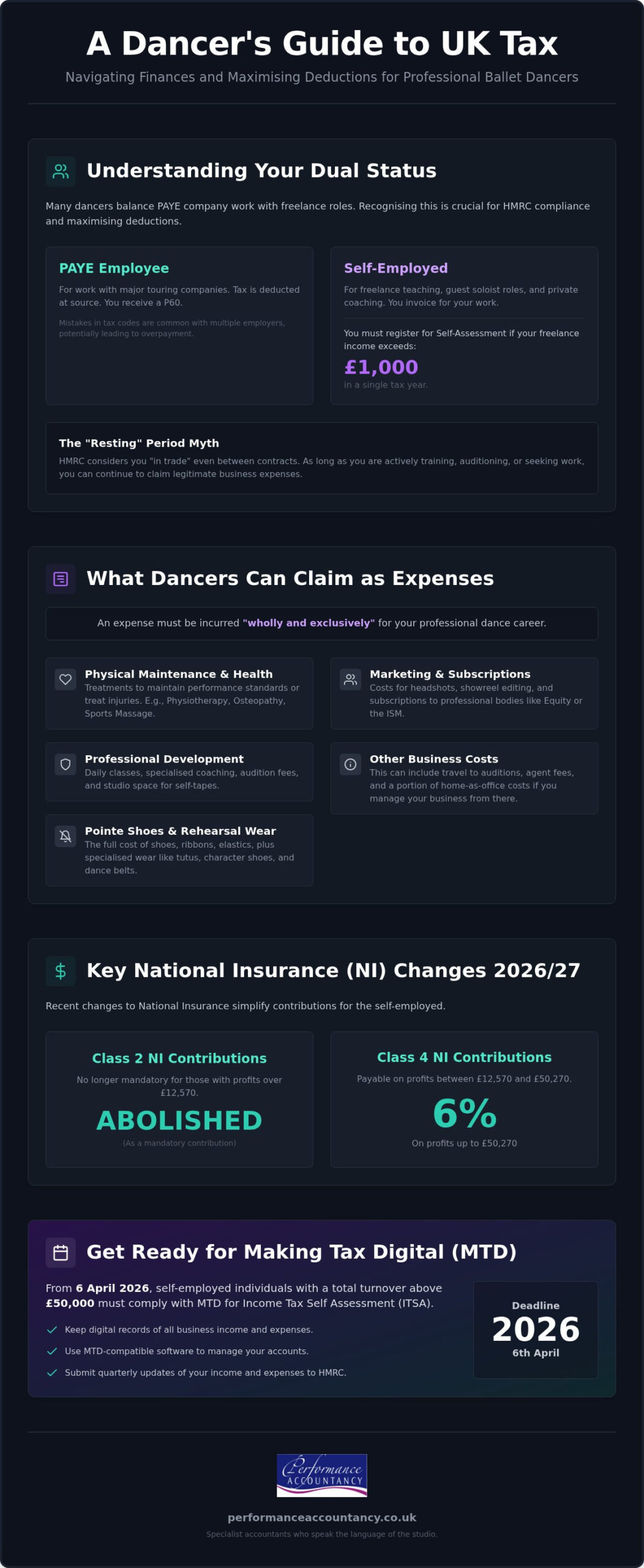
You might spend three months as a PAYE employee for a major touring company, then pivot immediately to freelance teaching or guest soloist roles. This “dual-status” reality is the norm for many UK professionals, yet it’s often where the most expensive financial mistakes happen. If you receive a P60 from a ballet company but also invoice for private coaching, you’re effectively running a small business alongside your employment. Recognising this distinction is vital because your status dictates exactly which expenses you can deduct to lower your bill for tax for ballet dancers UK.
If your “side-hustle” or freelance income exceeds £1,000 in a single tax year, HMRC requires you to register for Self-Assessment. Ignoring this threshold can lead to unwanted penalties. Gaining a solid foundation by Understanding Self-Assessment is the first step toward financial clarity, ensuring you don’t overpay on your combined earnings.
The “Resting” Period and HMRC Expectations
HMRC understands that a dancer’s career isn’t a linear 9-to-5. There are inevitable gaps between contracts, often referred to as “resting” periods. However, from a tax perspective, you don’t stop being a business just because the curtain has closed on a specific production. As long as you’re actively training, auditioning, or seeking new engagements, you’re still “in trade.” This allows you to continue claiming legitimate business expenses even during months when you aren’t performing. According to HMRC guidance BIM50160, performers are generally treated as carrying on a profession or vocation, meaning their income is taxed as trading profits rather than employment earnings. This classification is a powerful tool for dancers, as it opens the door to a much wider range of allowable deductions than a standard office worker could ever claim.
Mixed Income: PAYE vs. Self-Assessment
Juggling multiple income streams often leads to tax code chaos. When you have several employers, HMRC might apply an incorrect tax code, resulting in too much tax being deducted from your PAYE payslip. At the end of the year, you’ll need to report your total P60 income alongside your freelance profits on your tax return. For the 2026/27 tax year, the National Insurance landscape has shifted; Class 2 contributions are no longer mandatory for those with profits over £12,570, whilst Class 4 NI is set at 6% on profits up to £50,270. We help you reconcile these figures, ensuring your freelance expenses offset your total liability so you don’t pay a penny more than necessary. It’s about creating a streamlined system where your employment and self-employment work in harmony, rather than causing a backstage headache.
Allowable Expenses: What Ballet Dancers Can Claim in 2026
Every pound you spend on your craft is a potential deduction that lowers your final bill for tax for ballet dancers UK. HMRC operates on the “wholly and exclusively” principle. This means an expense is only deductible if it’s incurred solely for the purpose of your professional dance career. For a dancer, your body is essentially your business asset, which makes the line between personal and professional spending thinner than a stage flat. The official guidance on Allowable Expenses for Performers provides the necessary framework to justify these costs to the taxman.
Pointe shoes are the most obvious example of a business supply. Whether you go through a pair a month or a pair a week, the cost of shoes, ribbons, and elastics is fully deductible. Similarly, specialised rehearsal wear like tutus, character shoes, and dance belts are claimable. Physical maintenance is where many dancers miss out. Whilst general health costs are personal, targeted treatments like physiotherapy, osteopathy, and sports massage are deductible when they’re required to treat a performance injury or maintain the extreme physical standards your contracts demand.
Professional development is another significant area for deductions. You can claim for:
- Audition fees and the cost of studio space for self-tapes.
- Daily professional classes and specialised coaching sessions.
- Subscriptions to professional bodies like Equity or the ISM.
- Marketing costs, including headshots and showreel editing.
If the sheer volume of receipts for ribbons and physio feels overwhelming, a specialist performance accountant can help you categorise these costs correctly, ensuring you don’t leave money on the table.
Stage Appearance and Grooming
HMRC is strict about the “dual-purpose” trap. You can claim for stage makeup, false eyelashes, and specialized hair supplies used exclusively for performance. However, your everyday cosmetics and standard haircuts are considered personal expenses. The same rule applies to clothing. Your favourite gym leggings, even if worn in the studio, are often disqualified because they could be worn to the supermarket. To be deductible, clothing must be “recognisably a uniform” or a costume unsuitable for everyday life.
Travel, Touring, and Subsistence
Travel to auditions, rehearsals, and temporary performance venues is a legitimate business cost. If you’re touring within the UK, you can often claim subsistence costs for meals and accommodation. For international tours, you might face foreign withholding tax on your fees. Whilst we don’t handle residency issues, you can typically claim foreign tax credits on your UK return to ensure you aren’t taxed twice on the same performance. Keeping a digital log of these journeys makes the year-end process far less stressful.
Managing Irregular Income and Financial Rhythm
Freelance dance income rarely follows a steady beat. One month you’re performing on a world-class stage with a generous fee; the next you’re “resting” or focusing on lower-paid teaching work. This “feast or famine” cycle makes managing tax for ballet dancers UK feel like a high-stakes endurance test. To avoid a financial stumble, we recommend setting aside 25% to 30% of every invoice into a dedicated tax savings account. This ensures the money is already there when HMRC comes calling, protecting your peace of mind and your credit score.
The second year of self-employment often brings a nasty surprise known as “Payments on Account.” If your tax bill exceeds £1,000, HMRC requires you to pay half of your estimated next year’s tax by 31 January, and the other half by 31 July. It can feel like paying double tax in a single year, which is why having a separate business bank account is non-negotiable. This simple separation allows you to track professional memberships like Equity or the ISM and manage your tax reserves without them getting lost amongst your daily living costs.
The January Deadline Headache
Leaving your records until the festive season is a recipe for a New Year’s disaster. Instead, try to categorise your receipts and invoices at the end of every month. This small habit prevents the “shoebox of doom” from piling up and causing unnecessary anxiety. Approaching your accounts with the same daily discipline as a morning barre ensures that tax season is a graceful transition rather than a frantic scramble. With the transition toward Making Tax Digital (MTD) for Dancers, staying organised is no longer just a good habit; it’s becoming a mandatory part of your professional life.
Agent Fees and Commission
When you receive a performance fee, your agent usually deducts their commission and VAT before the money reaches your account. You must report the “gross” amount, which is the total before the agent’s cut, as your income and then claim the commission back as a professional expense. Be mindful of “buyouts” and royalties. These are often larger, one-off payments that can unexpectedly push you into a higher tax bracket or over the VAT threshold. Always keep clear records of “per diems” or travel reimbursements provided by a company. Whilst these aren’t usually taxable, failing to document them correctly can make your bank statements look confusing if HMRC ever decides to audit your return.
Making Tax Digital (MTD) for Dancers: Readiness for 2026
The rhythm of tax for ballet dancers UK is about to change significantly. From 6 April 2026, the traditional annual scramble to meet the January deadline will be replaced by a more frequent, digital-first approach. Under the Making Tax Digital for Income Tax Self-Assessment (ITSA) rules, self-employed dancers and landlords with a qualifying gross income over £50,000 must keep digital records and send quarterly updates to HMRC. This isn’t just a minor tweak to the system; it’s the largest administrative shift in a generation, designed to reduce errors and provide a more real-time view of your financial health.
Whilst the £50,000 threshold applies first, those with a qualifying income over £30,000 will be brought into the fold from 6 April 2027. Instead of one big performance at the end of the year, you’ll provide four smaller updates, with the first quarterly deadline falling on 7 August 2026. Choosing the right software is vital. You need an HMRC-compatible app that understands the nuance of a creative career, rather than a complex corporate spreadsheet that feels like a foreign language.
The 4-Step MTD Readiness Plan
Preparing for this transition doesn’t have to be overwhelming if you take it one step at a time. First, check your total turnover across all freelance streams, including teaching, guesting, and royalties, to see if you meet the 2026 threshold. Second, select an MTD-compliant software or partner with a specialist who can handle the technical side for you. Third, start digitalising your receipts immediately; the era of the physical shoebox is officially over. Finally, schedule your quarterly update deadlines into your professional calendar. Your first report for the period of 6 April to 5 July 2026 will be due by 7 August 2026.
Digital Bookkeeping for the Busy Performer
Digital record-keeping actually offers a surprising amount of freedom for the touring dancer. Using receipt-scanning apps allows you to snap a photo of a train ticket or a physio invoice between rehearsals, instantly categorising the expense without needing to carry paper around. This provides a real-time view of your profitability, helping you make informed decisions about which contracts to take. Most importantly, MTD helps you avoid nasty end-of-year tax surprises, as you’ll have a much clearer idea of your liability throughout the season. If the thought of quarterly reporting makes your head spin, our MTD IT support can help you choreograph a stress-free transition well before the 2026 deadline.
Why Specialist Performance Accountancy is a Career Investment
A traditional high-street accountant might excel at handling a local shop’s books, but they rarely understand the physical and professional demands of a performing arts career. They might view a sports massage as a personal treat or question why you need several different pairs of shoes for a single rehearsal period. Choosing a specialist means you don’t have to spend your time justifying your business needs. We speak the language of the studio and the stage, ensuring that your approach to tax for ballet dancers UK is as precise as your technique.
Performance Accountancy was founded by Louise, a Chartered Accountant who is also a former professional opera singer. This unique background means we truly understand the irregular income cycles and the specific pressures of the creative sector. Whether you are an ISM member looking for specialised accounting services or a freelance soloist navigating multiple contracts, we provide a protective barrier between you and HMRC. Our goal is to handle the administrative headaches so you can focus on your craft.
More Than Just a Tax Return
As your career progresses, your financial structure should evolve with it. We provide strategic advice on when it’s most tax-efficient to move from being a sole trader to forming a Limited Company. This decision is often triggered by rising income or the need for better liability protection. For high-earning soloists and choreographers, we also manage VAT returns and ensure compliance with the £85,000 registration threshold. Our bookkeeping support is designed to be fluid, fitting around your rehearsals, tours, and “resting” periods rather than forcing you into a rigid corporate mould.
Getting Started with Performance Accountancy
We believe that financial clarity should be accessible and transparent. That’s why we offer a Free No-Obligation Chat to discuss your specific situation and identify where you could be saving money. You’ll receive a clear, upfront quote for our services, whether you need help with a one-off Self-Assessment or ongoing MTD support. We work with a wide range of professionals, from conductors and actors to ballet dancers, providing the same level of rigorous accuracy and creative empathy to every client.
Organise your dance finances with a specialist today and take the first step toward a more manageable, stress-free career.
Step Into Your Financial Future with Confidence
Mastering tax for ballet dancers UK doesn’t mean you have to trade your creativity for a calculator. By identifying every legitimate deduction, from your ribbons to your recovery sessions, you ensure your finances are as strong as your core. As the 2026 MTD transition approaches, moving away from the “shoebox” method toward digital bookkeeping will provide the real-time clarity you need to navigate irregular performance seasons.
You don’t have to choreograph this transition alone. At Performance Accountancy, we bridge the gap between the studio and the spreadsheet. Louise, our founder, is a Chartered Accountant and former professional opera singer who understands exactly what it’s like to balance a P60 with freelance guesting. As specialists in ISM member accounting and experts in Making Tax Digital, we’re here to guide you through every quarterly update and Self-Assessment deadline with expertise and empathy.
Take control of your professional finances and protect your peace of mind. Book your free consultation with Louise today and let us handle the compliance whilst you focus on the stage. You’ve done the hard work in the studio; let’s make sure your bank account reflects that dedication.
Frequently Asked Questions
Do I need to register for tax if I only teach dance on the side?
You must register for Self-Assessment if your side-hustle income from teaching exceeds the £1,000 Trading Allowance in a tax year. Even if you’re primarily a PAYE employee, this additional income is taxable. Registering by 5 October following the end of the tax year ensures you avoid failure-to-notify penalties. It’s a simple process that keeps your “side” career fully compliant with HMRC regulations whilst you focus on your choreography.
Can I claim for my gym membership or Pilates classes as a ballet dancer?
General gym memberships are usually not deductible because they have a “duality of purpose,” meaning they benefit your personal health as well as your work. However, if a Pilates class is specifically prescribed by a specialist to treat a dance-related injury, it may be allowable. HMRC is strict here; unless the activity is purely for professional maintenance and unsuitable for “everyday” fitness, it’s safer to leave it amongst your personal costs.
What happens if I forget to file my Self-Assessment by the January deadline?
Missing the 31 January deadline triggers an immediate £100 automatic penalty, even if you have no tax to pay. If you’re three months late, HMRC adds daily fines of £10, capped at £900. After six months, a further penalty of 5% of the tax due (or £300, whichever is greater) is applied. Staying organised throughout the year is the best way to avoid these expensive backstage headaches.
Can I claim for my pointe shoes and ribbons on my tax return?
You can absolutely claim for pointe shoes, ribbons, and elastics as they are essential, specialised equipment for your craft. These items are considered “wholly and exclusively” for your professional performance and rehearsal. Keep your receipts for every pair; for a busy professional, these small costs quickly add up to a significant deduction on your tax for ballet dancers UK return, lowering your overall liability.
How does Making Tax Digital (MTD) change things for dancers in 2026?
From April 2026, MTD requires you to submit quarterly digital updates to HMRC rather than just one annual return. This applies if your total qualifying income exceeds £50,000. You’ll need to use MTD-compliant software to keep digital records of every invoice and receipt. This shift aims to provide a real-time view of your taxes, helping you avoid the shock of a large, unexpected bill in January.
Can I claim for physiotherapy or sports massage as a professional dancer?
Physiotherapy and sports massages are deductible when they are used to treat a specific performance injury or maintain the extreme physical standards required for your contracts. Unlike general health costs, these are viewed as maintenance for your primary business asset: your body. Ensure your therapist provides a receipt, and keep a record of how the treatment related specifically to your professional dance work or recovery.
How do I handle tax if I perform on an international tour?
You must report your worldwide income on your UK tax return, including fees earned on international tours. If the country where you performed deducted tax at source, you can usually claim a Foreign Tax Credit to prevent double taxation. Keep clear records of your gross fee, any foreign tax withheld, and your travel expenses. This ensures you only pay the correct amount of tax for ballet dancers UK.
Should I set up a Limited Company for my choreography work?
Setting up a Limited Company can be tax-efficient if your choreography profits are high, but it involves significantly more administrative responsibility. A company is a separate legal entity, requiring its own bank account and annual statutory accounts. Whilst it can reduce your National Insurance bill, the added costs of accountancy and filing mean it’s usually only beneficial once your income reaches a certain threshold. We can help you calculate if this move is right for you.