What if the 20% VAT you pay on agent fees, touring accommodation, and bespoke costumes could be funnelled directly back into your next creative project? Reclaiming VAT on expenses for performers often feels like an improvised solo where the stakes are far too high. You likely find the administrative burden frustrating, especially when it steals precious hours from your rehearsals or your time on stage. It’s perfectly natural to feel anxious about making mistakes on your returns, particularly when trying to justify “dual-use” items like stage wear or professional coaching.
We believe your creative rhythm shouldn’t be disrupted by HMRC headaches. This guide will help you master the complexities of the 2026 VAT landscape, ensuring you maximise your input tax claims whilst protecting your peace of mind. We’ll explore the current £90,000 registration threshold, provide a clear system for organising your receipts, and explain how to navigate Making Tax Digital (MTD) with confidence. By the end, you’ll have a structured path to lower tax bills and a more manageable financial life, leaving you free to focus on your performance.
Key Takeaways
- Identify the exact moment your turnover hits the £90,000 threshold to turn VAT registration from a chore into a strategic advantage for your career.
- Master the art of reclaiming VAT on expenses for performers by learning which instruments, equipment, and bespoke costumes HMRC considers “allowable”.
- Evaluate whether the simplicity of the Flat Rate Scheme or the pound-for-pound recovery of the Standard Scheme better suits your unique creative practice.
- Maximise your initial claim by uncovering the rules for recovering tax on professional kit purchased up to four years before your actual registration date.
- Streamline your administrative rhythm with a clear system for MTD compliance, ensuring your digital records are audit-ready without the usual headache.
Understanding the Stage: VAT Basics for Performing Artists
Think of Value-added tax (VAT) in the United Kingdom as the background score to your professional life. It’s always there, sometimes subtle, sometimes crashingly loud, but always influencing the tempo of your finances. For performers, VAT is a tax on the “taxable supplies” you provide, such as a concert fee, a session recording, or a residency. It’s also a tax you pay on almost every professional tool you use, from your instrument strings to your agent’s commission.
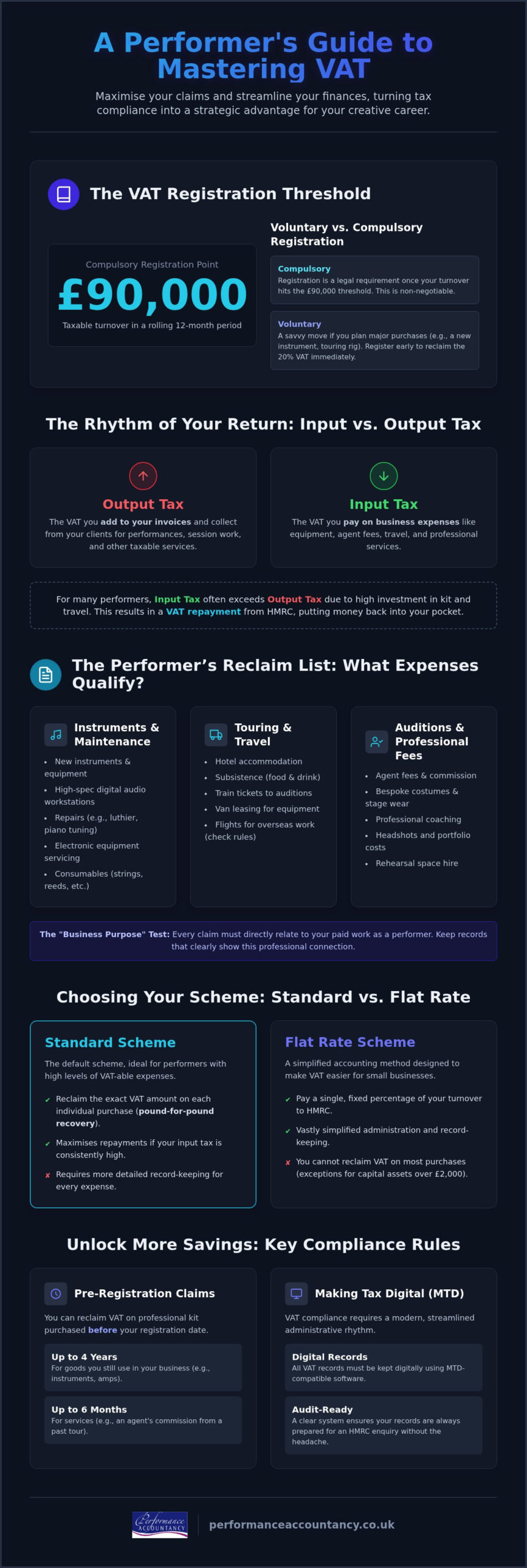
Managing this involves a balance between two main elements: Output tax and Input tax. Output tax is the VAT you add to your invoices when you’re registered. Input tax is the VAT you pay when buying equipment or services. The rhythm of your quarterly return is simply the difference between these two figures. Because performers often invest heavily in high-value kit and constant travel, they frequently find themselves in a “repayment” position. This means HMRC owes you money because you’ve spent more on VAT-eligible expenses than you’ve collected in fees. This is why reclaiming VAT on expenses for performers is such a vital skill for maintaining your creative rhythm.
Voluntary vs Compulsory Registration
The threshold drama usually begins when your taxable turnover approaches £90,000 in a rolling 12-month period. At this point, registration isn’t a choice; it’s a legal requirement. However, don’t wait for the law to force your hand if you’re planning a major purchase. Registering voluntarily can be a savvy move. If you’re about to buy a £10,000 harp or a professional-grade touring rig, registering early allows you to reclaim that 20% VAT immediately. The trade-off is the paperwork. You’ll need to file digital returns every three months, so you must decide if the tax savings outweigh the administrative time taken away from your practice.
The “Business Purpose” Test
HMRC is strict about why you’re spending money. Every claim must pass the “business purpose” test, meaning the expense must relate directly to the work you get paid for. This covers everything from the train ticket to an audition to the headshots that got you through the door. For a freelance musician, business purpose is defined as any expenditure essential to the maintenance of professional standards, the procurement of work, or the delivery of musical services. If a purchase helps you get on stage or stay there, it’s likely to pass the test. Always ensure your records reflect this professional connection to avoid any future “headaches” during an enquiry.
The Performer’s Reclaim List: What Expenses Qualify?
Identifying what counts as a legitimate business expense is where the real “art” of accounting begins. HMRC expects a direct link between your spending and your ability to earn a fee. For most creatives, this covers a surprisingly broad spectrum of costs, ranging from the physical tools of your trade to the digital platforms that host your portfolio. Mastering the nuances of reclaiming VAT on expenses for performers ensures you aren’t leaving money on the table that could be better spent on your next production.
Instruments, Maintenance, and Repairs
Whether you’re purchasing a concert harp or a high-spec digital audio workstation, the 20% VAT on these assets is often your largest potential recovery. Don’t ignore the smaller, recurring “hidden” VAT in maintenance. Piano tuning, luthier repairs, and electronic equipment servicing are all standard-rated services. However, be careful with your insurance. Most specialist policies are subject to Insurance Premium Tax (IPT) rather than VAT; this is a common point of confusion that can lead to errors on your return.
Touring and Travel: Beyond the Commute
Touring creates a unique set of administrative challenges. You can generally reclaim VAT on hotel accommodation and subsistence whilst working away from home, provided the trip is purely for professional purposes. When your work takes you abroad, the rules shift. It’s vital to check the HMRC guidance on entertainment services to determine if UK VAT applies to your specific performance location. Regarding transport, leasing a van for your kit usually allows for a full VAT reclaim, whereas cars are subject to much stricter “private use” rules that often limit your recovery.
The Audition and Rehearsal Circuit
The costs of simply “being” a performer are significant. Agent fees are a prime example; most agencies charge VAT on their commission, and this is entirely reclaimable for registered artists. Similarly, rehearsal studio hire and audition space bookings carry VAT that you should be recovering. Your professional identity also requires constant upkeep. VAT on headshots, showreel production, and website hosting is all eligible for reclaim. Even your subscriptions to bodies like the ISM or Equity often carry VAT or are treated as professional costs that support your taxable supplies. If you’re feeling overwhelmed by the volume of receipts, our specialist accounting services for performers can help you organise your records into a clear, manageable system.
Standard Accounting vs the VAT Flat Rate Scheme
Choosing your VAT scheme is much like selecting the right acoustics for a performance; the wrong environment can muffle your success. Most artists start with the Standard Scheme. It’s the traditional approach where you record every penny of VAT paid on your professional costs and subtract it from the VAT you’ve collected on your fees. This pound-for-pound recovery is often the most lucrative path for those focused on reclaiming VAT on expenses for performers, especially if your career requires significant investment in tangible assets.
The Standard Scheme: Best for High Spenders
The Flat Rate Scheme: Pros and Cons
The Flat Rate Scheme (FRS) was designed to simplify the administrative “headache” by allowing you to pay a fixed percentage of your gross turnover to HMRC. You don’t reclaim VAT on individual purchases, but you keep the difference between the 20% you charge and the lower flat rate you pay. For performers, the base rate is often 14.5%, with a 1% discount in your first year of registration. It sounds enticingly simple, but there is a significant trap: the “Limited Cost Trader” rule.
HMRC applies a 16.5% rate to any business that spends very little on “relevant goods”. Crucially for our sector, items like agent fees, travel, rent, and even many instruments don’t count as “goods” under these specific rules. If your spending on relevant goods is less than 2% of your turnover, you’re forced onto that higher 16.5% rate. For most actors and opera singers, this makes the FRS a poor choice. However, for directors or conductors with minimal equipment needs and high fees, the simplicity might still hold a certain charm. We suggest a careful audit of your spending patterns before committing to a scheme that could inadvertently increase your tax bill.
The Art of Apportionment: Dual-Use and Pre-Registration
Blocking a scene requires precision, and so does the art of apportionment. Most creatives don’t lead lives that are neatly divided into “office hours” and “home life”. Your living room might be your rehearsal space, and your personal mobile is likely the same one your agent calls with a booking. HMRC understands this reality, but they require a logical, defensible method for reclaiming VAT on expenses for performers when an item serves two masters. Getting this right protects you from future scrutiny whilst ensuring you don’t miss out on legitimate savings.
Reclaiming Past Purchases
When you finally register for VAT, you can often perform a “back-dated” reclaim that provides a significant cash injection. The rules are generous but strict. You can reclaim VAT on goods purchased up to four years before your registration date, provided you still own those items and use them for your professional work today. This is a huge win for musicians who bought expensive instruments or conductors who invested in high-end audio equipment years ago. For services like website design or professional coaching, the window for recovery is much tighter, limited to just six months prior to your registration date. To succeed, you must have the original VAT invoices; a simple bank statement won’t satisfy an inspector.
The Home Office and Studio Split
If your spare room is where you practice your scales or edit your showreels, you’re entitled to reclaim a portion of the VAT on your utility bills. Calculating the “business proportion” doesn’t have to be a headache. You might base it on the number of rooms in your house or the number of hours the studio is in use. Consistency is the key here. Whether it’s your internet connection or your heating, keep a simple log or a spreadsheet that explains how you arrived at your percentage. If you can show a clear, rhythmic logic to your calculations, an HMRC inspector is much more likely to accept your figures without a fight.
Be mindful of the “Clawback” rule. If you reclaim VAT on a piece of kit and then stop using it for work, or if you sell it, HMRC may expect a portion of that tax back. This is particularly relevant for high-value items like grand pianos or touring vans. Managing these overlapping rules is part of the “Specialist Insider” support we provide. If you want to ensure your pre-registration claim is maximised and your dual-use splits are watertight, book a specialist VAT review with our team today.
MTD and Specialist Support: Orchestrating Your Compliance
By 2026, the era of the shoebox full of receipts has firmly closed. Making Tax Digital (MTD) is now the standard for all VAT-registered businesses, and it’s non-negotiable. For a creative professional, this means your records must be kept digitally from the moment of transaction. Whilst this might feel like an unwelcome encore to an already long day, it’s actually the most reliable way of reclaiming VAT on expenses for performers without triggering an audit. HMRC now requires “digital links” between your software and their portal, meaning manual data entry is a relic of the past.
The MTD Workflow for Artists
Choosing the right digital tools is essential for managing irregular, multi-source income. You have two main paths: full cloud accounting software or bridging software. Cloud platforms offer real-time bank feeds that categorise your spending automatically, which is ideal if you want a constant view of your financial health. Bridging software is a lighter touch, allowing you to keep your existing spreadsheets whilst ensuring the final submission meets HMRC’s digital requirements. Whichever you choose, the goal is to eliminate the “headache” of the quarterly deadline by maintaining your records in real-time. Missing a filing date in this digital environment is much harder to justify, so establishing a rhythmic workflow is your best defence against penalties.
The Performance Accountancy Advantage
A generic high-street accountant might understand the math, but they rarely understand the life. They might question why a “business” expense includes a specific shade of stage makeup or why you’re claiming for a rehearsal space on a Sunday. At Performance Accountancy, our operatic background means we speak your language. We know the difference between a costume and “ordinary” clothes, and we’re experts at spotting reclaiming VAT on expenses for performers opportunities that generalists often overlook. As specialists in ISM member accounting services, we provide tailored support for musicians, actors, and dancers who need their finances to be as disciplined as their craft.
We move you from a state of administrative confusion to one of organised calm. We don’t just file your returns; we build a bespoke VAT strategy that protects your creative rhythm and maximises your recovery. If you’re ready to hand over the ledger and get back to the stage, book a consultation with our specialist arts accountants today. Let us handle the compliance so you can focus on the performance.
Take the Stage with Financial Confidence
Mastering your VAT obligations is about more than just avoiding HMRC penalties; it’s about reclaiming the capital that fuels your creative growth. By understanding the £90,000 threshold and the nuances of the Standard vs Flat Rate schemes, you can ensure every pound spent on your craft works harder for you. Whether you’re navigating the 4-year rule for instrument reclaims or setting up a digital workflow for MTD compliance, the goal is a system that runs smoothly in the wings whilst you’re in the spotlight.
Reclaiming VAT on expenses for performers shouldn’t be a solo performance you dread. As Chartered Accountants with professional operatic experience, we provide specialist ISM member accounting support and deep expertise in Making Tax Digital specifically for the performing arts. We’ll protect your creative rhythm from administrative headaches, transforming your tax returns into a well-rehearsed routine. Let us handle your VAT returns so you can focus on the music. Your talent belongs on stage, not buried under a mountain of digital receipts. We’re here to help you find your financial rhythm.
Frequently Asked Questions
Can I reclaim VAT on my stage makeup and hair styling?
Yes, you can reclaim VAT on these costs provided they are used exclusively for your professional performances. If you buy specialist theatrical makeup or pay for styling specifically for a production or promotional headshot, it’s a legitimate claim. However, everyday cosmetics used for your personal life are excluded. HMRC looks for a clear distinction between your stage persona and your private life, so keep your professional receipts separate from your supermarket shop.
What happens if I forget to ask for a VAT receipt at a rehearsal studio?
You cannot technically reclaim VAT without a valid VAT invoice that shows the supplier’s registration number. If you forget to ask at the time, contact the studio and ask them to email a digital copy. Under Making Tax Digital rules, having a digital record is essential for compliance. If the studio isn’t VAT-registered, there won’t be any tax to reclaim anyway, so always check their status before you book your rehearsal space.
Can I claim VAT back on my car if I use it to transport my harp or drum kit?
Reclaiming VAT on a car is notoriously difficult unless the vehicle is used 100% for business with no private use at all. Most performers find it more effective to claim the flat-rate mileage allowance instead. If you lease a van specifically to transport large instruments, you can usually reclaim the VAT on the lease payments. For cars, HMRC assumes some personal use exists, which typically blocks a full VAT recovery on the purchase price.
Do I have to charge VAT on my performance fees if I am registered?
Yes, once you are VAT-registered, you must add 20% VAT to all your UK performance invoices. This applies whether you’re performing at a large theatre or a small private event. Whilst it makes your services more expensive for non-registered clients, it’s the mechanism that allows for reclaiming VAT on expenses for performers. You simply collect the tax on behalf of HMRC and offset it against the VAT you’ve paid on your professional costs.
How far back can I go to reclaim VAT on a violin I bought years ago?
You can go back up to four years to reclaim VAT on goods, provided you still own the instrument and use it for your professional work. This is a significant benefit for musicians who invested in high-quality violins or cellos before they hit the registration threshold. You must have the original VAT invoice from the date of purchase. If you bought the instrument from a private seller or a non-registered dealer, no VAT can be recovered.
Is the VAT treatment different for international tours in the EU?
A Limited Cost Trader is a business that spends less than 2% of its turnover on “relevant goods”. If you fall into this category, you are forced to use a flat VAT rate of 16.5%, which often wipes out the benefits of the Flat Rate Scheme. Because many performer expenses like travel, rent, and agent fees are classed as services, artists frequently trigger this rule. This makes reclaiming VAT on expenses for performers through the Standard Scheme much more effective.
Do I need a separate bank account for my VAT-registered business?
Whilst not a legal requirement for sole traders, a separate business bank account is highly recommended for VAT compliance and MTD. It creates a clean digital trail of your professional income and expenses, making your quarterly returns much easier to process. Separating your performance fees from your personal grocery spend reduces the risk of errors. It also provides the organised calm needed when an HMRC inspector asks to see your records during a routine check.